2,281 posters, 63 videos, 56 audios, 43 topics, 18 sessions, 6,174 authors, 2,323 institutions
ePostersLive by SciGen Technologies S.A. All rights reserved.
RCOG World Congress 2025
June 23 - 25, 2025 | ExCeL London, UK
EP.1395
Comparison Between Two Regimes of Antibiotic Prophylaxis in Caesarean Section - Retrospective Study
Poster Presenter
Authors
Affiliations
Part of Topic
Intrapartum care
Comparison Between the Two Regimens of Antibiotic Prophylaxis in Caesarean Section (LSCS) - A Retrospective Study
Author: Dr. Sweety Soni*, MBBS, MD, MRCOG; Dr. Neelam Bapna*, MBBS, MS, MRCOG
*Senior Consultant, Department of Obstetrics & Gynaecology, Saket Hospital, Jaipur - 302020, Rajasthan, India
Correspondence Address:
Dr. Sweety Soni, 81, Keshav Vihar, Gopalpura Bypass Road, Jaipur – 302018, Rajasthan, India
E-mail: sweetynsoni@gmail.com
Introduction :
Globally the incidence of Caesarean section (LSCS) is on the rise. It is the most common major surgical procedure in Obstetrics. It can be associated with postpartum infections including morbidity like wound infection, urinary tract infection (UTI), endometritis and rarely Sepsis. Worldwide, infectious pathology is the second most common cause of maternal mortality. Timely administration of antibiotics is known to reduce the risk of infectious morbidity in postpartum phase.
Subsequently several studies have been done which support single / two dose prophylactic antibiotic as compared to multidose, multidrug regimen [2]. But changing the long-standing practice is difficult due to clinician’s concerns regarding consequences of post - surgical infection. Importantly there is need for judicious use of antibiotics to balance against increasing risk of development of antimicrobial resistance (AMR).
Objective :
To compare the efficacy of two dose versus multiple doses antibiotic prophylaxis to prevent postpartum infectious morbidity in women undergoing caesarean section.
Design :
A retrospective study was designed at our institution to study LSCS associated postpartum infectious morbidities. The design was based on the different practices of the two main consultants in our institution.
Methodology :
A retrospective study was conducted at tertiary care teaching hospital in Jaipur, India. It included women at 37 completed weeks of pregnancy undergoing emergency or elective LSCS, between January 2024 and May 2024.
Patients were divided into two sub-groups, 50 in each, based on the practices of two main consultants of the hospital.
Group A received only two doses of Ceftriaxone 1gm: the first dose 30–60 minutes before incision and second at 12 hours post-surgery.
Group B received Ceftriaxone 1gm 30–60 minutes pre-surgery, followed by Ceftriaxone 1gm (12-hourly), Metronidazole 500mg (8-hourly), and Amikacin 500mg (12-hourly) for 48 hours, followed by oral Cefixime 200mg twice daily for 5 days.
All women were catheterized for 24–48 hours. They were clinically assessed for wound infection (SSI), urinary tract infection (UTI) and endometritis in post-operative period. Patient temperature was recorded 4 times a day for 3 days postoperatively. Dressing was checked on 4th postoperative day (POD) i.e. on the day of discharge. Women were reviewed in out-patient department (OPD) one week following discharge. Data was sourced from hospital records.
Results :
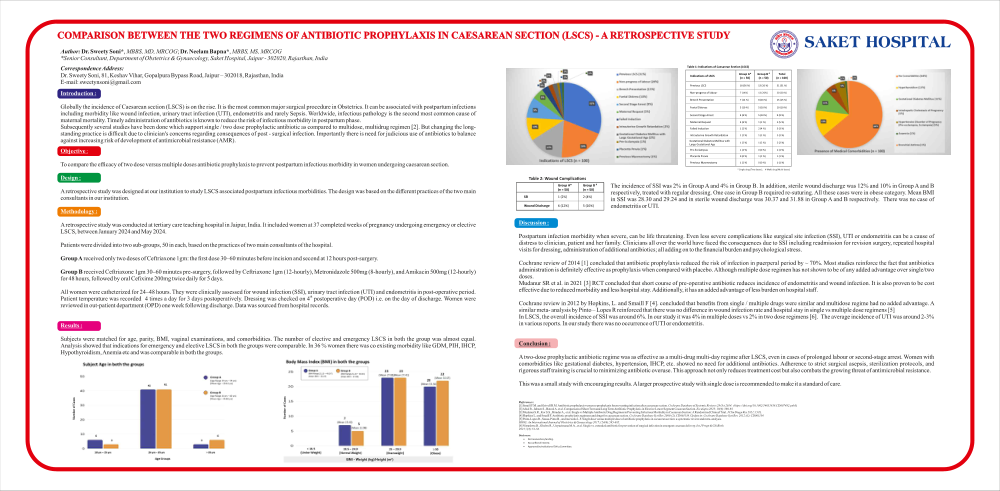
Subjects were matched for age, parity, BMI, vaginal examinations, and comorbidities. The number of elective and emergency LSCS in both the group was almost equal. Analysis showed that indications for emergency and elective LSCS in both the groups were comparable. In 36 % women there was co existing morbidity like GDM, PIH, IHCP, Hypothyroidism, Anemia etc and was comparable in both the groups.
The incidence of SSI was 2% in Group A and 4% in Group B. In addition, sterile wound discharge was 12% and 10% in Group A and B respectively, treated with regular dressing. One case in Group B required re-suturing. All these cases were in obese category. Mean BMI in SSI was 28.30 and 29.24 and in sterile wound discharge was 30.37 and 31.88 in Group A and B respectively. There was no case of endometritis or UTI.
Discussion :
Postpartum infection morbidity when severe, can be life threatening. Even less severe complications like surgical site infection (SSI), UTI or endometritis can be a cause of distress to clinician, patient and her family. Clinicians all over the world have faced the consequences due to SSI including readmission for revision surgery, repeated hospital visits for dressing, administration of additional antibiotics; all adding on to the financial burden and psychological stress.
Cochrane review of 2014 [1] concluded that antibiotic prophylaxis reduced the risk of infection in puerperal period by ~ 70%. Most studies reinforce the fact that antibiotics administration is definitely effective as prophylaxis when compared with placebo. Although multiple dose regimen has not shown to be of any added advantage over single/two doses.
Mudanur SR et al. in 2021 [3] RCT concluded that short course of pre-operative antibiotic reduces incidence of endometritis and wound infection. It is also proven to be cost effective due to reduced morbidity and less hospital stay. Additionally, it has an added advantage of less burden on hospital staff.
Cochrane review in 2012 by Hopkins, L. and Smaill F [4]. concluded that benefits from single / multiple drugs were similar and multidose regime had no added advantage. A similar meta- analysis by Pinto – Lopes R reinforced that there was no difference in wound infection rate and hospital stay in single vs multiple dose regimens [5]
In LSCS, the overall incidence of SSI was around 6%. In our study it was 4% in multiple doses vs 2% in two dose regimens [6]. The average incidence of UTI was around 2-3% in various reports. In our study there was no occurrence of UTI or endometritis.
Conclusion :
A two-dose prophylactic antibiotic regime was as effective as a multi-drug multi-day regime after LSCS, even in cases of prolonged labour or second-stage arrest. Women with comorbidities like gestational diabetes, hypertension, IHCP, etc. showed no need for additional antibiotics. Adherence to strict surgical asepsis, sterilization protocols, and rigorous staff training is crucial to minimizing antibiotic overuse. This approach not only reduces treatment cost but also combats the growing threat of antimicrobial resistance.
This was a small study with encouraging results. A larger prospective study with single dose is recommended to make it a standard of care.