2,281 posters, 63 videos, 56 audios, 43 topics, 18 sessions, 6,174 authors, 2,323 institutions
ePostersLive by SciGen Technologies S.A. All rights reserved.
RCOG World Congress 2025
June 23 - 25, 2025 | ExCeL London, UK
EP.1394
FIT4LABOUR – A POTENTIAL FOR ‘SMART’ COMPUTER-BASED TRIAGE AT LABOUR ONSET
Poster Presenter
Part of Topic
Intrapartum care
FIT4LABOUR– A POTENTIAL FOR ‘SMART’
COMPUTER-BASED TRIAGE AT LABOUR ONSET
M. Tome, L.V. Bozhilova, A. Ugwumadu, L. Impey, A. Georgieva
Oxford Labour Monitoring Group, Nuffield Department of Women’s & Reproductive Health, University of Oxford, UK
OBJECTIVE
Timely identification of fetal compromise at labour onset remains
challenging. We developed Fit4Labour, a digital triage tool that analyses
CTG and clinical risk factors to support clinical decision-making.
PRIMARY AIMS:
1. Evaluate accuracy in predicting severe fetal compromise* at birth.
2. Assess impact on clinical decision-making and communication.
*Severe fetal compromise defined as: intrapartum stillbirth, neonatal death, neonatal encephalopathy,
HIE, or seizures.
STUDY DESIGN:
1. Retrospective analysis of routinely collected clinical data.
2. Prospective usability and feasibility studies in two UK hospitals.
MODEL DEVELOPMENT
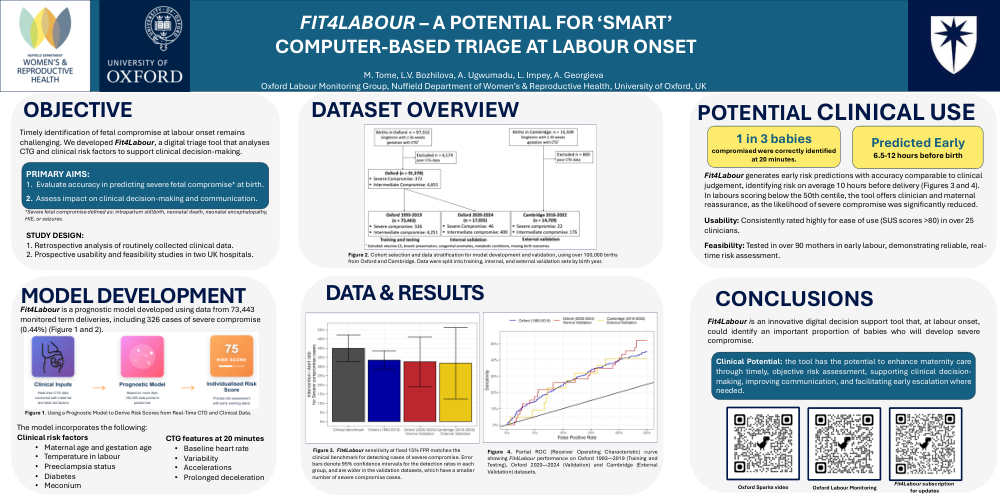
Fit4Labour is a prognostic model developed using data from 73,443
monitored term deliveries, including 326 cases of severe compromise
(0.44%) (Figure 1 and 2).
The model incorporates the following:
Clinical risk factors
• Maternal age and gestation age
• Temperature in labour
• Preeclampsia status
• Diabetes
• Meconium
CTG features at 20 minutes
• Baseline heart rate
• Variability
• Accelerations
• Prolonged deceleration
DATA AND RESULTS
(See poster and abstract)
POTENTIAL CLINICAL USE
1 in 3 babies
compromised were correctly identified
at 20 minutes.
Predicted Early
6.5-12 hours before birth
Fit4Labour generates early risk predictions with accuracy comparable to clinical
judgement, identifying risk on average 10 hours before delivery (Figures 3 and 4).
In labours scoring below the 50th centile, the tool offers clinician and maternal
reassurance, as the likelihood of severe compromise was significantly reduced.
Usability: Consistently rated highly for ease of use (SUS scores >80) in over 25
clinicians.
Feasibility: Tested in over 90 mothers in early labour, demonstrating reliable, real-
time risk assessment.
CONCLUSIONS
Fit4Labour is an innovative digital decision support tool that, at labour onset,
could identify an important proportion of babies who will develop severe
compromise.
Clinical Potential: the tool has the potential to enhance maternity care
through timely, objective risk assessment, supporting clinical decision-
making, improving communication, and facilitating early escalation where
needed.