2,281 posters, 63 videos, 56 audios, 43 topics, 18 sessions, 6,174 authors, 2,323 institutions
ePostersLive by SciGen Technologies S.A. All rights reserved.
RCOG World Congress 2025
June 23 - 25, 2025 | ExCeL London, UK
EP.1393
Comparative Efficacy of Ondansetron and Granisetron in Preventing Hypotension during Cesarean Section
Part of Topic
Intrapartum care
Comparative Efficacy of Ondansetron and Granisetron in Preventing Hypotension during Cesarean Section
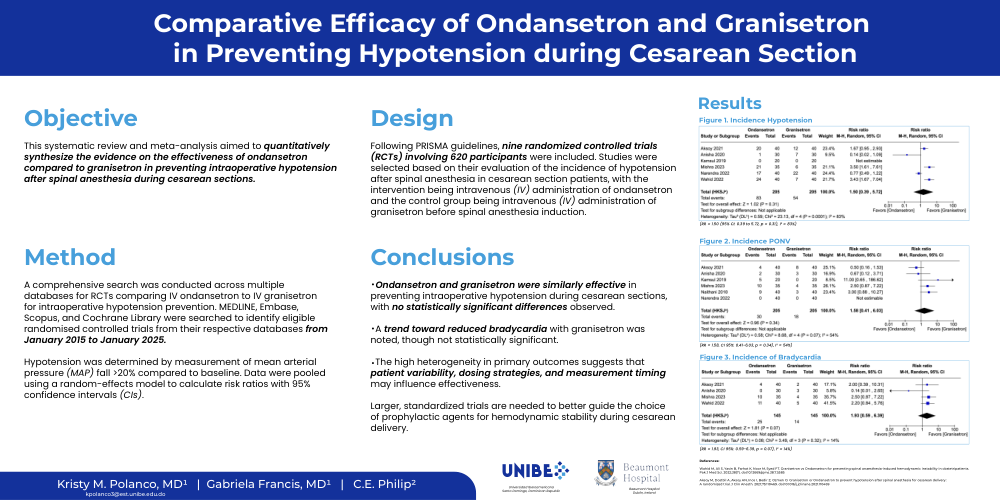
Objective: This systematic review and meta-analysis aimed to quantitatively synthesize the evidence on the effectiveness of ondansetron compared to granisetron in preventing intraoperative hypotension after spinal anesthesia during cesarean sections.
Design: Following PRISMA guidelines, nine randomized controlled trials (RCTs) involving 620 participants were included. Studies were selected based on their evaluation of the incidence of hypotension after spinal anesthesia in cesarean section patients, with the intervention being intravenous (IV) administration of ondansetron and the control group being intravenous (IV) administration of granisetron before spinal anesthesia induction.
Method: A comprehensive search was conducted across multiple databases for RCTs comparing IV ondansetron to IV granisetron for intraoperative hypotension prevention. MEDLINE, Embase, Scopus, and Cochrane Library were searched to identify eligible randomised controlled trials from their respective databases from January 2015 to January 2025. Hypotension was determined by measurement of mean arterial pressure (MAP) fall >20% compared to baseline. Data were pooled using a random-effects model to calculate risk ratios with 95% confidence intervals (CIs).
Results: The meta-analysis demonstrated no statistical difference between ondansetron and granisetron for preventing incidence of intraoperative hypotension (RR = 1.50 (95% CI: 0.39 to 5.72, p = 0.31), I² = 83%). It also demonstrated no statistical difference for preventing bradycardia, though showing a trend toward significance in favor of granisetron (RR = 1.93, CI 95%: 0.59-6.39, p = 0.07), I² = 14%). No statistical significance was found for preventing PONV (RR = 1.58, CI 95%: 0.41-6.03, p = 0.34), I² = 54%) or shivering (RR = 0.76, CI 95%: 0.40-1.42, p = 0.39), I² = 0%).
Conclusions: The meta-analysis found ondansetron and granisetron similarly effective in preventing hypotension during cesarean sections, with no statistically significant difference in outcomes like bradycardia, although a trend towards significance was observed for granisetron. The high heterogeneity in primary outcomes suggests that patient characteristics, dosing regimens, or timing of arterial pressure measurement might influence the effectiveness of these interventions. These findings underscore the need for larger, more standardized trials to explore intraoperative hemodynamic changes in greater depth. Such studies would help to better identify the most effective pharmacological interventions and refine their clinical application, leading to improved patient outcomes.