2,281 posters, 63 videos, 56 audios, 43 topics, 18 sessions, 6,174 authors, 2,323 institutions
ePostersLive by SciGen Technologies S.A. All rights reserved.
RCOG World Congress 2025
June 23 - 25, 2025 | ExCeL London, UK
EP.1391
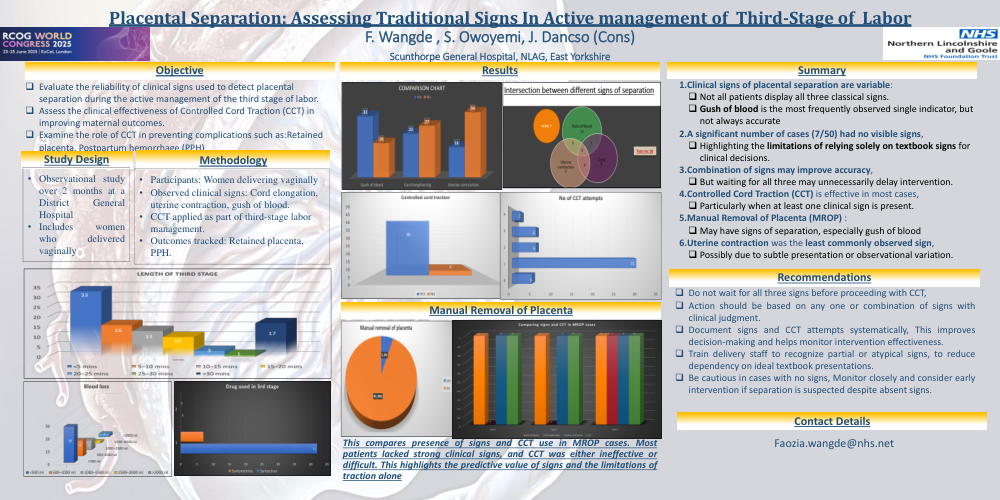
Placental Separation: Assessing Traditional Signs In Active management of Third-Stage of Labor
Poster Presenter
Authors
Affiliations
Part of Topic
Intrapartum care
Objective
❑ Evaluate the reliability of clinical signs used to detect placental
separation during the active management of the third stage of labor.
❑ Assess the clinical effectiveness of Controlled Cord Traction (CCT) in
improving maternal outcomes.
❑ Examine the role of CCT in preventing complications such as:Retained
placenta, Postpartum hemorrhage (PPH)
Study Design
• Observational study
over 2 months at a
District General
Hospital
• Includes women
who delivered
vaginally
Methodology
• Participants: Women delivering vaginally
• Observed clinical signs: Cord elongation,
uterine contraction, gush of blood.
• CCT applied as part of third-stage labor
management.
• Outcomes tracked: Retained placenta,
PPH.
Summary
1.Clinical signs of placental separation are variable:
❑ Not all patients display all three classical signs.
❑ Gush of blood is the most frequently observed single indicator, but
not always accurate
2.A significant number of cases (7/50) had no visible signs,
❑ Highlighting the limitations of relying solely on textbook signs for
clinical decisions.
3.Combination of signs may improve accuracy,
❑ But waiting for all three may unnecessarily delay intervention.
4.Controlled Cord Traction (CCT) is effective in most cases,
❑ Particularly when at least one clinical sign is present.
5.Manual Removal of Placenta (MROP) :
❑ May have signs of separation, especially gush of blood
6.Uterine contraction was the least commonly observed sign,
❑ Possibly due to subtle presentation or observational variation.
Recommendations
❑ Do not wait for all three signs before proceeding with CCT,
❑ Action should be based on any one or combination of signs with
clinical judgment.
❑ Document signs and CCT attempts systematically, This improves
decision-making and helps monitor intervention effectiveness.
❑ Train delivery staff to recognize partial or atypical signs, to reduce
dependency on ideal textbook presentations.
❑ Be cautious in cases with no signs, Monitor closely and consider early
intervention if separation is suspected despite absent signs.