Loading...

2,281 posters, 63 videos, 56 audios, 43 topics, 18 sessions, 6,174 authors, 2,323 institutions

ePostersLive by SciGen Technologies S.A. All rights reserved.

RCOG World Congress 2025

June 23 - 25, 2025 | ExCeL London, UK

EP.1382

An observational study- Intrapartum meconium, maternal - neonatal outcomes using physiological CTG interpretation.
Part of Topic

Intrapartum care

An observational study on intrapartum meconium, maternal and neonatal outcomes with continuous fetal assessment using physiological interpretation of cardiotocograph (CTG)

Dr Bonilla Nayar (Consultant Obstetrician) and Dr Nehal Shah (Honorary Clinical Fellow), Northwick Park Hospital

Introduction  Physiological interpretation of intrapartum fetal monitoring (CTG) was introduced at Northwick Park Maternity Unit in December 2022, a move away from NICE CTG classification. Meconium-stained amniotic fluid (MSAF)  is an intrapartum risk factor and continuous CTG  monitoring is recommended in labour.  Meconium occurs in about 10% of term deliveries, increasing to 30% by 42 weeks While usually physiological and linked to fetal maturity, can be lead to adverse neonatal outcomes(1)

Aim  To analyse maternal and neonatal outcomes with intrapartum MSAF at term, using physiological interpretation of intrapartum CTG -a standard practice.

Method  Cohort of 68 women with MSAF who delivered between 1st April and 31st July 2024 were included in this retrospective study. Data from Cerner EPR retrieved- maternal factors, labour details, type of meconium (thin/thick), oxytocin use, delivery mode, neonatal outcomes (Apgar, birth weight, cord pH, NICU admission), and CTG interpretation as no hypoxia, gradual evolving hypoxia subacute, acute, or chronic hypoxia.

Results

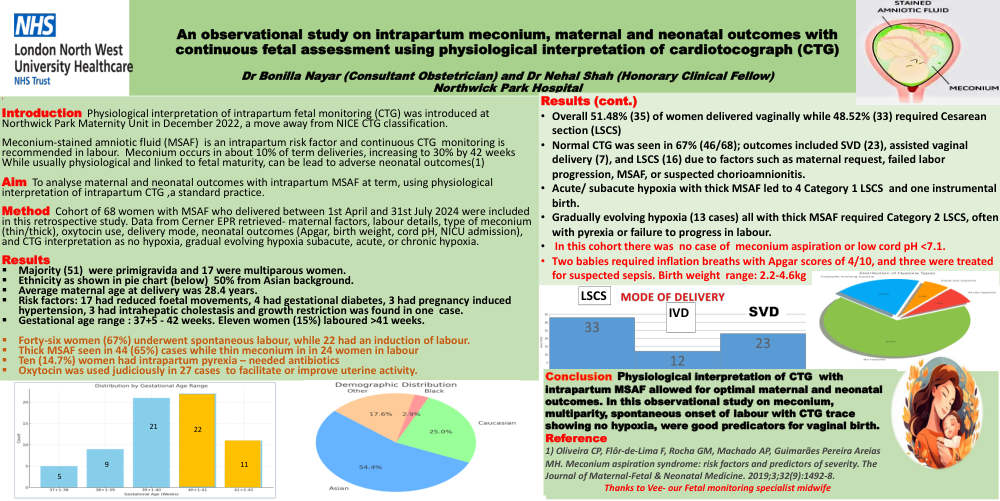
Majority (51)  were primigravida and 17 were multiparous women.
Ethnicity as shown in pie chart (below)  50% from Asian background.
Average maternal age at delivery was 28.4 years. 
Risk factors: 17 had reduced foetal movements, 4 had gestational diabetes, 3 had pregnancy induced hypertension, 3 had intrahepatic cholestasis and growth restriction was found in one  case.  
Gestational age range : 37+5 - 42 weeks. Eleven women (15%) laboured >41 weeks. 
Forty-six women (67%) underwent spontaneous labour, while 22 had an induction of labour.
Thick MSAF seen in 44 (65%) cases while thin meconium in in 24 women in labour
Ten (14.7%) women had intrapartum pyrexia – needed antibiotics
Oxytocin was used judiciously in 27 cases  to facilitate or improve uterine activity. 
Overall 51.48% (35) of women delivered vaginally while 48.52% (33) required Cesarean section (LSCS)
Normal CTG was seen in 67% (46/68); outcomes included SVD (23), assisted vaginal delivery (7), and LSCS (16) due to factors such as maternal request, failed labor progression, MSAF, or suspected chorioamnionitis.
Acute/ subacute hypoxia with thick MSAF led to 4 Category 1 LSCS  and one instrumental birth.
Gradually evolving hypoxia (13 cases) all with thick MSAF required Category 2 LSCS, often with pyrexia or failure to progress in labour.
In this cohort there was  no case of  meconium aspiration or low cord pH <7.1.
Two babies required inflation breaths with Apgar scores of 4/10, and three were treated for suspected sepsis. Birth weight  range: 2.2-4.6kg 
 
Conclusion 
Physiological interpretation of CTG  with intrapartum MSAF allowed for optimal maternal and neonatal outcomes. In this observational study on meconium, multiparity, spontaneous onset of labour with CTG trace showing no hypoxia, were good predicators for vaginal birth
Copyright © 2015-2026, ePostersLive® SciGen is a registered trademark of SciGen Technologies S.A. Patent pending.

This website and third-party tools we use rely on cookies for the best user experience. By selecting "I agree", you agree to cookie usage as described in our Privacy Policy.