2,281 posters, 63 videos, 56 audios, 43 topics, 18 sessions, 6,174 authors, 2,323 institutions
ePostersLive by SciGen Technologies S.A. All rights reserved.
RCOG World Congress 2025
June 23 - 25, 2025 | ExCeL London, UK
EP.1376
Cohort on “Impacted Fetal Head and Use of Fetal Pillow”
Poster Presenter
Part of Topic
Intrapartum care
Cohort on “Impacted Fetal Head and Use of Fetal Pillow”
Authors: Ms Shamsa Kassam, Dr Rabia Haq
Institution: Luton and Dunstable Hospital, Bedfordshire Foundation Trust
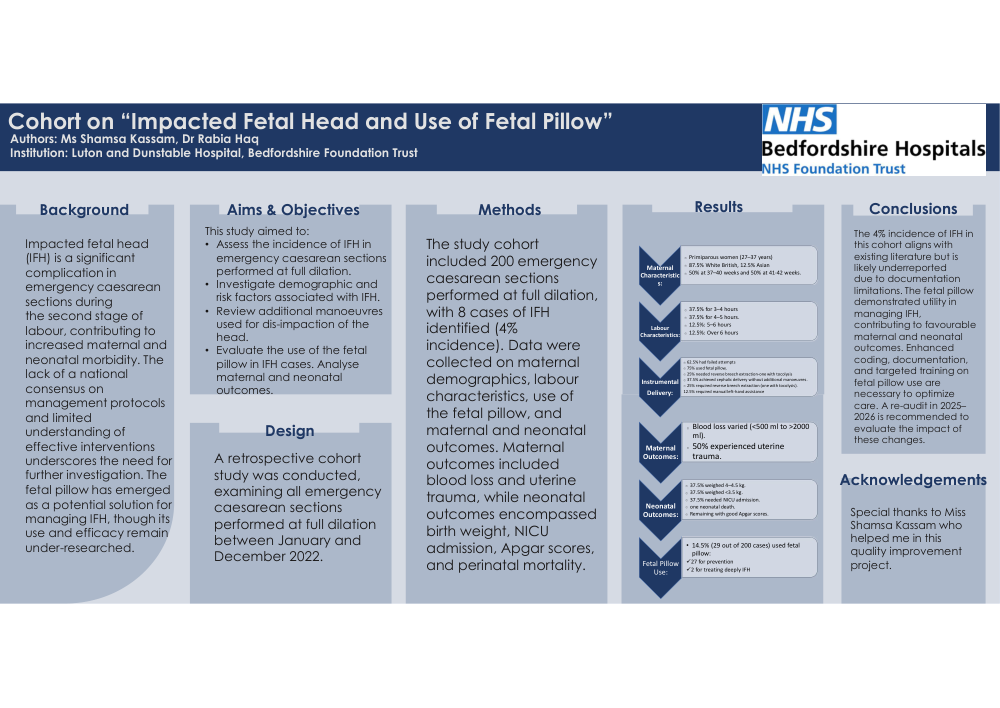
Background: Impacted fetal head (IFH) is a significant complication in emergency caesarean sections during the second stage of labour, contributing to increased maternal and neonatal morbidity. The lack of a national consensus on management protocols and limited understanding of effective interventions underscores the need for further investigation. The fetal pillow has emerged as a potential solution for managing IFH, though its use and efficacy remain under-researched.
Aims & Objectives- This study aimed to: • Assess the incidence of IFH in emergency caesarean sections performed at full dilation. • Investigate demographic and risk factors associated with IFH. • Review additional manoeuvres used for dis-impaction of the head. • Evaluate the use of the fetal pillow in IFH cases. Analyse maternal and neonatal outcomes.
Design- A retrospective cohort study was conducted, examining all emergency caesarean sections performed at full dilation between January and December 2022.
Methods: The study cohort included 200 emergency caesarean sections performed at full dilation, with 8 cases of IFH identified (4% incidence). Data were collected on maternal demographics, labour characteristics, use of the fetal pillow, and maternal and neonatal outcomes. Maternal outcomes included blood loss and uterine trauma, while neonatal outcomes encompassed birth weight, NICU admission, Apgar scores, and perinatal mortality.
Results Maternal Characteristic s: Primiparous women (27–37 years) 87.5% White British, 12.5% Asian 50% at 37–40 weeks and 50% at 41-42 weeks. Labour Characteristics: 37.5% for 3–4 hours, 37.5% for 4–5 hours. 12.5%: 5–6 hours 12.5%: Over 6 hours Instrumental Delivery: 62.5% had failed attempts 75% used fetalpillow, 25% needed reverse breech extraction-one with tocolysis 37.5% achieved cephalic delivery without additional manoeuvres. 25% required reverse breech extraction (one with tocolysis). 12.5% required manual left-hand assistance Blood loss varied (<500 ml to >2000 ml). 50% experienced uterine trauma. Maternal Outcomes: 37.5% weighed 4–4.5 kg. Neonatal Outcomes: Fetal Pillow Use: 37.5% weighed <3.5 kg. 37.5% needed NICU admission. one neonatal death. Remaining with good Apgar scores. • 14.5% (29 out of 200 cases) used fetal pillow: 27 for prevention 2 for treating deeply IFH.
Conclusions: The 4% incidence of IFH in this cohort aligns with existing literature but is likely underreported due to documentation imitations. The fetal pillow demonstrated utility in managing IFH, contributing to favourable maternal and neonatal outcomes. Enhanced coding, documentation, and targeted training on fetal pillow use are necessary to optimize care. A re-audit in 2025 2026 is recommended to evaluate the impact of these changes.
Acknowledgements: Special thanks to Miss Shamsa Kassam who helped me in this quality improvement project.