2,281 posters, 63 videos, 56 audios, 43 topics, 18 sessions, 6,174 authors, 2,323 institutions
ePostersLive by SciGen Technologies S.A. All rights reserved.
RCOG World Congress 2025
June 23 - 25, 2025 | ExCeL London, UK
EP.1375
Episiotomy in the USA: have we got it right?
Part of Topic
Intrapartum care
Episiotomy: Have we got it right?
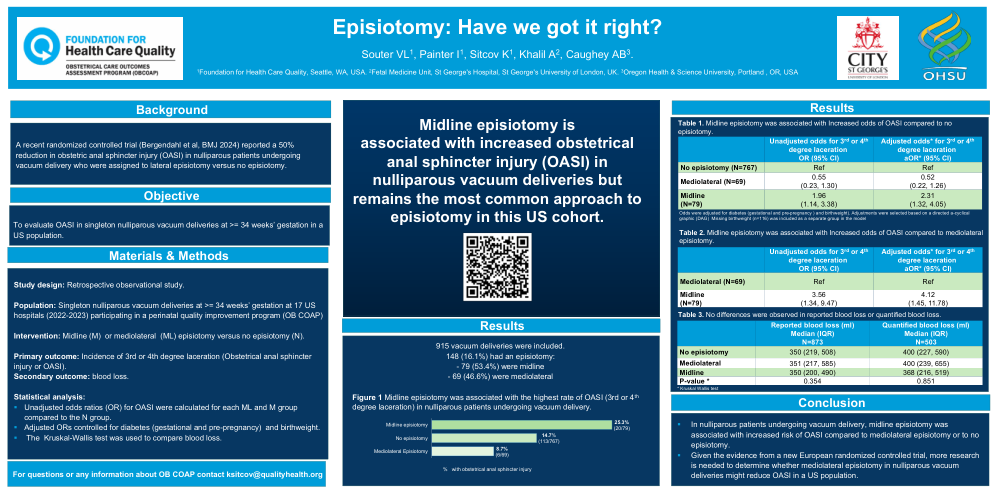
Background: A recent randomized controlled trial (Bergendahl et al, BMJ 2024) reported a 50% reduction in obstetric anal sphincter injury (OASI) in nulliparous patients undergoing vacuum delivery who were assigned to lateral episiotomy versus no episiotomy.
Objective: To evaluate OASI in singleton nulliparous vacuum deliveries at >= 34 weeks’ gestation in a US population.
Materials and Methods:
Study design: Retrospective observational study.
Population: Singleton nulliparous vacuum deliveries at >= 34 weeks’ gestation at 17 US hospitals (2022-2023) participating in a perinatal quality improvement program (OB COAP)
Intervention: Midline (M) or mediolateral (ML) episiotomy versus no episiotomy (N).
Primary outcome: Incidence of 3rd or 4th degree laceration (Obstetrical anal sphincter injury or OASI).
Secondary outcome: blood loss.
Statistical analysis: Unadjusted odds ratios (OR) for OASI were calculated for each ML and M group compared to the N group. Adjusted ORs controlled for diabetes (gestational and pre-pregnancy) and birthweight. The Kruskal-Wallis test was used to compare blood loss.
Results:
915 vacuum deliveries were included. 148 (16.1%) had an episiotomy: 79 (53.4%) were midline and 69 (46.6%) were mediolateral.