2,281 posters, 63 videos, 56 audios, 43 topics, 18 sessions, 6,174 authors, 2,323 institutions
ePostersLive by SciGen Technologies S.A. All rights reserved.
RCOG World Congress 2025
June 23 - 25, 2025 | ExCeL London, UK
EP.1373
Efficacy and Safety of Vaginal Misoprostol Compared to Dinoprostone for Labour Induction
Poster Presenter
Part of Topic
Intrapartum care
Efficacy and Safety of Vaginal Misoprostol Compared to Vaginal Dinoprostone for Induction of Labour: A Systematic Review
Authors: Georgina Andersson (1), Benjamin Greenfield (1,2), Professor David Lissauer (2), Professor Andrew Weeks (2), Andrew Sharp (2), Gemma Clayton (3), Abi Merriel (1,2)
1-Centre for Women’s Health Research, Department of Women’s Health, Institute of Life Course and Medical Sciences, University of Liverpool, 2- Liverpool Women’s Hospital, 3- University of Bristol
Introduction
In 2022-23, 33% of labours were induced in England. Dinoprostone is commonly used, but there is increasing evidence that Misoprostol is a good alternative. This study aimed to compare the efficacy and safety of vaginal Misoprostol and vaginal Dinoprostone. We used duration of induction to assess efficacy because people who have been induced commonly describe induction as a lengthy process, impacting the patient experience.
Methodology
Electronic databases were searched for randomised trials comparing singleton, term inductions with Dinoprostone or Misoprostol. Primary outcome was vaginal delivery within 24 hours (VD24). Secondary outcomes included mode of delivery, induction to delivery interval, oxytocin augmentation, uterine hyperstimulation, fetal distress and adverse maternal or neonatal outcomes. Data extraction used a standardised, proforma including a Cochrane Risk of Bias tool. A random effects meta-analysis was performed using R.
Results
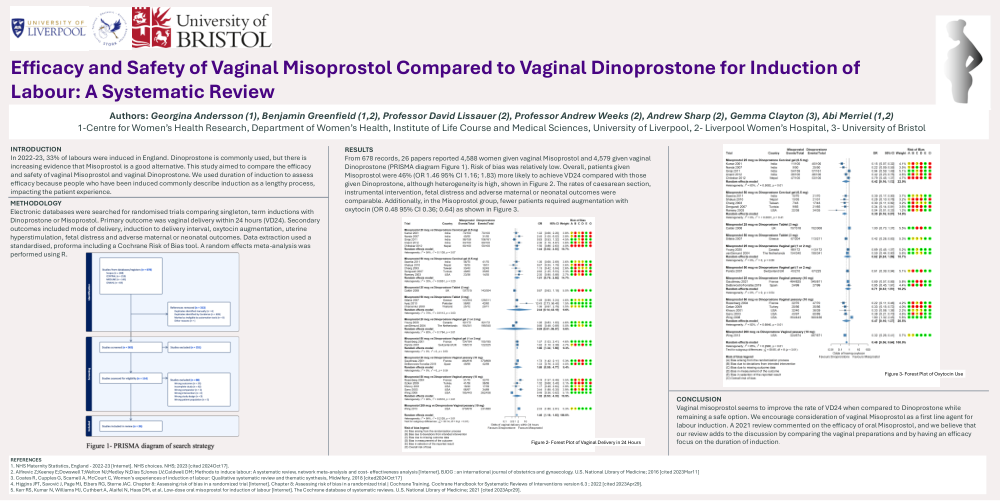
From 678 records, 26 papers reported 4,588 women given vaginal Misoprostol and 4,579 given vaginal Dinoprostone (PRISMA diagram Figure 1). Risk of bias was relatively low. Overall, patients given Misoprostol were 46% (OR 1.46 95% CI 1.16; 1.83) more likely to achieve VD24 compared with those given Dinoprostone, although heterogeneity is high, shown in Figure 2. The rates of caesarean section, instrumental intervention, fetal distress and adverse maternal or neonatal outcomes were comparable. Additionally, in the Misoprostol group, fewer patients required augmentation with oxytocin (OR 0.48 95% CI 0.36; 0.64) as shown in Figure 3.
Conclusion
Vaginal misoprostol seems to improve the rate of VD24 when compared to Dinoprostone while remaining a safe option. We encourage consideration of vaginal Misoprostol as a first line agent for labour induction. A 2021 review commented on the efficacy of oral Misoprostol, and we believe that our review adds to the discussion by comparing the vaginal preparations and by having an efficacy focus on the duration of induction.
References
1. NHS Maternity Statistics, England - 2022-23 [Internet]. NHS choices. NHS; 2023 [cited 2024Oct17].
2. Alfirevic Z;Keeney E;Dowswell T;Welton NJ;Medley N;Dias S;Jones LV;Caldwell DM; Methods to induce labour: A systematic review, network meta-analysis and cost- effectiveness analysis [Internet]. BJOG : an international journal of obstetrics and gynaecology. U.S. National Library of Medicine; 2016 [cited 2023Mar11]
3. Coates R, Cupples G, Scamell A, McCourt C, Women’s experiences of induction of labour: Qualitative systematic review and thematic synthesis, Midwifery, 2018 [cited2024Oct17]
4. Higgins JPT, Savović J, Page MJ, Elbers RG, Sterne JAC. Chapter 8: Assessing risk of bias in a randomized trial [Internet]. Chapter 8: Assessing risk of bias in a randomized trial | Cochrane Training. Cochrane Handbook for Systematic Reviews of Interventions version 6.3 ; 2022 [cited 2023Apr29].
5. Kerr RS, Kumar N, Williams MJ, Cuthbert A, Alaifel N, Haas DM, et al. Low-dose oral misoprostol for induction of labour [Internet]. The Cochrane database of systematic reviews. U.S. National Library of Medicine; 2021 [cited 2023Apr29].