2,281 posters, 63 videos, 56 audios, 43 topics, 18 sessions, 6,174 authors, 2,323 institutions
ePostersLive by SciGen Technologies S.A. All rights reserved.
RCOG World Congress 2025
June 23 - 25, 2025 | ExCeL London, UK
EP.1371
Social Determinants of Health and personal dynamics in intrapartum Electronic Fetal Monitoring
Poster Presenter
Authors
Affiliations
Part of Topic
Intrapartum care
Social Determinants Of Health and Personal Dynamics in Intrapartum Electronic Fetal Monitoring: A Socio-Technical Perspective
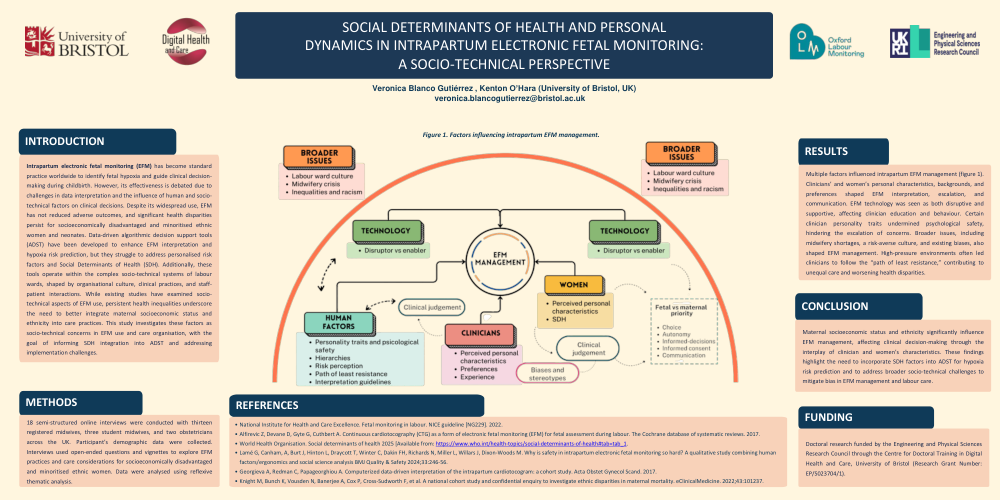
Introduction. Intrapartum electronic fetal monitoring (EFM) has become standard practice worldwide to identify fetal hypoxia and guide clinical decision-making during childbirth. However, its effectiveness is debated due to challenges in data interpretation and the influence of human and socio-technical factors on clinical decisions. Despite its widespread use, EFM has not reduced adverse outcomes, and significant health disparities persist for socioeconomically disadvantaged and minoritised ethnic women and neonates. Data-driven algorithmic decision support tools (ADST) have been developed to enhance EFM interpretation and hypoxia risk prediction, but they struggle to address personalised risk factors and Social Determinants of Health (SDH). Additionally, these tools operate within the complex socio-technical systems of labour wards, shaped by organisational culture, clinical practices, and staff-patient interactions. While existing studies have examined socio-technical aspects of EFM use, persistent health inequalities underscore the need to better integrate maternal socioeconomic status and ethnicity into care practices. This study investigates these factors as socio-technical concerns in EFM use and care organisation, with the goal of informing SDH integration into ADST and addressing implementation challenges. Methods.18semi-structured online interviews were conducted with thirteen registered midwives, three student midwives, and two obstetricians across the UK. Participant’s demographic data were collected. Interviews used open-ended questions and vignettes to explore EFM practices and care considerations for socioeconomically disadvantaged and minoritised ethnic women. Data were analysed using reflexive thematic analysis. Results. Multiple factors influenced intrapartum EFM management (figure 1). Clinicians’ and women’s personal characteristics, backgrounds, and preferences shaped EFM interpretation, escalation, and communication. EFM technology was seen as both disruptive and supportive, affecting clinician education and behaviour. Certain clinician personality traits undermined psychological safety, hindering the escalation of concerns. Broader issues, including midwifery shortages, a risk-averse culture, and existing biases, also shaped EFM management. High-pressure environments often led clinicians to follow the “path of least resistance,” contributing to unequal care and worsening health disparities. Conclusions. Maternal socioeconomic status and ethnicity significantly influence EFM management, affecting clinical decision-making through the interplay of clinician and women’s characteristics. These findings highlight the need to incorporate SDH factors into ADST for hypoxia risk prediction and to address broader socio-technical challenges to mitigate bias in EFM management and labour care.