2,281 posters, 63 videos, 56 audios, 43 topics, 18 sessions, 6,174 authors, 2,323 institutions
ePostersLive by SciGen Technologies S.A. All rights reserved.
RCOG World Congress 2025
June 23 - 25, 2025 | ExCeL London, UK
EP.1368
Predictive factors of skin-to-skin contact in the postpartum period
Poster Presenter
Authors
Narjes Karmous, Omar Oualha, Abdelwahab Masmoudi, Badreddine Bouguerra
Affiliations
Department of Gynaecology and Obstetrics, Charles Nicolle Hospital, Department B- Charles Nicolle Hospital, Gynaecology and Obstetrics Department B, Charles Nicolle Hospital, Department Bof Obstetrics and Gynaecology, Charles Nicolle Hospital, Department of Obstetrics and Gynecology B, Charles Nicolle Hospital, Gynaecology and Obstetrics Department B of Charles Nicolle Hospital, Gynaecology and Obstetrics department B- Charles Nicolle Hospital, Charles Nicolle Hospital, Obstetrics and Gynaecology Service B, Department B of Gynaecology and Obstetrics- Charles Nicolle Hospital, Department B of Obstetrics and Gynecology, Charles Nicolle Hospital
Part of Topic
Intrapartum care
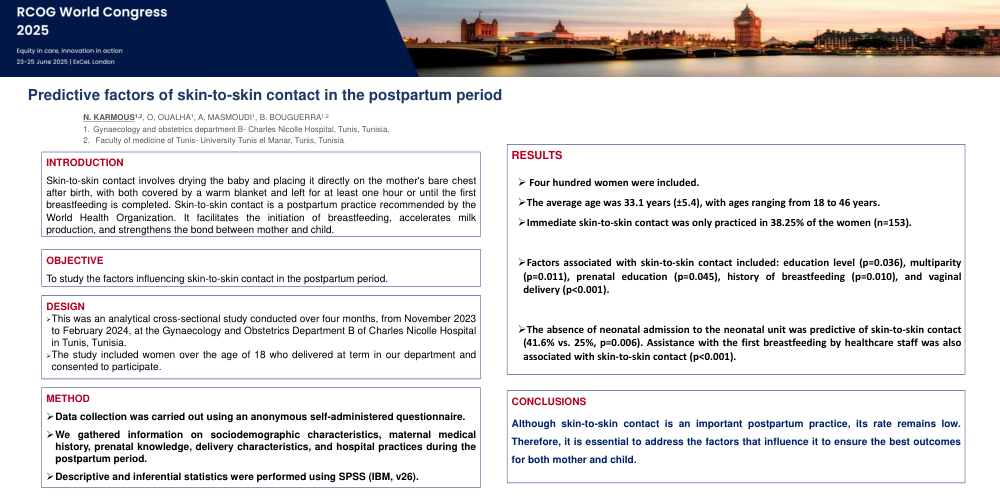
Predictive factors of skin-to-skin contact in the postpartum period
Introduction
Skin-to-skin contact involves drying the baby and placing it directly on the mother's bare chest after birth, with both covered by a warm blanket and left for at least one hour or until the first breastfeeding is completed.
Skin-to-skin contact is a postpartum practice recommended by the World Health Organization. It facilitates the initiation of breastfeeding, accelerates milk production, and strengthens the bond between mother and child.
Objective
To study the factors influencing skin-to-skin contact in the postpartum period.
Design
This was an analytical cross-sectional study conducted over four months, from November 2023 to February 2024, at the Gynaecology and Obstetrics Department B of Charles Nicolle Hospital in Tunis, Tunisia. The study included women over the age of 18 who delivered at term in our department and consented to participate.
Method
Data collection was carried out using an anonymous self-administered questionnaire. We gathered information on sociodemographic characteristics, maternal medical history, prenatal knowledge, delivery characteristics, and hospital practices during the postpartum period. Descriptive and inferential statistics were performed using SPSS (IBM, v26).
Results
Four hundred women were included. The average age was 33.1 years (±5.4), with ages ranging from 18 to 46 years. Immediate skin-to-skin contact was only practiced in 38.25% of the women (n=153).
Factors associated with skin-to-skin contact included: education level (p=0.036), multiparity (p=0.011), prenatal education (p=0.045), history of breastfeeding (p=0.010), and vaginal delivery (p<0.001). The absence of neonatal admission to the neonatal unit was predictive of skin-to-skin contact (41.6% vs. 25%, p=0.006). Assistance with the first breastfeeding by healthcare staff was also associated with skin-to-skin contact (p<0.001).
Conclusions
Although skin-to-skin contact is an important postpartum practice, its rate remains low. Therefore, it is essential to address the factors that influence it to ensure the best outcomes for both mother and child.