2,281 posters, 63 videos, 56 audios, 43 topics, 18 sessions, 6,174 authors, 2,323 institutions
ePostersLive by SciGen Technologies S.A. All rights reserved.
RCOG World Congress 2025
June 23 - 25, 2025 | ExCeL London, UK
EP.1366
Postpartum acute kidney failure: experience of a Tunisian tertiary care center
Poster Presenter
Authors
Affiliations
Department of Gynaecology and Obstetrics, Charles Nicolle Hospital, Department B- Charles Nicolle Hospital, Gynaecology and Obstetrics Department B, Charles Nicolle Hospital, Department Bof Obstetrics and Gynaecology, Charles Nicolle Hospital, Department of Obstetrics and Gynecology B, Charles Nicolle Hospital, Gynaecology and Obstetrics Department B of Charles Nicolle Hospital, Gynaecology and Obstetrics department B- Charles Nicolle Hospital, Charles Nicolle Hospital, Obstetrics and Gynaecology Service B, Department B of Gynaecology and Obstetrics- Charles Nicolle Hospital, Department B of Obstetrics and Gynecology, Charles Nicolle Hospital
Part of Topic
Intrapartum care
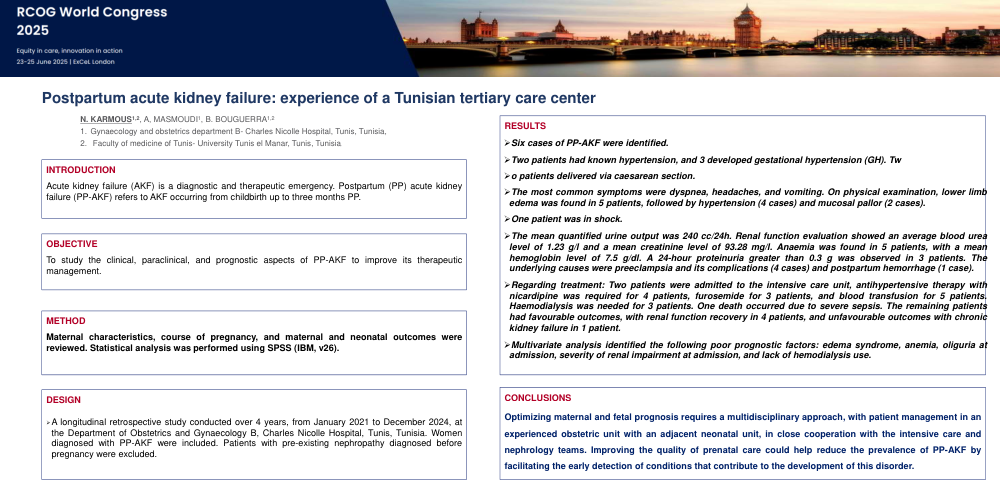
Postpartum acute kidney failure: experience of a Tunisian tertiary care center
Objective:
Acute kidney failure (AKF) is a diagnostic and therapeutic emergency. Postpartum (PP) acute kidney failure (PP-AKF) refers to AKF occurring from childbirth up to three months PP.
Our aim was to study the clinical, paraclinical, and prognostic aspects of PP-AKF to improve its therapeutic management.
Design:
A longitudinal retrospective study conducted over 4 years, from January 2021 to December 2024, at the Department Bof Obstetrics and Gynaecology, Charles Nicolle Hospital, Tunis, Tunisia. Women diagnosed with PP-AKF were included. Patients with pre-existing nephropathy diagnosed before pregnancy were excluded.
Method:
Maternal characteristics, course of pregnancy, and maternal and neonatal outcomes were reviewed. Statistical analysis was performed using SPSS (IBM, v26).
Results:
Six cases of PP-AKF were identified. Two patients had known hypertension, and 3 developed gestational hypertension (GH). Two patients delivered via caesarean section. The most common symptoms were dyspnea, headaches, and vomiting. On physical examination, lower limb edema was found in 5 patients, followed by hypertension (4 cases) and mucosal pallor (2 cases). One patient was in shock. The mean quantified urine output was 240 cc/24h. Renal function evaluation showed an average blood urea level of 1.23 g/l and a mean creatinine level of 93.28 mg/l. Anaemia was found in 5 patients, with a mean hemoglobin level of 7.5 g/dl. A 24-hour proteinuria greater than 0.3 g was observed in 3 patients. The underlying causes were preeclampsia and its complications (4 cases) and postpartum hemorrhage (1 case). Regarding treatment: Two patients were admitted to the intensive care unit, antihypertensive therapy with nicardipine was required for 4 patients, furosemide for 3 patients, and blood transfusion for 5 patients. Haemodialysis was needed for 3 patients. One death occurred due to severe sepsis. The remaining patients had favourable outcomes, with renal function recovery in 4 patients, and unfavourable outcomes with chronic kidney failure in 1 patient.
Multivariate analysis identified the following poor prognostic factors: edema syndrome, anemia, oliguria at admission, severity of renal impairment at admission, and lack of hemodialysis use.
Conclusions:
Optimizing maternal and fetal prognosis requires a multidisciplinary approach, with patient management in an experienced obstetric unit with an adjacent neonatal unit, in close cooperation with the intensive care and nephrology teams. Improving the quality of prenatal care could help reduce the prevalence of PP-AKF by facilitating the early detection of conditions that contribute to the development of this disorder.