2,281 posters, 63 videos, 56 audios, 43 topics, 18 sessions, 6,174 authors, 2,323 institutions
ePostersLive by SciGen Technologies S.A. All rights reserved.
RCOG World Congress 2025
June 23 - 25, 2025 | ExCeL London, UK
EP.1359
INTRAVENOUS TRANEXAMIC ACID IN THIRD STAGE OF LABOR FOR PREVENTION POST-PARTUM HEMORRHAGE
Poster Presenter
Authors
Affiliations
Part of Topic
Intrapartum care
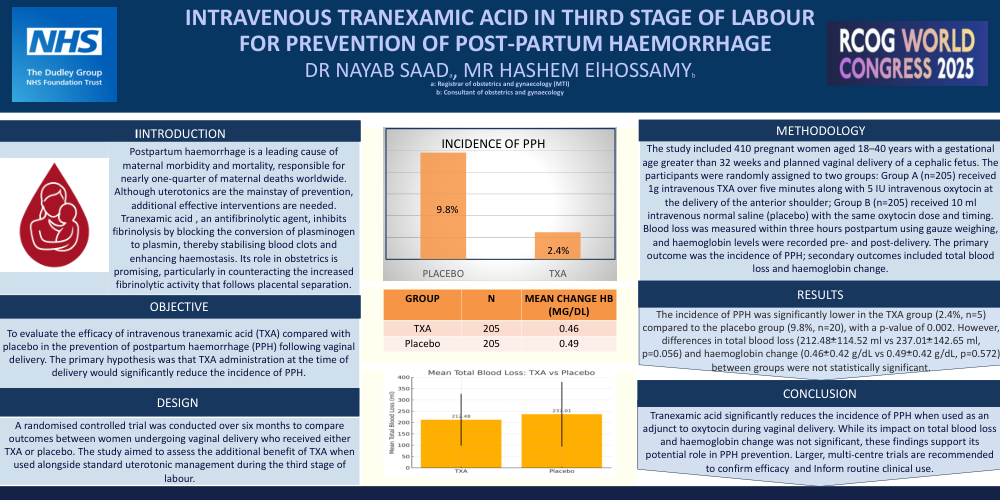
INTRAVENOUS TRANEXAMIC ACID IN THIRD STAGE OF LABOUR
FOR PREVENTION OF POST-PARTUM HAEMORRHAGE
DR NAYAB SAAD, MR HASHEM ELHOSSAMY
a: Registrar of obstetrics and gynaecology (MTI)
b: Consultant of obstetrics and gynaecology
Postpartum haemorrhage is a leading cause of
maternal morbidity and mortality, responsible for
nearly one-quarter of maternal deaths worldwide.
Although uterotonics are the mainstay of prevention,
additional effective interventions are needed.
Tranexamic acid , an antifibrinolytic agent, inhibits
fibrinolysis by blocking the conversion of plasminogen
to plasmin, thereby stabilising blood clots and
enhancing haemostasis. Its role in obstetrics is
promising, particularly in counteracting the increased
fibrinolytic activity that follows placental separation.
To evaluate the efficacy of intravenous tranexamic acid (TXA) compared with
placebo in the prevention of postpartum haemorrhage (PPH) following vaginal
delivery. The primary hypothesis was that TXA administration at the time of
delivery would significantly reduce the incidence of PPH.
A randomised controlled trial was conducted over six months to compare
outcomes between women undergoing vaginal delivery who received either
TXA or placebo. The study aimed to assess the additional benefit of TXA when
used alongside standard uterotonic management during the third stage of
labour.
The study included 410 pregnant women aged 18–40 years with a gestational
age greater than 32 weeks and planned vaginal delivery of a cephalic fetus. The
participants were randomly assigned to two groups: Group A (n=205) received
1g intravenous TXA over five minutes along with 5 IU intravenous oxytocin at
the delivery of the anterior shoulder; Group B (n=205) received 10 ml
intravenous normal saline (placebo) with the same oxytocin dose and timing.
Blood loss was measured within three hours postpartum using gauze weighing,
and haemoglobin levels were recorded pre- and post-delivery. The primary
outcome was the incidence of PPH; secondary outcomes included total blood
loss and haemoglobin change.
The incidence of PPH was significantly lower in the TXA group (2.4%, n=5)
compared to the placebo group (9.8%, n=20), with a p-value of 0.002. However,
differences in total blood loss (212.48 114.52 ml vs 237.01 142.65 ml,
p=0.056) and haemoglobin change (0.46 0.42 g/dL vs 0.49 0.42 g/dL, p=0.572)
between groups were not statistically significant.
Tranexamic acid significantly reduces the incidence of PPH when used as an
adjunct to oxytocin during vaginal delivery. While its impact on total blood loss
and haemoglobin change was not significant, these findings support its
potential role in PPH prevention. Larger, multi-centre trials are recommended
to confirm efficacy and Inform routine clinical use.