2,281 posters, 63 videos, 56 audios, 43 topics, 18 sessions, 6,174 authors, 2,323 institutions
ePostersLive by SciGen Technologies S.A. All rights reserved.
RCOG World Congress 2025
June 23 - 25, 2025 | ExCeL London, UK
EP.1356
Outcomes of Emergency Cesarean Section Following Failed Instrumental Delivery.
Poster Presenter
Authors
Affiliations
Part of Topic
Intrapartum care
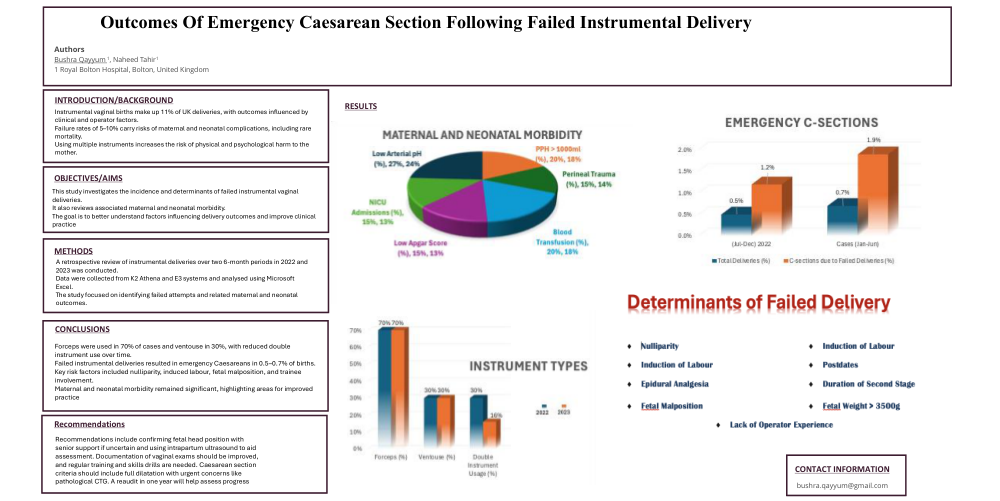
Outcomes Of Emergency Caesarean Section Following Failed Instrumental Delivery
INTRODUCTION/BACKGROUND
Instrumental vaginal births make up 11% of UK deliveries, with outcomes influenced by clinical and operator factors.
Failure rates of 5–10% carry risks of maternal and neonatal complications, including rare mortality.
Using multiple instruments increases the risk of physical and psychological harm to the mother.
OBJECTIVES/AIMS
This study investigates the incidence and determinants of failed instrumental vaginal deliveries.
It also reviews associated maternal and neonatal morbidity.
The goal is to better understand factors influencing delivery outcomes and improve clinical practice
METHODS
A retrospective review of instrumental deliveries over two 6-month periods in 2022 and 2023 was conducted.
Data were collected from K2 Athena and E3 systems and analysed using Microsoft Excel.
The study focused on identifying failed attempts and related maternal and neonatal outcomes.
CONCLUSIONS
Forceps were used in 70% of cases and ventouse in 30%, with reduced double instrument use over time.
Failed instrumental deliveries resulted in emergency Caesareans in 0.5–0.7% of births.
Key risk factors included nulliparity, induced labour, fetal malposition, and trainee involvement.
Maternal and neonatal morbidity remained significant, highlighting areas for improved practice
Recommendations
Recommendations include confirming fetal head position with senior support if uncertain and using intrapartum ultrasound to aid assessment. Documentation of vaginal exams should be improved, and regular training and skills drills are needed. Caesarean section criteria should include full dilatation with urgent concerns like pathological CTG. A reaudit in one year will help assess progress
Determinants of Failed Delivery
¨ Nulliparity
¨ Induction of Labour
¨ Postdates
¨ Epidural Analgesia
¨ Duration of Second Stage
¨ Fetal Malposition
¨ Fetal Weight > 3500g
¨ Lack of Operator Experience