2,281 posters, 63 videos, 56 audios, 43 topics, 18 sessions, 6,174 authors, 2,323 institutions
ePostersLive by SciGen Technologies S.A. All rights reserved.
RCOG World Congress 2025
June 23 - 25, 2025 | ExCeL London, UK
EP.1355
Protecting mothers: Understanding and preventing obstetric anal sphincter injuries (OASI)
Poster Presenter
Part of Topic
Intrapartum care
OBJECTIVE: Obstetric anal sphincter injuries (OASI) at the time of vaginal delivery can cause
significant long term morbidity like dyspareunia and faecal and flatal incontinence, which affect the
quality of life of the women. Despite OASI-care bundle, a significant proportion of vaginal deliveries
continue to be affected by anal sphincter injuries. This audit is to identify the risk factors associated
with OASI and evaluate effective strategies for their prevention.
DESIGN: This audit focuses on women who sustained obstetric anal sphincter injuries between Ist
January 2023 and 31 st December,2023,in a District General Hospital in the United Kingdom (UK).
Data collected include demographic details, mode of delivery, and operator status at the time of
delivery and review of episiotomy usage.
METHOD: Systematic review of medical case records to collect relevant data during the time frame.
Data accuracy is ensured by cross-checking entries and maintaining confidentiality.
RESULTS :
The overall incidence of OASI in our District General hospital was 2.08%, which was slightly
lower than the UK national average 2.9%.
Nulliparous women were more frequently affected than parous women.
Type 3B tears were the most common tear in our hospital, occurring equally in normal
vaginal and instrumental deliveries.
Type 3A were more frequently seen in normal vaginal deliveries(NVD), while type 3C were
predominant in instrumental deliveries.
Fourth degree tears were the least frequent tear, with all cases of this severe complication
occurring during NVD, warranting training of the staff.
80% of NVD with OASI were not given episiotomy, which raises the question whether
timely episiotomy could have prevented these injuries.
RECOMMENDATIONS
The importance of antenatal counselling regarding OASI and it’s impact on the quality of life.
The importance to assess the perineum prior to delivery to identify short perineal body, scarred or
tight perineum.
Adequate training for the staff in performing episiotomy at the correct angle and suturing.
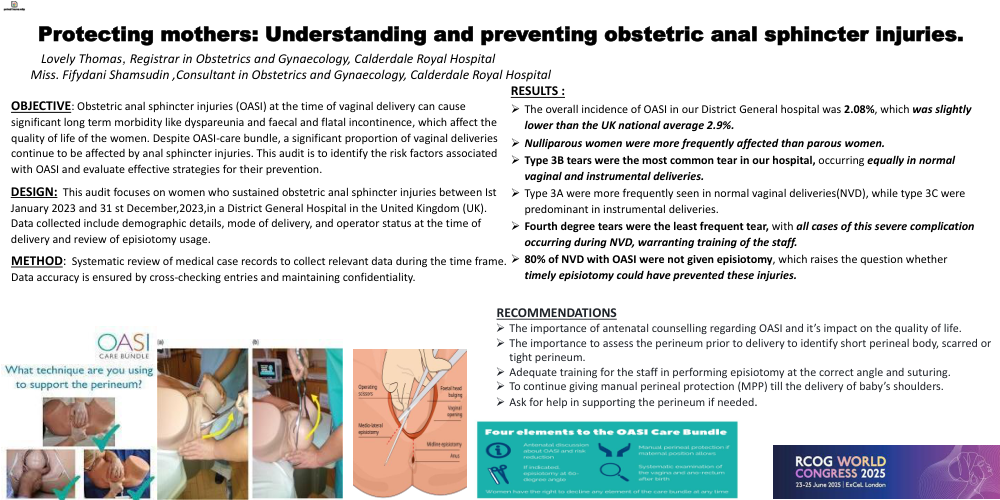
To continue giving manual perineal protection (MPP) till the delivery of baby’s shoulders.
Ask for help in supporting the perineum if needed.