2,281 posters, 63 videos, 56 audios, 43 topics, 18 sessions, 6,174 authors, 2,323 institutions
ePostersLive by SciGen Technologies S.A. All rights reserved.
RCOG World Congress 2025
June 23 - 25, 2025 | ExCeL London, UK
EP.1353
Impact of early prophylactic tranexamic acid on instrumental birth postpartum haemorrhage rates.
Poster Presenter
Part of Topic
Intrapartum care
Impact of Early Prophylactic Tranexamic Acid on Instrumental Birth Postpartum Haemorrhage
Dr James Mac Taggart, Ms Millicent Nwandison, Hannah Lilley
Introduction
-
A new guideline was introduced at Chelsea and Westminster Hospital in 2019 which recommended:
-
A midwifery support worker to proactively measure EBL with updates every 100ml at all instrumentals,
-
Transfer patients with additional risk factors for major obstetric haemorrhage (MOH) to theatre,
-
Administration of tranexamic acid (TXA) if EBL reaches 500ml.
-
A retrospective audit carried out in March 2023 showed a reduction in rates of Major Obstetric Haemorrhage (MOH) after this was introduced, though noted rates had increased again from February 2021.
-
This audit recommended administration of 1g IV TXA at the time of instrumental delivery, alongside first line third stage medications (syntometrine or syntocinon), rather than waiting for EBL to reach 500ml.
-
It also recommended administering a second dose of TXA 30 minutes later if clinically indicated.
Methodology
-
A retrospective audit of total EBLs for all instrumental deliveries at Chelsea and Westminster was extracted from our maternity electronic patient record system from January 2023 to June 2024.
-
Data from these deliveries was split into three groups comparing the 6 month period before we started giving TXA at time of instrumental with the two 6 month periods after this was implemented.
-
Each group was further split by estimated blood loss (500-999ml, 1000-1499ml, 1500-1999ml and >2000ml) and location of delivery (delivery suite room or operating theatre).
-
Rates of PPH are expressed as a percentage off all deliveries of that type (ventouse or forceps).
-
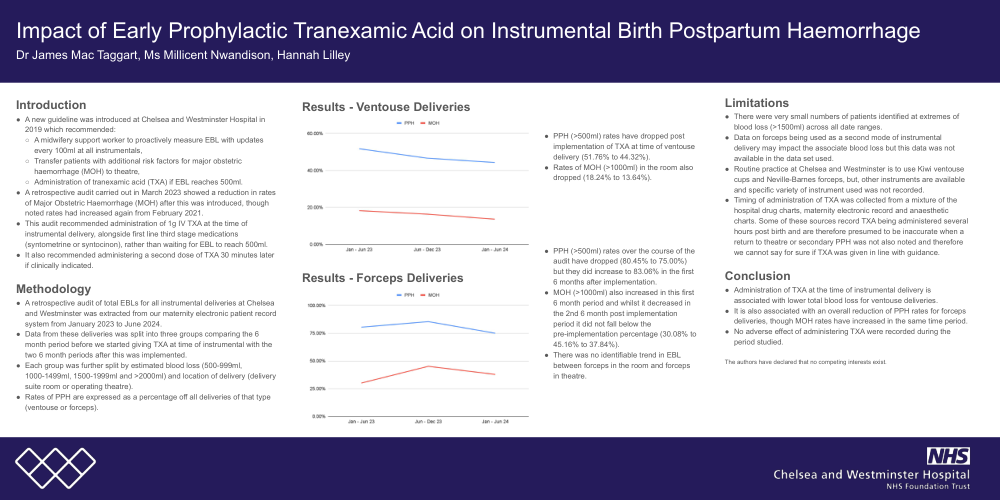
PPH (>500ml) rates have dropped post implementation of TXA at time of ventouse delivery (51.76% to 44.32%).
-
Rates of MOH (>1000ml) in the room also dropped (18.24% to 13.64%).
-
PPH (>500ml) rates over the course of the audit have dropped (80.45% to 75.00%) but they did increase to 83.06% in the first 6 months after implementation.
-
MOH (>1000ml) also increased in this first 6 month period and whilst it decreased in the 2nd 6 month post implementation period it did not fall below the pre-implementation percentage (30.08% to 45.16% to 37.84%).
-
There was no identifiable trend in EBL between forceps in the room and forceps in theatre.
Limitations
-
There were very small numbers of patients identified at extremes of blood loss (>1500ml) across all date ranges.
-
Data on forceps being used as a second mode of instrumental delivery may impact the associate blood loss but this data was not available in the data set used.
-
Routine practice at Chelsea and Westminster is to use Kiwi ventouse cups and Neville-Barnes forceps, but, other instruments are available and specific variety of instrument used was not recorded.
-
Timing of administration of TXA was collected from a mixture of the hospital drug charts, maternity electronic record and anaesthetic charts. Some of these sources record TXA being administered several hours post birth and are therefore presumed to be inaccurate when a return to theatre or secondary PPH was not also noted and therefore we cannot say for sure if TXA was given in line with guidance.
Conclusion
-
Administration of TXA at the time of instrumental delivery is associated with lower total blood loss for ventouse deliveries.
-
It is also associated with an overall reduction of PPH rates for forceps deliveries, though MOH rates have increased in the same time period.
-
No adverse effect of administering TXA were recorded during the period studied.