2,281 posters, 63 videos, 56 audios, 43 topics, 18 sessions, 6,174 authors, 2,323 institutions
ePostersLive by SciGen Technologies S.A. All rights reserved.
RCOG World Congress 2025
June 23 - 25, 2025 | ExCeL London, UK
EP.1350
COMPARING IMMEDIATE AND DELAYED INDUCTION FOR TERM PRE-LABOUR RUPTURE OF MEMBRANE
Poster Presenter
Part of Topic
Intrapartum care
Title
COMPARING IMMEDIATE AND DELAYED INDUCTION FOR TERM PRE-LABOUR RUPTURE OF MEMBRANE
Background
The two options for managing pre-labour rupture of membranes (PROM) at term are immediate and delayed labour induction. The preferred option in our environment remains unresolved by the currently available evidence.
Objective
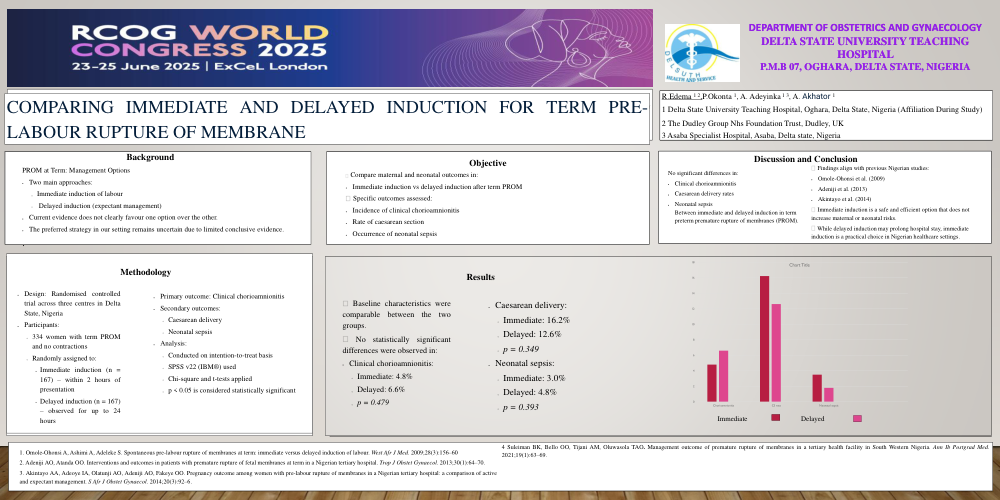
This study compared maternal and neonatal outcomes between immediate and delayed labour induction following term preterm premature rupture of membranes (PROM). Specific objectives included comparing the incidence of clinical chorioamnionitis, caesarean section, and neonatal sepsis between the two groups.
Methodology
This randomised controlled trial was carried out across three centres in Delta State, Nigeria. A total of 334 women with term PROM and no contractions were assigned to immediate (n = 167) or delayed induction (n = 167). The immediate group underwent induction within two hours of presentation, and the delayed group was observed for up to 24 hours for spontaneous labour onset. The primary outcome was clinical chorioamnionitis, while secondary outcomes included caesarean delivery and neonatal sepsis. Data were analysed using SPSS v22 (IBM®) on an intention-to-treat basis. Chi-square and t-tests were used for comparisons. Significance was established at p < 0.05.
Results
Baseline characteristics were similar across groups. No significant differences were observed in clinical chorioamnionitis (4.8% vs 6.6%, p = 0.479), caesarean delivery rates (16.2% vs 12.6%, p = 0.349), or neonatal sepsis (3.0% vs 4.8%, p = 0.393) between the immediate and delayed arms.
Discussion and Conclusion
No significant differences were found in the rates of clinical chorioamnionitis, caesarean delivery, or neonatal sepsis between immediate and delayed induction in term PROM. This supports findings from Nigerian studies (Omole-Ohonsi et al1., 2009; Adeniji et al2., 2013; Akintayo et al3., 2014), which reported that immediate induction is safe and does not increase maternal or neonatal risks. Although delayed induction may extend hospital stays, immediate induction offers a safe and efficient option in Nigerian settings.