2,281 posters, 63 videos, 56 audios, 43 topics, 18 sessions, 6,174 authors, 2,323 institutions
ePostersLive by SciGen Technologies S.A. All rights reserved.
RCOG World Congress 2025
June 23 - 25, 2025 | ExCeL London, UK
EP.1349
Optimizing Forceps Delivery Safety: Predicting Anal Sphincter Injury with Intrapartum Ultrasound
Poster Presenter
Authors
Affiliations
Part of Topic
Intrapartum care
Optimizing Forceps Delivery Safety: Predicting Anal Sphincter Injury with Intrapartum Ultrasound
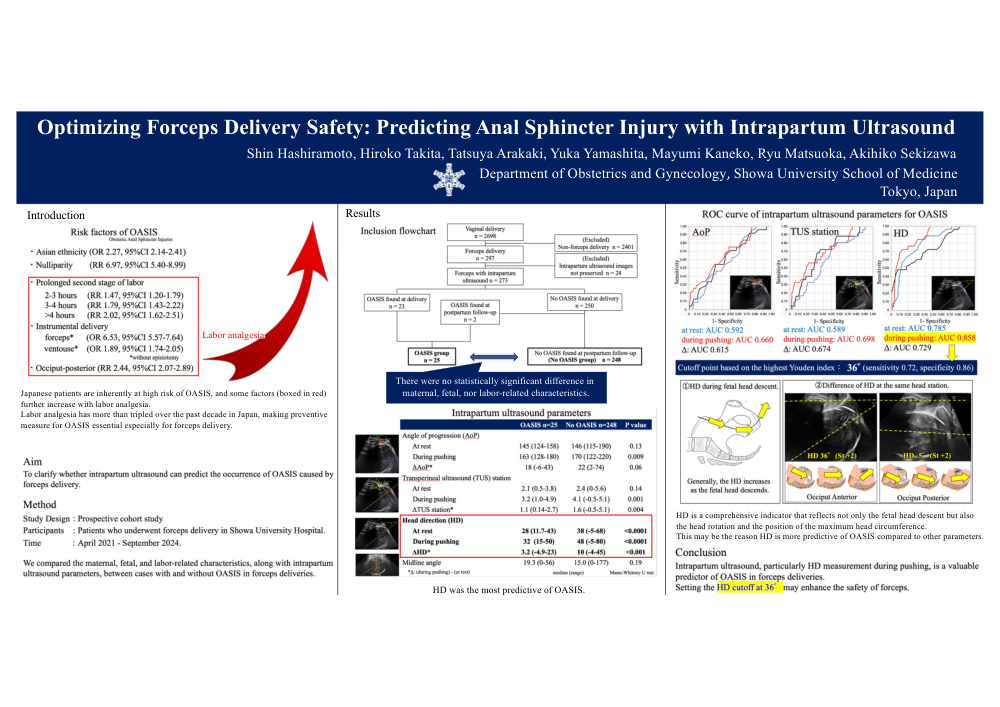
Japanese patients are inherently at high risk of OASIS, and some factors (boxed in red) further increase with labor analgesia. Labor analgesia has more than tripled over the past decade in Japan, making preventive measure for OASIS essential especially for forceps delivery.
The aim is to clarify whether intrapartum ultrasound can predict the occurrence of OASIS caused by forceps delivery.
We compared the maternal, fetal, and labor-related characteristics, along with intrapartum ultrasound parameters, between cases with and without OASIS in forceps deliveries.
Out of the total of 2698 vaginal deliveries, 273 underwent forceps using intrapartum ultrasound. 23 had OASIS found at delivery, and 2 patients had OASIS found at postpartum follow-up using transanal ultrasound.
When we look at the intrapartum ultrasound parameters, measurements obtained during pushing was more predictive of OASIS compared to measurements obtained at rest or the difference between during pushing and at rest. When we look at each parameters, head direction, HD was the most predictive of OASIS, and was significantly lower in cases with OASIS.
HD is a comprehensive indicator that reflects not only the fetal head descent but also the head rotation and the position of the maximum head circumference.
This may be the reason HD was more predictive of OASIS compared to AoP or TUS station, which only reflects the fetal head descent.
Intrapartum ultrasound, particularly HD measurement during pushing, is a valuable predictor of OASIS in forceps deliveries.
Setting the HD cutoff at 36°may enhance the safety of forceps.