2,281 posters, 63 videos, 56 audios, 43 topics, 18 sessions, 6,174 authors, 2,323 institutions
ePostersLive by SciGen Technologies S.A. All rights reserved.
RCOG World Congress 2025
June 23 - 25, 2025 | ExCeL London, UK
EP.1347
Being ROBUST to tackle rising PPH rates
Poster Presenter
Authors
Affiliations
Part of Topic
Intrapartum care
Background
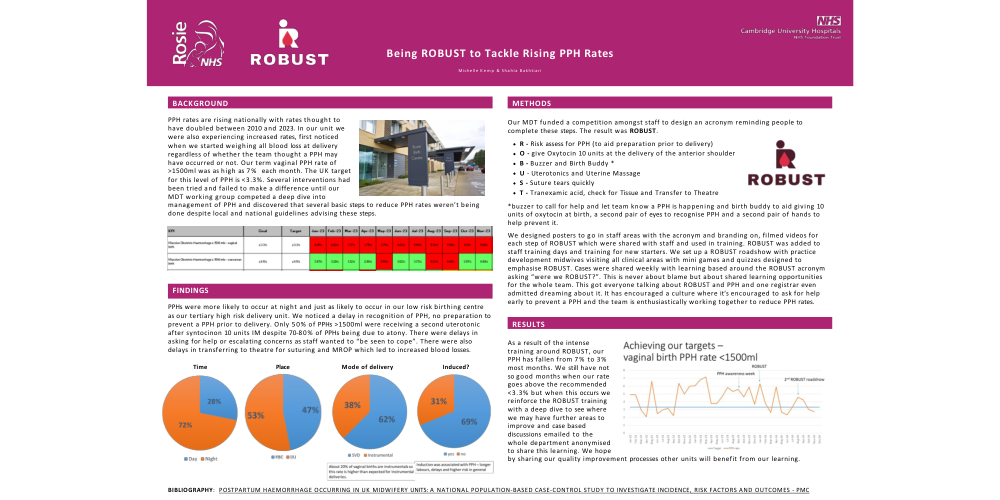
PPH rates are rising nationally with rates thought to have doubled between 2010 and 2023. In our unit we were also experiencing increased rates, first noticed when we started weighing all blood loss at delivery regardless of whether the team thought a PPH may have occurred or not. Our term vaginal PPH rate of
>1500ml was as high as 7% each month. The UK target for this level of PPH is <3.3%. Several interventions had been tried and failed to make a difference until our MDT working group competed a deep dive into
management of PPH and discovered that several basic steps to reduce PPH rates weren’t being done despite local and national guidelines advising these steps.
Findings
PPHs were more likely to occur at night and just as likely to occur in our low risk birthing centre as our tertiary high risk delivery unit. We noticed a delay in recognition of PPH, no preparation to prevent a PPH prior to delivery. Only 50% of PPHs >1500ml were receiving a second uterotonic after syntocinon 10 units IM despite 70-80% of PPHs being due to atony. There were delays in asking for help or escalating concerns as staff wanted to “be seen to cope”. There were also delays in transferring to theatre for suturing and MROP which led to increased blood losses.
Methods
Our MDT funded a competition amongst staff to design an acronym reminding people to complete these steps. The result was ROBUST.
R - Risk assess for PPH (to aid preparation prior to delivery)
O - give Oxytocin 10 units at the delivery of the anterior shoulder
B - Buzzer and Birth Buddy *
U - Uterotonics and Uterine Massage
S - Suture tears quickly
T - Tranexamic acid, check for Tissue and Transfer to Theatre
*buzzer to call for help and let team know a PPH is happening and birth buddy to aid giving 10 units of oxytocin at birth, a second pair of eyes to recognise PPH and a second pair of hands to help prevent it.
We designed posters to go in staff areas with the acronym and branding on, filmed videos for each step of ROBUST which were shared with staff and used in training. ROBUST was added to staff training days and training for new starters. We set up a ROBUST roadshow with practice development midwives visiting all clinical areas with mini games and quizzes designed to emphasise ROBUST. Cases were shared weekly with learning based around the ROBUST acronym asking “were we ROBUST?”. This is never about blame but about shared learning opportunities for the whole team. This got everyone talking about ROBUST and PPH and one registrar even admitted dreaming about it. It has encouraged a culture where it’s encouraged to ask for help early to prevent a PPH and the team is enthusiastically working together to reduce PPH rates.
Results
As a result of the intense training around ROBUST, our PPH has fallen from 7% to 3% most months. We still have not so good months when our rate goes above the recommended
<3.3% but when this occurs we reinforce the ROBUST training with a deep dive to see where we may have further areas to improve and case based discussions emailed to the whole department anonymised to share this learning. We hope
by sharing our quality improvement processes other units will benefit from our learning