2,281 posters, 63 videos, 56 audios, 43 topics, 18 sessions, 6,174 authors, 2,323 institutions
ePostersLive by SciGen Technologies S.A. All rights reserved.
RCOG World Congress 2025
June 23 - 25, 2025 | ExCeL London, UK
EP.1346
Adverse Outcomes Associated with Delayed Intervention in Prolonged Second Stage: Five-Year Analysis
Poster Presenter
Part of Topic
Intrapartum care
Adverse Outcomes Associated with Delayed Intervention in Prolonged Second Stage: Five-Year Analysis
Objective: NICE guidelines recommend considering intervention if birth is not imminent after 4 hours in the second stage of labor.This study aims to evaluate maternal and fetal outcomes in prolonged second-stage labor, identify critical time points for deterioration, and develop a risk stratification system to guide timely intervention.
Methods: Retrospective analysis of 150 cases with second stage exceeding 4 hours (4-8 hours) from 2019-2024 at a district general hospital managing 5,000 deliveries annually. Analysis focused on mode of delivery, maternal complications, fetal outcomes, and their relationship to duration of second stage.
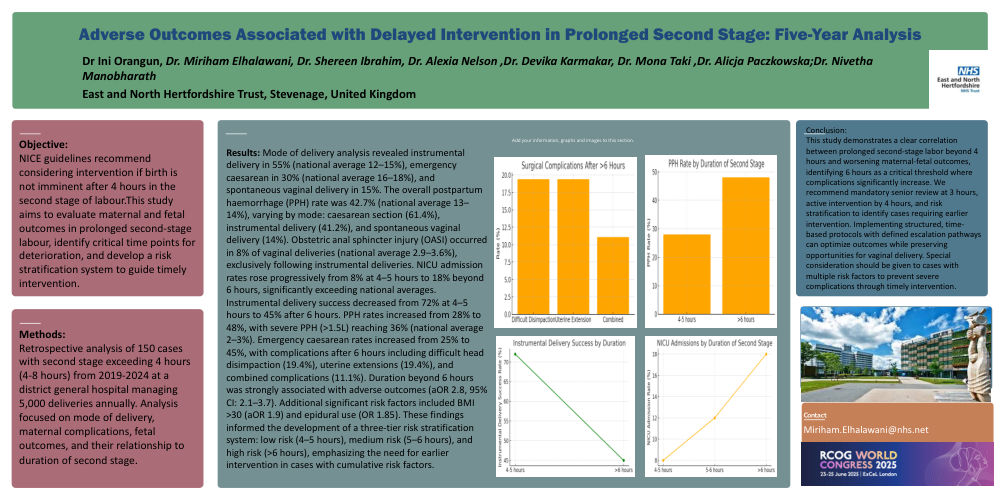
Results: Mode of delivery analysis revealed instrumental delivery in 55% (national average 12–15%), emergency caesarean in 30% (national average 16–18%), and spontaneous vaginal delivery in 15%. The overall postpartum hemorrhage (PPH) rate was 42.7% (national average 13–14%), varying by mode: caesarean section (61.4%), instrumental delivery (41.2%), and spontaneous vaginal delivery (14%). Obstetric anal sphincter injury (OASI) occurred in 8% of vaginal deliveries (national average 2.9–3.6%), exclusively following instrumental deliveries. NICU admission rates rose progressively from 8% at 4–5 hours to 18% beyond 6 hours, significantly exceeding national averages.Instrumental delivery success decreased from 72% at 4–5 hours to 45% after 6 hours. PPH rates increased from 28% to 48%, with severe PPH (>1.5L) reaching 36% (national average 2–3%). Emergency caesarean rates increased from 25% to 45%, with complications after 6 hours including difficult head disimpaction (19.4%), uterine extensions (19.4%), and combined complications (11.1%). Duration beyond 6 hours was strongly associated with adverse outcomes (aOR 2.8, 95% CI: 2.1–3.7). Additional significant risk factors included BMI >30 (aOR 1.9) and epidural use (OR 1.85). These findings informed the development of a three-tier risk stratification system: low risk (4–5 hours), medium risk (5–6 hours), and high risk (>6 hours), emphasizing the need for earlier intervention in cases with cumulative risk factors.
Conclusion: This study demonstrates a clear correlation between prolonged second-stage labor beyond 4 hours and worsening maternal-fetal outcomes, identifying 6 hours as a critical threshold where complications significantly increase. We recommend mandatory senior review at 3 hours, active intervention by 4 hours, and risk stratification to identify cases requiring earlier intervention. Implementing structured, time-based protocols with defined escalation pathways can optimize outcomes while preserving opportunities for vaginal delivery. Special consideration should be given to cases with multiple risk factors to prevent severe complications through timely intervention.