2,281 posters, 63 videos, 56 audios, 43 topics, 18 sessions, 6,174 authors, 2,323 institutions
ePostersLive by SciGen Technologies S.A. All rights reserved.
RCOG World Congress 2025
June 23 - 25, 2025 | ExCeL London, UK
EP.1345
Cervical Assessment Discordance in Arrested First Stage Labour
Poster Presenter
Authors
Affiliations
Part of Topic
Intrapartum care
Labour dystocia due to arrest in cervical dilatation in the first stage of labour is the most common cause of Emergency Caesarean Section (CS). Emergency CS poses significant maternal and neonatal risks. Ensuring correct diagnosis of cervical dilatation arrest is essential to minimise these risks and is achieved with consistent and sensitive cervical assessment during Vaginal Examination (VE).
This study aimed to audit the data from intrapartum VE in all cases of arrested cervical dilatation that resulted in a CS, within a 12-month period at a secondary Obstetric centre, to answer the following key questions:
70 cases of patients who had undergone a CS for the indication of ‘Delay in progress first stage,’ were identified. Files were manually reviewed. Data collected included general patient demographics, intrapartum interventions, and partogram data (including dilatation in sequential VEs, assessor, number of VEs and number of different practitioners performing VE). Pre-theatre VE was compared to pre-incision VE to identify discordance. Additionally, assuming a positive or stagnant progression of labour, cases of inter-VE discordance (where cervical dilatation had decreased in a subsequent VE) were identified.
The data affirmed and highlighted patient factors that contribute to labour dystocia. Majority of the patients who experienced labour dystocia were primiparous and were induced.
Although there is limited evidence that epidural anaesthesia increases the likelihood of labour dystocia, a notable proportion of our patients who experienced labour dystocia had received an epidural.
There is strong evidence in the literature that advanced maternal age and obesity increase the risk of labour dystocia. However, no such patterns were observed in our data. This may be attributed to the size of the data set.
On average, the included women had 5.31 VEs in labour (4.97-5.66, 95% CI) and were examined by 4.01 different practitioners (3.77-4.26, 95% CI)
Results of pre-theatre VE and pre-incision VE were discordant in 34.3% (24) cases with a mean discrepancy of 1.13cm, (0.982-1.28cm, 95% CI). The data demonstrated equivocal results with regards to over or under-diagnosis or labour dystocia.
A further 21 cases of inter-VE discordance were identified, with a mean discrepancy of 1.39cm (1.00-1.78cm, 95% CI).
Linear regression models were used to identify factors that contributed to VE discordance and showed the strongest correlation between number of VEs conducted and number of practitioners examining (R=0.940), though these results were not statistically significant (p=0.650, p= 0.230).
Logistical regression models also showed predictive factors of number of VEs and number of practitioners on the presence of VE discordance. Notably, duration of augmentation was a statistically significant predictor of VE discordance, which may act as a surrogate measure of increased opportunities for VE discordance, such as longer labour, more VEs performed, staff changes, or complex progression of labour.
Importantly, the time elapsed between pre-theatre VE and pre-incision VE (Decision-Delivery Interval) was not a predictor of VE discordance, which eliminates this as a potential confounder.
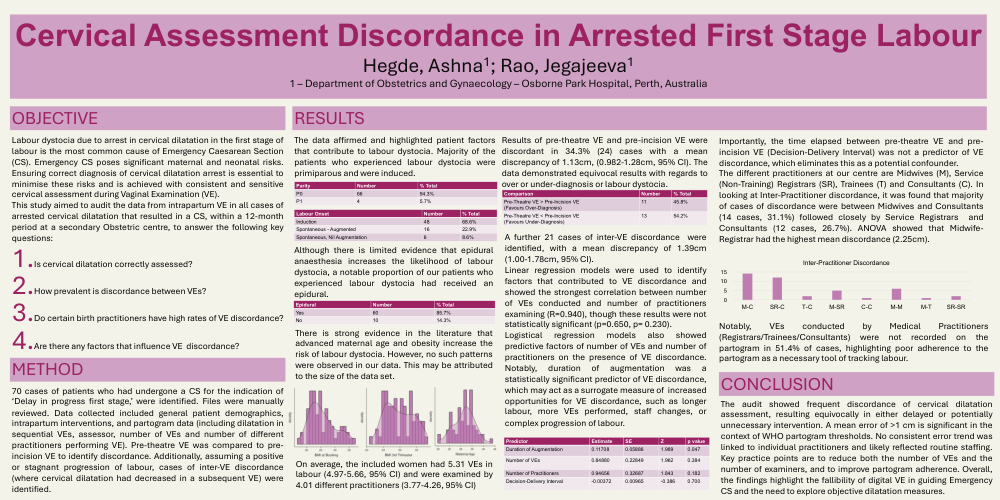
The different practitioners at our centre are Midwives (M), Service (Non-Training) Registrars (SR), Trainees (T) and Consultants (C). In looking at Inter-Practitioner discordance, it was found that majority of cases of discordance were between Midwives and Consultants (14 cases, 31.1%) followed closely by Service Registrars and Consultants (12 cases, 26.7%). ANOVA showed that Midwife-Registrar had the highest mean discordance (2.25cm).
Notably, VEs conducted by Medical Practitioners (Registrars/Trainees/Consultants) were not recorded on the partogram in 51.4% of cases, highlighting poor adherence to the partogram as a necessary tool of tracking labour.
The audit showed frequent discordance of cervical dilatation assessment, resulting equivocally in either delayed or potentially unnecessary intervention. A mean error of >1 cm is significant in the context of WHO partogram thresholds. No consistent error trend was linked to individual practitioners and likely reflected routine staffing. Key practice points are to reduce both the number of VEs and the number of examiners, and to improve partogram adherence. Overall, the findings highlight the fallibility of digital VE in guiding Emergency CS and the need to explore objective dilatation measures.