58 posters, 14 topics, 4 sessions, 188 authors, 62 institutions
ePostersLive by SciGen Technologies S.A. All rights reserved.
PSRC 69th Annual Meeting 2024
May 16-19, 2024 | The Westin Copley Place, Boston, MA

EP27
Reducing Financial Toxicity By Improving Speech Outcomes: The Surgeons Contribution To The Big Picture
Poster Presenter
Part of Topic
Craniofacial
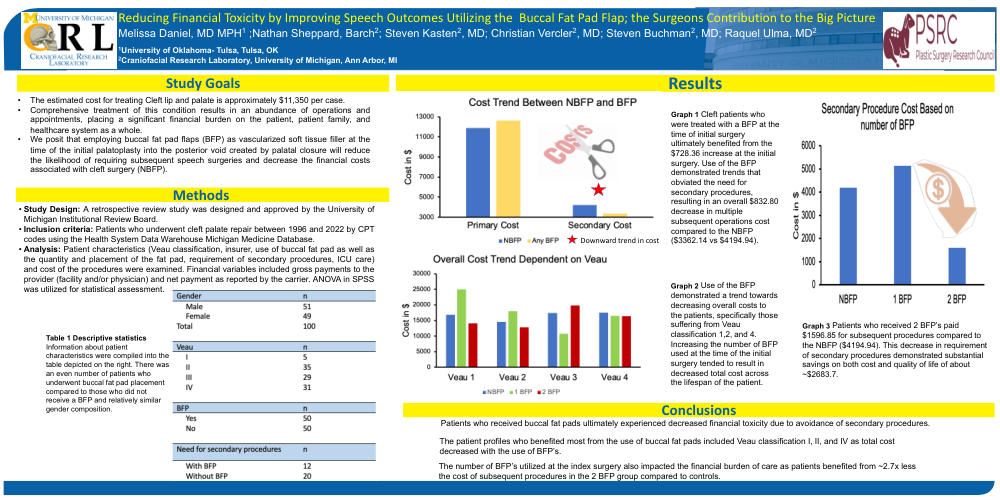
The estimated cost for treating Cleft lip and palate is approximately $11,350 per case.
Comprehensive treatment of this condition results in an abundance of operations and
appointments, placing a significant financial burden on the patient, patient family, and
healthcare system as a whole.
We posit that employing buccal fat pad flaps (BFP) as vascularized soft tissue filler at the
time of the initial palatoplasty into the posterior void created by palatal closure will reduce
the likelihood of requiring subsequent speech surgeries and decrease the financial costs
associated with cleft surgery (NBFP).
Study Design: A retrospective review study was designed and approved by the University of
Michigan Institutional Review Board.
Inclusion criteria: Patients who underwent cleft palate repair between 1996 and 2022 by CPT
codes using the Health System Data Warehouse Michigan Medicine Database.
Analysis: Patient characteristics (Veau classification, insurer, use of buccal fat pad as well as
the quantity and placement of the fat pad, requirement of secondary procedures, ICU care)
and cost of the procedures were examined. Financial variables included gross payments to the
provider (facility and/or physician) and net payment as reported by the carrier. ANOVA in SPSS
was utilized for statistical assessment.
Table 1 Descriptive statistics: Information about patient characteristics were compiled into the table depicted on the right. There was
an even number of patients who underwent buccal fat pad placement compared to those who did not receive a BFP and relatively similar
gender composition.
Graph 1 Cleft patients who were treated with a BFP at the time of initial surgery ultimately benefited from the $728.36 increase at the initial
surgery. Use of the BFP demonstrated trends that obviated the need for secondary procedures, resulting in an overall $832.80 decrease in multiple
subsequent operations cost compared to the NBFP ($3362.14 vs $4194.94).
Graph 2 Use of the BFP demonstrated a trend towards decreasing overall costs to the patients, specifically those
suffering from Veau classification 1,2, and 4. Increasing the number of BFP used at the time of the initial surgery tended to result in
decreased total cost across the lifespan of the patient.
Graph 3 Patients who received 2 BFP’s paid $1596.85 for subsequent procedures compared to the NBFP ($4194.94). This decrease in requirement
of secondary procedures demonstrated substantial savings on both cost and quality of life of about ~$2683.7.
Patients who received buccal fat pads ultimately experienced decreased financial toxicity due to avoidance of secondary procedures.
The patient profiles who benefited most from the use of buccal fat pads included Veau classification I, II, and IV as total cost
decreased with the use of BFP’s.
The number of BFP’s utilized at the index surgery also impacted the financial burden