58 posters, 14 topics, 4 sessions, 188 authors, 62 institutions
ePostersLive by SciGen Technologies S.A. All rights reserved.
PSRC 69th Annual Meeting 2024
May 16-19, 2024 | The Westin Copley Place, Boston, MA

EP14
Mandibular Condylar Neck Fractures: A Treatment Algorithm
Poster Presenter
Part of Topic
Craniofacial
Mandibular Condylar Neck Fractures: A Treatment Algorithm
Sai Anusha Sanka, BA, MPH; Damini Tandon MD; Nicholas Fadell, BS; Esther Ochoa, BA; Gary B. Skolnick, BA, MBA; John J Chi, MD MPHS; Dennis C Nguyen, MD MS; Kamlesh B Patel, MD MSc
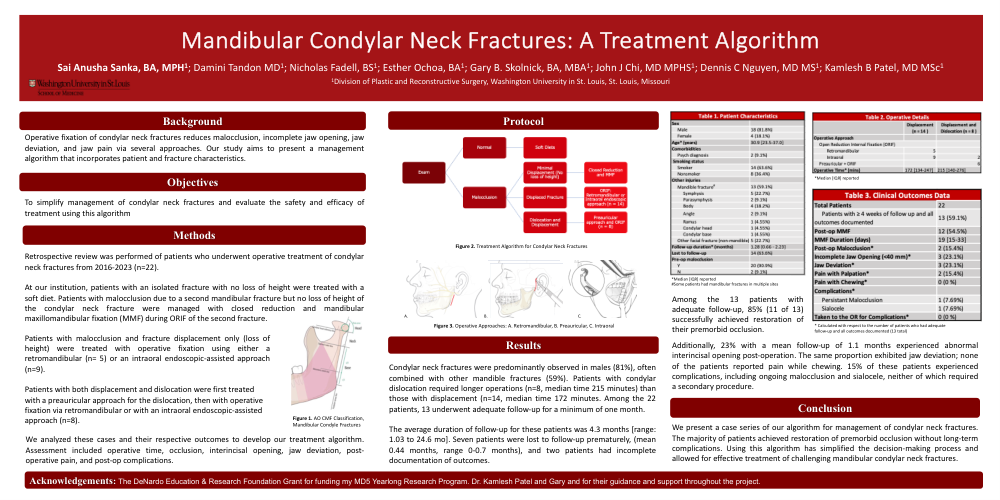
Background: Operative fixation of condylar neck fractures reduces malocclusion, incomplete jaw opening, jaw deviation, and jaw pain via several approaches. Our study aims to present a management algorithm that incorporates patient and fracture characteristics.
Methods: Retrospective review was performed of patients who underwent operative treatment of condylar neck fractures from 2016-2023 (n=22). At our institution, patients with an isolated fracture with no loss of height were treated with a soft diet. Patients with malocclusion due to a second mandibular fracture but no loss of height of the condylar neck fracture were managed with closed reduction and mandibular maxillomandibular fixation (MMF) during ORIF of the second fracture. Patients with malocclusion and fracture displacement only (loss of height) were treated with operative fixation using either a retromandibular (n= 5) or an intraoral endoscopic-assisted approach (n=9). Patients with both displacement and dislocation were first treated with a preauricular approach for the dislocation, then with operative fixation via retromandibular or with an intraoral endoscopic-assisted approach (n=8). We analyzed these cases and their respective outcomes to develop our treatment algorithm. Assessment included operative time, occlusion, interincisal opening, jaw deviation, post-operative pain, and post-op complications.
Results: Condylar neck fractures were predominantly observed in males (81%), often combined with other mandible fractures (59%). Patients with condylar dislocation required longer operations (n=8, median time 215 minutes) than those with displacement (n=14, median time 172 minutes. Among the 22 patients, 13 underwent adequate follow-up for a minimum of one month. The average duration of follow-up for these patients was 4.3 months [range: 1.03 to 24.6 mo]. Seven patients were lost to follow-up prematurely, (mean 0.44 months, range 0-0.7 months), and two patients had incomplete documentation of outcomes. Among the 13 patients with adequate follow-up, 85% successfully achieved restoration of their premorbid occlusion. Additionally, 23% with a mean follow-up of 1.1 months experienced abnormal interincisal opening post-operation. The same proportion exhibited jaw deviation; none of the patients reported pain while chewing. 15% of these patients experienced complications, including ongoing malocclusion and sialocele, neither of which required a secondary procedure.
Conclusion: In conclusion, we present a case series of our algorithm for management of condylar neck fractures. The majority of patients achieved restoration of premorbid occlusion without long-term complications. Using this algorithm has simplified the decision-making process and allowed for effective treatment of challenging mandibular condylar neck fractures.