Loading...

58 posters, 14 topics, 4 sessions, 188 authors, 62 institutions

ePostersLive by SciGen Technologies S.A. All rights reserved.

PSRC 69th Annual Meeting 2024

May 16-19, 2024 | The Westin Copley Place, Boston, MA

PSRC 69th Annual Meeting 2024 banner

EP16

Impact Of Social Vulnerability, Race, And Urbanicity On Surgical Timing For Patients With Craniosynostosis
Part of Topic

Craniofacial

Understanding Sociodemographic Factors Impacting Timing of Craniosynostosis Surgery

Emily E. Hecox MD; Shelley R. Edwards PhD; Katherine E. Baker MS; Mary E. McMinn BS; Jamie W. Lewis BS;

Savannah C. Walker MD; Keeley Frederick MHA; Laura S Humphries MD; Ian C. Hoppe MD                 

The University of Mississippi Medical Center

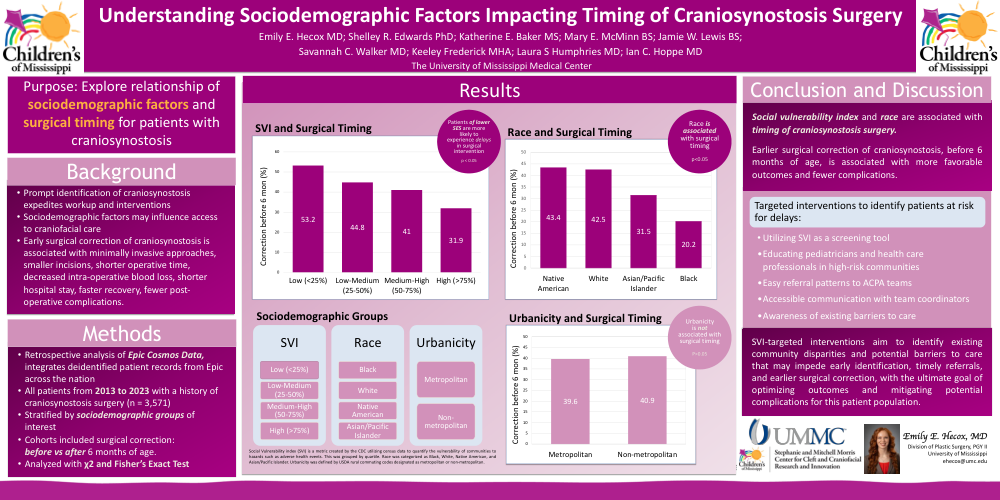
Purpose: Explore relationship of sociodemographic factors and surgical timing for patients with craniosynostosis

Background

•Prompt identification of craniosynostosis expedites workup and interventions
•Sociodemographic factors may influence access to craniofacial care
•Early surgical correction of craniosynostosis is associated with minimally invasive approaches, smaller incisions, shorter operative time, decreased intra-operative blood loss, shorter hospital stay, faster recovery, fewer post-operative complications.
 
Methods
•Retrospective analysis of Epic Cosmos Data, integrates deidentified patient records from Epic across the nation
•All patients from 2013 to 2023 with a history of craniosynostosis surgery (n = 3,571)
•Stratified by sociodemographic groups of interest
•Cohorts included surgical correction: before vs after 6 months of age.
•Analyzed with χ2 and Fisher’s Exact Test
 
Discussion and Conclusion

Social vulnerability index and race are associated with timing of craniosynostosis surgery.

Earlier surgical correction of craniosynostosis, before 6 months of age, is associated with more favorable outcomes and fewer complications.

Targeted interventions to identify patients at risk for delays:

•Utilizing SVI as a screening tool
•Educating pediatricians and health care professionals in high-risk communities
•Easy referral patterns to ACPA teams
•Accessible communication with team coordinators
•Awareness of existing barriers to care

SVI-targeted interventions aim to identify existing community disparities and potential barriers to care that may impede early identification, timely referrals, and earlier surgical correction, with the ultimate goal of optimizing outcomes and mitigating potential complications for this patient population.


PSRC 69th Annual Meeting 2024 » banner
Copyright © 2015-2026, ePostersLive® SciGen is a registered trademark of SciGen Technologies S.A. Patent pending.

This website and third-party tools we use rely on cookies for the best user experience. By selecting "I agree", you agree to cookie usage as described in our Privacy Policy.