58 posters, 14 topics, 4 sessions, 188 authors, 62 institutions
ePostersLive by SciGen Technologies S.A. All rights reserved.
PSRC 69th Annual Meeting 2024
May 16-19, 2024 | The Westin Copley Place, Boston, MA

EP10
In Vivo Evaluation Of Cartilage Decellularized And Sterilized Using Supercritical CO<sub>2</sub>
Poster Presenter
Authors
Affiliations
Part of Topic
Craniofacial
In vivo Evaluation of Cartilage Decellularized and Sterilized Using Supercritical CO2
PURPOSE
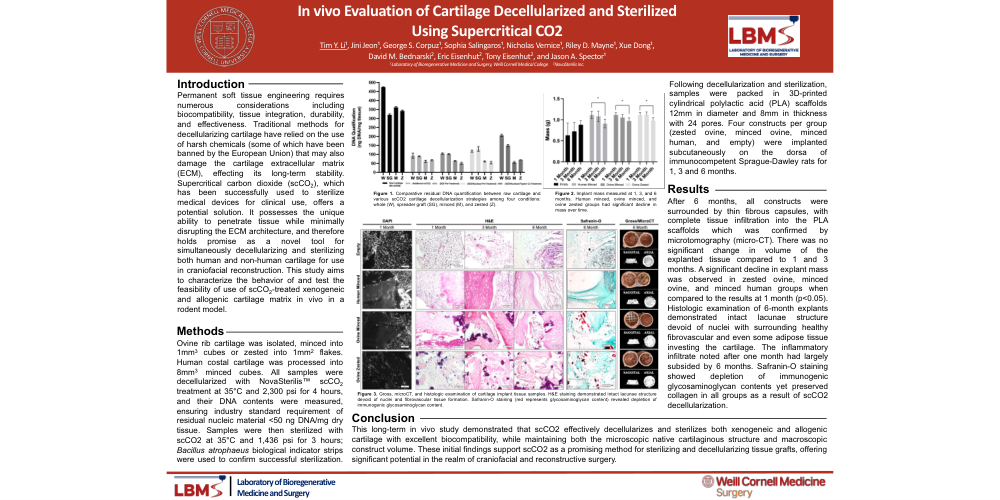
Permanent soft tissue engineering requires numerous considerations including biocompatibility, tissue integration, durability, and effectiveness. Traditional methods for decellularizing cartilage have relied on the use of harsh chemicals (some of which have been banned by the European Union) that may also damage the cartilage extracellular matrix (ECM), effecting its long-term stability. Supercritical carbon dioxide (scCO2), which has been successfully used to sterilize medical devices for clinical use, offers a potential solution. It possesses the unique ability to penetrate tissue while minimally disrupting the ECM architecture, and therefore holds promise as a novel tool for simultaneously decellularizing and sterilizing both human and non-human cartilage for use in craniofacial reconstruction. This study aims to characterize the behavior of and test the feasibility of use of scCO2-treated xenogeneic and allogenic cartilage matrix in vivo in a rodent model.
METHODS
Ovine rib cartilage was isolated, minced into 1mm3 cubes or zested into 1mm2 flakes. Human costal cartilage was processed into 8mm3 minced cubes. All samples were decellularized with NovaSterilis™ scCO2 treatment at 35°C and 2,300 psi for 4 hours, and their DNA contents were measured, ensuring industry standard requirement of residual nucleic material <50 ng DNA/mg dry tissue. Samples were then sterilized with scCO2 at 35°C and 1,436 psi for 3 hours; Bacillus atrophaeus biological indicator strips were used to confirm successful sterilization. Following decellularization and sterilization, samples were packed in 3D-printed cylindrical polylactic acid (PLA) scaffolds 12mm in diameter and 8mm in thickness with 24 pores. Four constructs per group (zested ovine, minced ovine, minced human, and empty) were implanted subcutaneously on the dorsa of immunocompetent Sprague-Dawley rats for 1, 3 and 6 months.
RESULTS
After 6 months, all constructs were surrounded by thin fibrous capsules, with complete tissue infiltration into the PLA scaffolds which was confirmed by microtomography (micro-CT). There was no significant change in volume of the explanted tissue compared to 1 and 3 months. A significant decline in explant mass was observed in zested ovine, minced ovine, and minced human groups when compared to the results at 1 month (p<0.05). Histologic examination of 6-month explants demonstrated intact lacunae structure devoid of nuclei with surrounding healthy fibrovascular and even some adipose tissue investing the cartilage. The inflammatory infiltrate noted after one month had largely subsided by 6 months. Safranin-O staining showed depletion of immunogenic glycosaminoglycan contents yet preserved collagen in all groups as a result of scCO2 decellularization.
CONCLUSIONS
This long-term in vivo study demonstrated that scCO2 effectively decellularizes and sterilizes both xenogeneic and allogenic cartilage with excellent biocompatibility, while maintaining both the microscopic native cartilaginous structure and macroscopic construct volume. These initial findings support scCO2 as a promising method for sterilizing and decellularizing tissue grafts, offering significant potential in the realm of craniofacial and reconstructive surgery.