58 posters, 14 topics, 4 sessions, 188 authors, 62 institutions
ePostersLive by SciGen Technologies S.A. All rights reserved.
PSRC 69th Annual Meeting 2024
May 16-19, 2024 | The Westin Copley Place, Boston, MA

EP22
Recombinant Human Bone Morphogenetic Protein-2 (rhBMP-2) As An Alternative To Autologous Bone Graft In Pediatric Craniofacial Reconstruction: A Systematic Review
Poster Presenter
Authors
Affiliations
Part of Topic
Craniofacial
Recombinant Human Bone Morphogenetic Protein-2 (rhBMP-2) as an Alternative to Autologous Bone Graft in Pediatric Craniofacial Reconstruction: A Systematic Review
Daniel Lee1, Laiba Murad1, Jesse Chou, MD2, and Martin Hoard, MD, DDS2
1: University of Virginia School of Medicine, Charlottesville, VA
2: Department of Plastic and Maxillofacial Surgery, University of Virginia, Charlottesville, VA
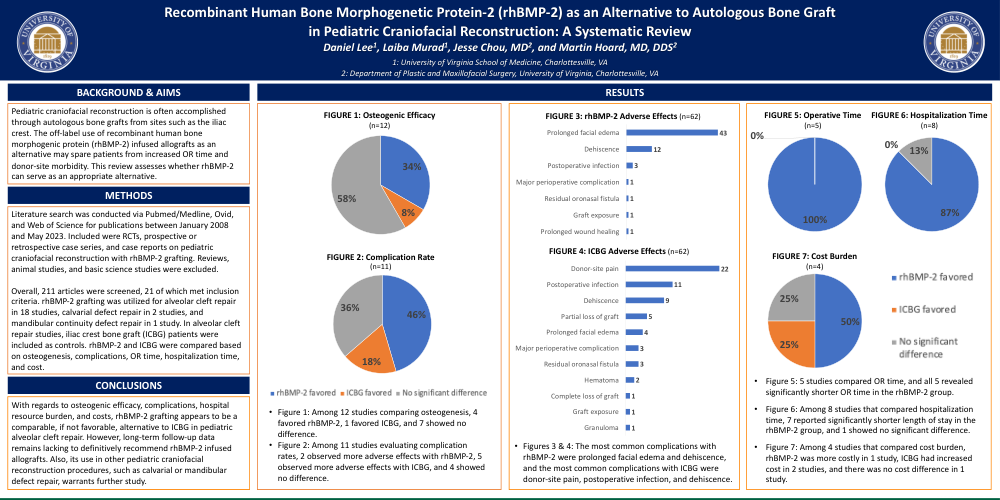
BACKGROUND & AIMS: Pediatric craniofacial reconstruction is often accomplished through autologous bone grafts from sites such as the iliac crest. The off-label use of recombinant human bone morphogenic protein (rhBMP-2) infused allografts as an alternative may spare patients from increased OR time and donor-site morbidity. This review assesses whether rhBMP-2 can serve as an appropriate alternative.
METHODS: Literature search was conducted via Pubmed/Medline, Ovid, and Web of Science for publications between January 2008 and May 2023. Included were RCTs, prospective or retrospective case series, and case reports on pediatric craniofacial reconstruction with rhBMP-2 grafting. Reviews, animal studies, and basic science studies were excluded.
Overall, 211 articles were screened, 21 of which met inclusion criteria. rhBMP-2 grafting was utilized for alveolar cleft repair in 18 studies, calvarial defect repair in 2 studies, and mandibular continuity defect repair in 1 study. In alveolar cleft repair studies, iliac crest bone graft (ICBG) patients were included as controls. rhBMP-2 and ICBG were compared based on osteogenesis, complications, OR time, hospitalization time, and cost.
RESULTS:
CONCLUSIONS: With regards to osteogenic efficacy, complications, hospital resource burden, and costs, rhBMP-2 grafting appears to be a comparable, if not favorable, alternative to ICBG in pediatric alveolar cleft repair. However, long-term follow-up data remains lacking to definitively recommend rhBMP-2 infused allografts. Also, its use in other pediatric craniofacial reconstruction procedures, such as calvarial or mandibular defect repair, warrants further study.