58 posters, 14 topics, 4 sessions, 188 authors, 62 institutions
ePostersLive by SciGen Technologies S.A. All rights reserved.
PSRC 69th Annual Meeting 2024
May 16-19, 2024 | The Westin Copley Place, Boston, MA

EP20
Impact Of Mandibular Distraction On Hyoid Position In Patients With Pierre Robin Sequence
Poster Presenter
Authors
Shelby Nathan, Annie Wang, Peishu Li, Hannes Prescher, Fatima Bouftas, Callum Ross, Russell Reid
Affiliations
Part of Topic
Craniofacial
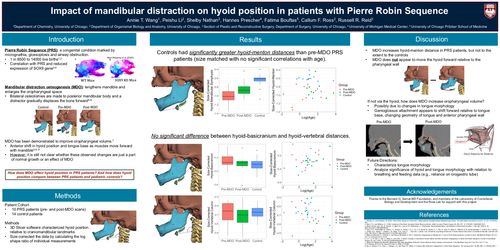
INTRODUCTION Pierre Robin Sequence (PRS): a congenital condition marked by micrognathia, glossoptosis and airway obstruction. 1 in 8500 to 14000 live births. Correlation with PRS and reduced expression of SOX9 gene. Mandibular distraction osteogenesis (MDO): lengthens mandible and enlarges the oropharyngeal space. Bilateral osteotomies are made to posterior mandibular body and a distractor gradually displaces the bone forward. MDO has been demonstrated to improve oropharyngeal volume. Anterior shift in hyoid position and tongue base as muscles move forward with mandible. However: it is still not clear whether these observed changes are just a part of normal growth or an effect of MDO.
HYPOTHESIS How does MDO affect hyoid position in PRS patients? And how does hyoid position compare between PRS patients and pediatric controls?
METHODS 10 PRS patients (pre- and post-MDO scans), 14 control patients. 3D Slicer software characterized hyoid position relative to craniomandibular landmarks. Size-corrected the data by calculating the log shape ratio of individual measurements.
RESULTS Controls had significantly greater hyoid-menton distances than pre-MDO PRS patients (size matched with no significant correlations with age). No significant difference between hyoid-basicranium and hyoid-vertebral distances.
DISCUSSION MDO increases hyoid-menton distance in PRS patients, but not to the extent to the controls. MDO does notappear to move the hyoid forward relative to the pharyngeal wall. If not via the hyoid, how does MDO increase oropharyngeal volume? Possibly due to changes in tongue morphology. Genioglossus attachment appears to shift forward relative to tongue base, changing geometry of tongue and anterior pharyngeal wall.
FUTURE DIRECTIONS Characterize tongue morphology. Analyze significance of hyoid and tongue morphology with relation to breathing and feeding data (e.g., reliance on orogastric tube).