58 posters, 14 topics, 4 sessions, 188 authors, 62 institutions
ePostersLive by SciGen Technologies S.A. All rights reserved.
PSRC 69th Annual Meeting 2024
May 16-19, 2024 | The Westin Copley Place, Boston, MA

EP19
Predicting The Risk Of Enophthalmos After Pediatric Orbital Floor Fractures: An Application Of The “Orbital Index” Measure To Pediatric Surgical Planning
Poster Presenter
Authors
Affiliations
Part of Topic
Craniofacial
Predicting the Risk of Enophthalmos After Pediatric Orbital Floor Fractures: An Application of the “Orbital Index” Measure to Predict Surgical Planning
Alexander J. Comerci, BS; Megan Kerbag, MPH; Joseph Mocharnuk, BA; Angel Dixon, BA; Nicolás M. Kass, BA; Zhazira Irgebay, MD; Megan Pencek, MD; Janina Kueper, MD; Barton Branstetter, MD; Jesse A. Goldstein, MD
University of Pittsburgh Medical Center, Department of Plastic Surgery, Pittsburgh, PA; Lake Erie College of Osteopathic Medicine, Erie, PA; University of Pittsburgh Medical Center, Department of Radiology, Pittsburgh, PA; Children’s Hospital of Pittsburgh, Department of Plastic Surgery, Pittsburgh, PA
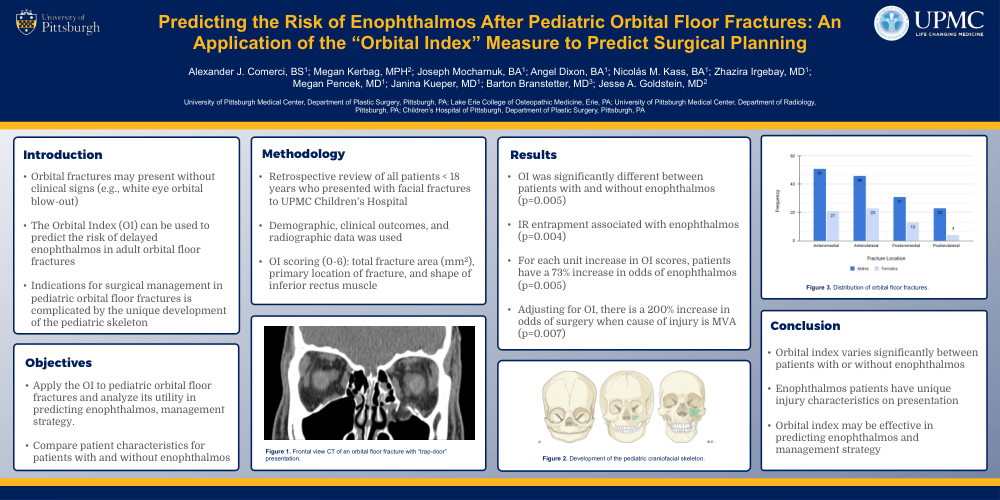
Introduction: Orbital fractures may present without clinical signs (e.g., white eye orbital blow-out). The Orbital Index (OI) can be used to predict the risk of delayed enophthalmos in adult orbital floor fractures. Indications for surgical management in pediatric orbital floor fractures is complicated by the unique development of the pediatric skeleton.
Objectives: Apply the OI to pediatric orbital floor fractures and analyze its utility in predicting enophthalmos, management strategy. Compare patient characteristics for patients with and without enophthalmos.
Methodology: Retrospective review of all patients < 18 years who presented with facial fractures to UPMC Children’s Hospital. Demographic, clinical outcomes, and radiographic data was used. OI scoring (0-6): total fracture area (mm2), primary location of fracture, and shape of inferior rectus muscle.
Results: OI was significantly different between patients with and without enophthalmos (p=0.005). IR entrapment associated with enophthalmos (p=0.004). For each unit increase in OI scores, patients have a 73% increase in odds of enophthalmos (p=0.005). Adjusting for OI, there is a 200% increase in odds of surgery when cause of injury is MVA (p=0.007).
Conclusion: Orbital index varies significantly between patients with or without enophthalmos. Enophthalmos patients have unique injury characteristics on presentation. Orbital index may be effective in predicting enophthalmos and management strategy.