58 posters, 14 topics, 4 sessions, 188 authors, 62 institutions
ePostersLive by SciGen Technologies S.A. All rights reserved.
PSRC 69th Annual Meeting 2024
May 16-19, 2024 | The Westin Copley Place, Boston, MA

EP18
From Chisels To Cyberspace: Technological Transitions In Craniosynostosis Surgical Management
Poster Presenter
Authors
Affiliations
Part of Topic
Craniofacial
From Chisels To Cyberspace: Technological Transitions In Craniosynostosis Surgical Management
Devansh Saini PhD1, Naji Bou Zeid MD2, Linping Zhao PhD2, Pravin Patel MD3, Quintin L. Williams Jr. PhD2, Tong-Chuan He MD PhD4,
Russell R. Reid MD PhD4, Lee Alkureishi MD3
University of Advancing Technology1, University of Illinois at Chicago2, University of Illinois at Chicago and Shriners Chicago3, The University of Chicago4
INTRODUCTION
Total Cranial Vault Remodeling (CVR) technique, which is used to treat Craniosynostosis is potentially
The surgical technique has undergone only minor refinements over the past 60 years, heavily relying on manual handheld tools to remodel a patient’s calvarial anatomy. This study proposes a novel technique leveraging 200 years of advancements in woodworking and engineering technologies to improve the speed, accuracy, and precision of the procedure.
METHODS
A systematic review using PRISMA methodology identified 12 studies showing quantifiable improvements from integrating technologies like CAD/CAM, virtual reality (VR), 3D printing, and computer numerical control (CNC) machining.
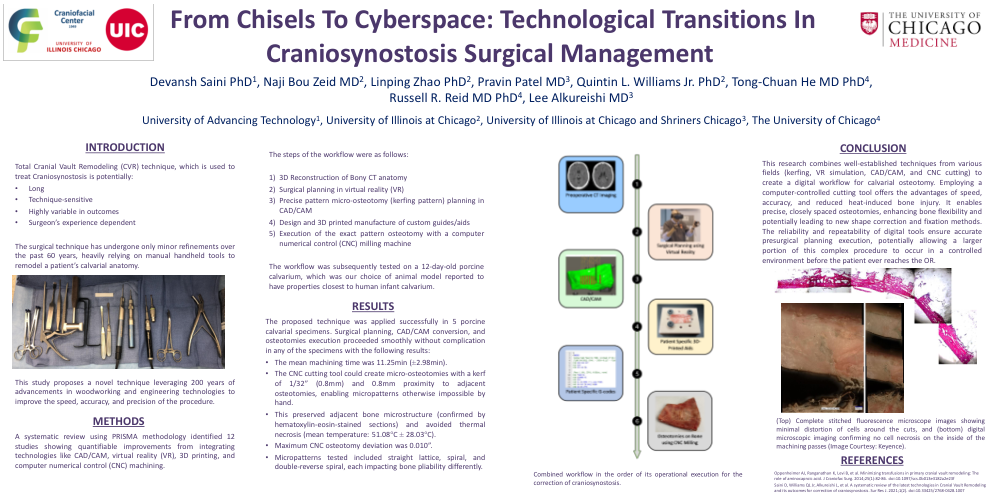
The steps of the workflow were as follows:
The workflow was subsequently tested on a 12-day-old porcine calvarium, which was our choice of animal model reported to have properties closest to human infant calvarium.
RESULTS
The proposed technique was applied successfully in 5 porcine calvarial specimens. Surgical planning, CAD/CAM conversion, and osteotomies execution proceeded smoothly without complication in any of the specimens with the following results:
CONCLUSION
This research combines well-established techniques from various fields (kerfing, VR simulation, CAD/CAM, and CNC cutting) to create a digital workflow for calvarial osteotomy. Employing a computer-controlled cutting tool offers the advantages of speed, accuracy, and reduced heat-induced bone injury. It enables precise, closely spaced osteotomies, enhancing bone flexibility and potentially leading to new shape correction and fixation methods. The reliability and repeatability of digital tools ensure accurate presurgical planning execution, potentially allowing a larger portion of this complex procedure to occur in a controlled environment before the patient ever reaches the OR.
REFERENCES
Oppenheimer AJ, Ranganathan K, Levi B, et al. Minimizing transfusions in primary cranial vault remodeling: The role of aminocaproic acid. J Craniofac Surg. 2014;25(1):82-86. doi:10.1097/scs.0b013e3182a2e23f
Saini D, Williams QL Jr, Alkureishi L, et al. A systematic review of the latest technologies in Cranial Vault Remodeling and its outcomes for correction of craniosynostosis. Sur Res J. 2021;1(2). doi:10.33425/2768-0428.1007