358 posters, 97 topics, 122 sessions, 958 authors, 239 institutions
ePostersLive by SciGen Technologies S.A. All rights reserved.
79th PostGraduate Assembly in Anesthesiology 2025
December 12 - 15, 2025 | New York City

3114
Sevoflurane causes widespread increase in PKMZ in the CA1 pyramidal cells of the hippocampus in adult male mice: Implications for Post-Operative Cognitive Dysfunction
Poster Presenter
Part of Topic
Basic Research
INTRODUCTION & BACKGROUND:
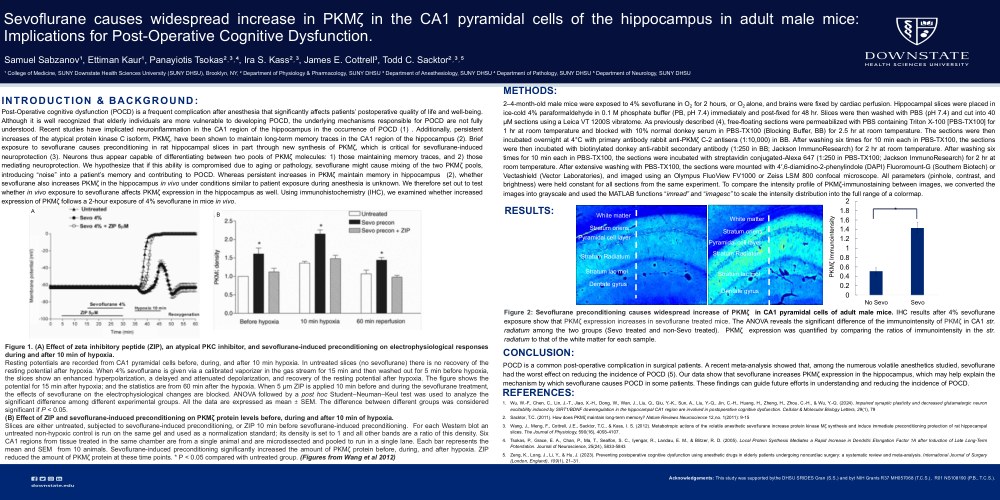
Post-Operative cognitive dysfunction (POCD) is a frequent complication after anesthesia that significantly affects patients’ postoperative quality of life and well-being. Although it is well recognized that elderly individuals are more vulnerable to developing POCD, the underlying mechanisms responsible for POCD are not fully understood. Recent studies have implicated neuroinflammation in the CA1 region of the hippocampus in the occurrence of POCD (1) . Additionally, persistent increases of the atypical protein kinase C isoform, PKMζ, have been shown to maintain long-term memory traces in the CA1 region of the hippocampus (2). Brief exposure to sevoflurane causes preconditioning in rat hippocampal slices in part through new synthesis of PKMζ, which is critical for sevoflurane-induced neuroprotection (3). Neurons thus appear capable of differentiating between two pools of PKMζmolecules: 1) those maintaining memory traces, and 2) those mediating neuroprotection. We hypothesize that if this ability is compromised due to aging or pathology, sevoflurane might cause mixing of the two PKMζ pools, introducing “noise” into a patient’s memory and contributing to POCD. Whereas persistent increases in PKMζ maintain memory in hippocampus (2), whether sevoflurane also increases PKMζ in the hippocampus in vivounder conditions similar to patient exposure during anesthesia is unknown. We therefore set out to test whether in vivo exposure to sevoflurane affects PKMζ expression in the hippocampus as well. Using immunohistochemistry (IHC), we examined whether increased expression of PKMζfollows a 2-hour exposure of 4% sevoflurane in mice in vivo.
RESULTS:
Sevoflurane preconditioning causes widespread increase of PKMζ in CA1 pyramidal cells of adult male mice. IHC results after 4% sevoflurane exposure show that PKMζexpression increases in sevoflurane treated mice.The ANOVA reveals the significant difference of the immunointensity of PKMζ in CA1 str. radiatum among the two groups (Sevo treated and non-Sevo treated). PKMζ expression was quantified by comparing the ratios of immunointensity in the str. radiatum to that of the white matter for each sample.
CONCLUSION:
POCD is a common post-operative complication in surgical patients. A recent meta-analysis showed that, among the numerous volatile anesthetics studied, sevoflurane had the worst effect on reducing the incidence of POCD (5). Our data show that sevoflurane increases PKMζ expression in the hippocampus, which may help explain the mechanism by which sevoflurane causes POCD in some patients. These findings can guide future efforts in understanding and reducing the incidence of POCD.
REFERENCES: