358 posters, 97 topics, 122 sessions, 958 authors, 239 institutions
ePostersLive by SciGen Technologies S.A. All rights reserved.
79th PostGraduate Assembly in Anesthesiology 2025
December 12 - 15, 2025 | New York City

3020
C8 Platform Impact: Enhancing Medical Resource Accessibility
Poster Presenter
Authors
Affiliations
Part of Topic
Basic Research - Global Health
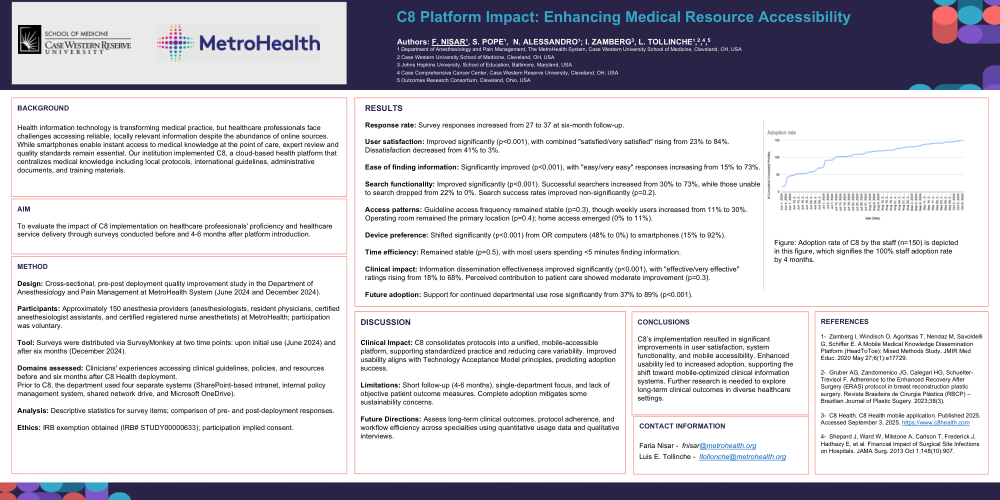
C8 Platform Impact: Enhancing Medical Resource Accessibility
Authors: F. NISAR¹, S. POPE¹, N. ALESSANDRO¹; I. ZAMBERG3, L. TOLLINCHE¹,2,4,5
1 Department of Anesthesiology and Pain Management, The MetroHealth System, Case Western University School of Medicine, Cleveland, OH, USA
2 Case Western University School of Medicine, Cleveland, OH, USA
3 Johns Hopkins University, School of Education, Baltimore, Maryland, USA
4 Case Comprehensive Cancer Center, Case Western Reserve University, Cleveland, OH, USA
5 Outcomes Research Consortium, Cleveland, Ohio, USA
BACKGROUND
Health information technology is transforming medical practice, but healthcare professionals face challenges accessing reliable, locally relevant information despite the abundance of online sources. While smartphones enable instant access to medical knowledge at the point of care, expert review and quality standards remain essential. Our institution implemented C8, a cloud-based health platform that centralizes medical knowledge including local protocols, international guidelines, administrative documents, and training materials.
AIM
To evaluate the impact of C8 implementation on healthcare professionals' proficiency and healthcare service delivery through surveys conducted before and 4-6 months after platform introduction.
METHOD
Design: Cross-sectional, pre-post deployment quality improvement study in the Department of Anesthesiology and Pain Management at MetroHealth System (June 2024 and December 2024).
Participants: Approximately 150 anesthesia providers (anesthesiologists, resident physicians, certified anesthesiologist assistants, and certified registered nurse anesthetists) at MetroHealth; participation was voluntary.
Tool: Surveys were distributed via SurveyMonkey at two time points: upon initial use (June 2024) and after six months (December 2024).
Domains assessed: Clinicians' experiences accessing clinical guidelines, policies, and resources before and six months after C8 Health deployment.
Prior to C8, the department used four separate systems (SharePoint-based intranet, internal policy management system, shared network drive, and Microsoft OneDrive).
Analysis: Descriptive statistics for survey items; comparison of pre- and post-deployment responses.
Ethics: IRB exemption obtained (IRB# STUDY00000633); participation implied consent.
RESULTS
Response rate: Survey responses increased from 27 to 37 at six-month follow-up.
User satisfaction: Improved significantly (p<0.001), with combined "satisfied/very satisfied" rising from 23% to 84%. Dissatisfaction decreased from 41% to 3%.
Ease of finding information: Significantly improved (p<0.001), with "easy/very easy" responses increasing from 15% to 73%.
Search functionality: Improved significantly (p<0.001). Successful searchers increased from 30% to 73%, while those unable to search dropped from 22% to 0%. Search success rates improved non-significantly (p=0.2).
Access patterns: Guideline access frequency remained stable (p=0.3), though weekly users increased from 11% to 30%. Operating room remained the primary location (p=0.4); home access emerged (0% to 11%).
Device preference: Shifted significantly (p<0.001) from OR computers (48% to 0%) to smartphones (15% to 92%).
Time efficiency: Remained stable (p=0.5), with most users spending <5 minutes finding information.
Clinical impact: Information dissemination effectiveness improved significantly (p<0.001), with "effective/very effective" ratings rising from 18% to 68%. Perceived contribution to patient care showed moderate improvement (p=0.3).
Future adoption: Support for continued departmental use rose significantly from 37% to 89% (p<0.001).
DISCUSSION
Clinical Impact: C8 consolidates protocols into a unified, mobile-accessible platform, supporting standardized practice and reducing care variability. Improved usability aligns with Technology Acceptance Model principles, predicting adoption success.
Limitations: Short follow-up (4-6 months), single-department focus, and lack of objective patient outcome measures. Complete adoption mitigates some sustainability concerns.
Future Directions: Assess long-term clinical outcomes, protocol adherence, and workflow efficiency across specialties using quantitative usage data and qualitative interviews.
CONCLUSIONS
C8’s implementation resulted in significant improvements in user satisfaction, system functionality, and mobile accessibility. Enhanced usability led to increased adoption, supporting the shift toward mobile-optimized clinical information systems. Further research is needed to explore long-term clinical outcomes in diverse healthcare settings.