358 posters, 97 topics, 122 sessions, 958 authors, 239 institutions
ePostersLive by SciGen Technologies S.A. All rights reserved.
79th PostGraduate Assembly in Anesthesiology 2025
December 12 - 15, 2025 | New York City

3042
Effects of Dobutamine and Vasopressin on Intestinal Microcirculation in Sepsis: A Randomized Placebo-Controlled Trial
Poster Presenter
Part of Topic
Basic Research - OTHER Sepsis
Effects of Dobutamine and Vasopressin on Intestinal Microcirculation in Sepsis: A Randomized Placebo-Controlled Trial
Sepsis is a life-threatening syndrome characterized by systemic inflammation and microcirculatory dysfunction, leading to multi-organ failure. Gastrointestinal microcirculation is crucial for maintaining the mucosal barrier and preventing bacterial translocation, yet targeted strategies to support gut perfusion in sepsis remain poorly defined. Dobutamine and vasopressin are commonly used in the hemodynamic management of septic shock, but their specific effects on intestinal microcirculation are insufficiently understood. We hypothesized that dobutamine, vasopressin, and their combination differentially affect intestinal microvascular oxygenation and perfusion in abdominal sepsis.
In this study, 88 male Wistar rats underwent CASP-induced sepsis or sham surgery. Microcirculation (µHbO₂ [%] and µFlow [AU]) was measured over 90 minutes. Arterial lactate was analyzed via POCT, and IL-6 levels via ELISA. Statistical analyses included normality testing, mixed-effects models with Dunnett correction for microcirculation, Sidak correction for lactate, and Mann–Whitney U testing for IL-6.
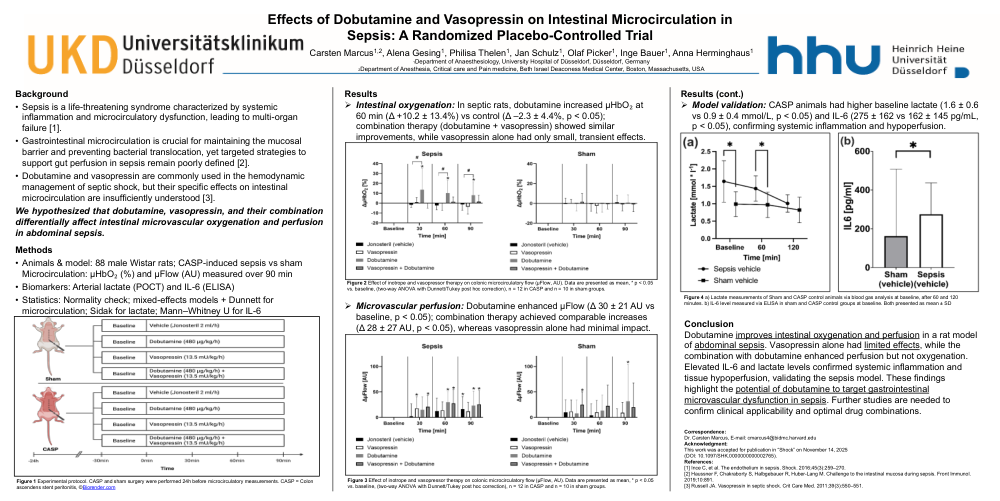
In septic rats, dobutamine increased intestinal µHbO₂ at 60 minutes (Δ +10.2 ± 13.4%) compared to control (Δ –2.3 ± 4.4%, p < 0.05). Combination therapy with dobutamine and vasopressin produced similar improvements, whereas vasopressin alone had only small, transient effects. With respect to microvascular perfusion, dobutamine enhanced µFlow (Δ 30 ± 21 AU vs baseline, p < 0.05). Combination therapy produced comparable increases (Δ 28 ± 27 AU, p < 0.05), while vasopressin alone showed minimal impact. Sham animals showed no relevant treatment effects.
Model validation confirmed significant systemic inflammation and hypoperfusion in CASP animals, as indicated by higher baseline lactate (1.6 ± 0.6 vs 0.9 ± 0.4 mmol/L, p < 0.05) and IL-6 levels (275 ± 162 vs 162 ± 145 pg/mL, p < 0.05).
In conclusion, dobutamine improves intestinal oxygenation and perfusion in a rat model of abdominal sepsis. Vasopressin alone had limited effects, while combination therapy enhanced perfusion but not oxygenation. Elevated IL-6 and lactate levels validated the sepsis model. These findings highlight the potential of dobutamine to target gastrointestinal microvascular dysfunction in sepsis, underscoring the need for further studies to confirm clinical applicability and optimize drug combinations.
Correspondence: Dr. Carsten Marcus, E-mail: cmarcus4@bidmc.harvard.edu.
Acknowledgement: This work was accepted for publication in “Shock” on November 14, 2025.
References:
-
Ince C et al., The endothelium in sepsis. Shock. 2016;45(3):259–270.
-
Haussner F, Chakraborty S, Halbgebauer R, Huber-Lang M. Challenge to the intestinal mucosa during sepsis. Front Immunol. 2019;10:891.
-
Russell JA. Vasopressin in septic shock. Crit Care Med. 2011;39(3):550–551.