226 posters, 5 topics, 20 sessions, 599 authors, 292 institutions
ePostersLive by SciGen Technologies S.A. All rights reserved.
Obstetric Anaesthesia Annual Scientific Meeting 2026
14-15 May 2026 | Liverpool Convention Centre

7163808
Optimising anaesthetic care for the morbidly obese parturient: recommendations from a single-centre service evaluation
Poster Presenter
Part of Topic
Service Evaluation
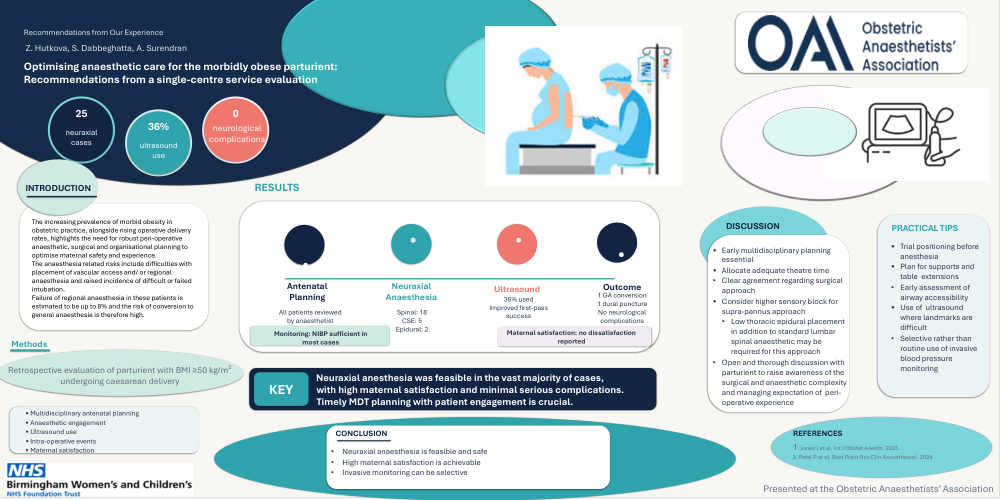
Optimising anaesthetic care for the morbidly obese parturient:
Recommendations from a single-centre service evaluation
Authors: Hutkova, S. Dabbeghatta, A. Surendran
Introduction:
The increasing prevalence of morbid obesity in obstetric practice, alongside rising operative delivery rates, highlights the need for robust peri-operative anaesthetic, surgical and organisational planning to optimise maternal safety and experience.
The anaesthesia related risks include difficulties with placement of vascular access and/ or regional anaesthesia and raised incidence of difficult or failed intubation.
Failure of regional anaesthesia in these patients is estimated to be up to 8% and the risk of conversion to general anaesthesia is therefore high.
Methrods:
Retrospective evaluation of parturient with BMI ≥50 kg/m²
undergoing caesarean delivery
• Multidisciplinary antenatal planning
• Anaesthetic engagement
• Ultrasound use
• Intra-operative events
• Maternal satisfaction
Results:
Antenatal Planning: All patients reviewed by anaesthetist
Neuraxial Anaesthesia: Spinal: 18, CSE: 5, Epidural: 2
Ultrasound: 36% used, Improved first-pass success
Outcome: 1 GA conversion, 1 dural puncture, No neurological complications
Maternal satisfaction: no dissatisfaction reported
Monitoring: NIBP sufficient in most cases
Key: Neuraxial anesthesia was feasible in the vast majority of cases with high maternal satisfaction and minimal serious complications. Timely MDT planning with patient engagement is crucial.
Conclusion:
• Early multidisciplinary planning essential
• Allocate adequate theatre time
• Consider higher sensory block for supra-pannus approach
• Trial positioning before anesthesia
• Plan for supports and table extensions
• Use of ultrasound where landmarks are difficult
1. Jones J et al. Int J Obstet Anesth. 2025
2. Patel P et al. Best Pract Res Clin Anaesthesiol. 2024