226 posters, 5 topics, 20 sessions, 599 authors, 292 institutions
ePostersLive by SciGen Technologies S.A. All rights reserved.
Obstetric Anaesthesia Annual Scientific Meeting 2026
14-15 May 2026 | Liverpool Convention Centre

7126539
Are enhanced recovery principles now embedded in standard practice for elective caesarean sections?
Poster Presenter
Part of Topic
Service Evaluation
Introduction:
Enhanced recovery after surgery (ERAS) has existed as a concept since the 1990s. Initially utilised in colorectal surgery, it has since been adopted by many surgical specialties, obstetrics included. The key principle of ERAS is to optimise pre, intra and post-operative care to improve the quality and speed of recovery in surgical patients.1 ERAS has been shown to have multiple benefits such as reducing length of stay in hospital, improving patient satisfaction, enabling a faster return to normal activities and reducing postoperative pain. These positives also bring significant economic advantages.2
We performed a service evaluation of elective lower segment caesarean sections (LSCS) at a London tertiary centre to see if enhanced recovery principles commonly feature in daily practice for planned caesarean deliveries.
Methods:
A “gold standard” for the intraoperative management of elective caesarean sections was devised using a combination of enhanced recovery for LSCS guidelines from the USA, Canada and the UK. Sources used included: Enhanced Recovery Canada3, the American Journal of Obstetric and Gynecology4, the Society for Obstetric Anaesthesiology and Perinatology5 and BJA Education6.
The final ERAS checklist consisted of 29 care points. 33 elective LSCS cases were observed from May 29th to June 18th 2025 to assess compliance with this checklist. We also measured the time from delivery to the time of skin-to-skin contact with the mother.
Results:
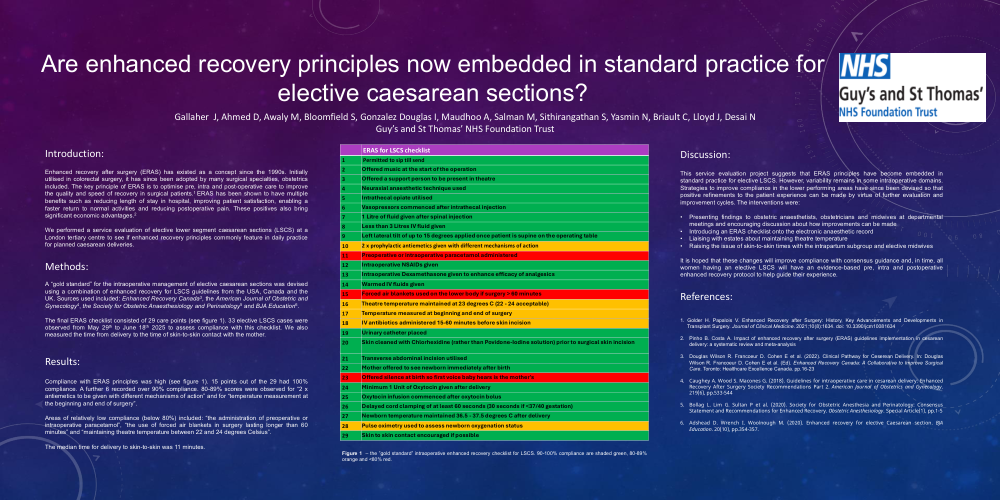
Compliance with ERAS principles was high. 15 points out of the 29 had 100% compliance. A further 6 recorded over 90% compliance. 80-89% scores were observed for “2 x antiemetics to be given with different mechanisms of action” and for “temperature measurement at the beginning and end of surgery”.
Areas of relatively low compliance (below 80%) included: “the administration of preoperative or intraoperative paracetamol”, “the use of forced air blankets in surgery lasting longer than 60 minutes” and “maintaining theatre temperature between 22 and 24 degrees Celsius”.
The median time for delivery to skin-to-skin was 11 minutes.
Discussion:
This service evaluation project suggests that ERAS principles have become embedded in standard practice for elective LSCS. However, variability remains in some intraoperative domains. Strategies to improve compliance in the lower performing areas have since been devised so that positive refinements to the patient experience can be made by virtue of further evaluation and improvement cycles. The interventions were:
1. Presenting findings to obstetric anaesthetists, obstetricians and midwives at departmental meetings and encouraging discussion about how improvements can be made
2. Introducing an ERAS checklist onto the electronic anaesthetic record
References:
1. Golder H. Papalois V. Enhanced Recovery after Surgery: History, Key Advancements and Developments in Transplant Surgery. Journal of Clinical Medicine. 2021;10(8):1634. doi: 10.3390/jcm10081634