226 posters, 5 topics, 20 sessions, 599 authors, 292 institutions
ePostersLive by SciGen Technologies S.A. All rights reserved.
Obstetric Anaesthesia Annual Scientific Meeting 2026
14-15 May 2026 | Liverpool Convention Centre

7156639
Reducing blood product wastage in obstetric hemorrhage: findings from two maternity units
Poster Presenter
Authors
Affiliations
Part of Topic
Service Evaluation
Reducing blood product wastage in obstetric haemorrhage: findings from two maternity units
Dr Flora Kormendy, Dr Hirenkumar Tailor
Queens Charlotte`s and Chelsea Hospital, London
Intoduction
Blood product wastage during periods of national shortage is a significant challenge that extends beyond laboratory processes and requires engagement from all clinicians. Major obstetric haemorrhage (MOH) remains a leading cause of maternal morbidity[1], and transfusion practice must balance rapid access to blood products with responsible stewardship. We conducted a service evaluation across two maternity units within Imperial College Healthcare NHS Trust to identify patterns of wastage and consider potential solutions.
The Trust operates across two obstetric sites: St Mary’s Hospital (SMH), which also functions as a major trauma centre, and Queen Charlotte’s and Chelsea Hospital (QCCH), located close to Hammersmith Hospital (HH), a major cardiac centre. Elective surgical activity at HH makes blood product usage more predictable than at SMH.
In 2025, the Trust introduced measures to reduce wastage, including the routine incorporation of fibrinogen concentrate into the major haemorrhage protocol and the discontinuation of automatic defrosting of blood products for Pack 1, Pack 2, and subsequent stages. At QCCH and HH, activation of these packs now requires a direct phone call to the laboratory. At SMH, however, where major trauma takes priority and clarity for laboratory staff is essential, the decision was made to retain automatic pack delivery during major haemorrhage events.
Method
We collaborated with the transfusion laboratories at QCCH and SMH to quantify blood product wastage across the two maternity sites. Data sheets covering the observation period from May 2024 to March 2025 were retrospectively extracted from the obstetric transfusion database and analysed in Excel with approval from the audit department.
After removing duplicate entries, we identified all units recorded as discarded and cross‑checked each case electronically to ensure these were genuinely wasted rather than undocumented returns or transfusions. For selected patients who received multiple transfusions or had discarded units, estimated blood loss (EBL) was also recorded, although EBL was not available for all cases.
All data were subsequently anonymised. The final dataset included unit identifiers, product type, and tracking information such as whether units were transfused, returned, or discarded.
The analysis focused on comparing QCCH and SMH in relation to product handling, recirculation practices, and the impact of incorporating fibrinogen concentrate into the updated major obstetric haemorrhage (MOH) protocol.
Results
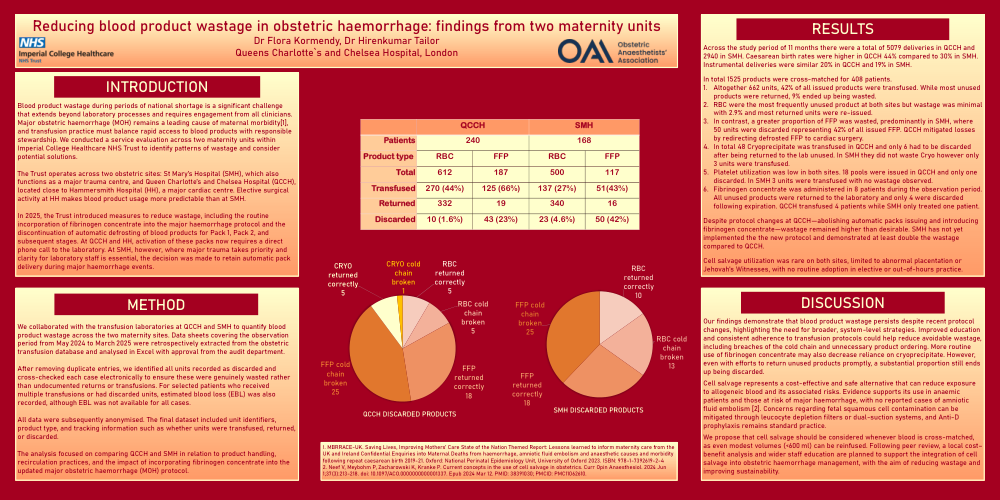
Across the study period of 11 months there were a total of 5079 deliveries in QCCH and 2940 in SMH. Caesarean birth rates were higher in QCCH 44% compared to 30% in SMH. Instrumental deliveries were similar 20% in QCCH and 19% in SMH.
In total 1525 products were cross-matched for 408 patients.
Cell salvage utilization was rare on both sites, limited to abnormal placentation or Jehovah’s Witnesses, with no routine adoption in elective or out-of-hours practice.
Discussion
Our findings demonstrate that blood product wastage persists despite recent protocol changes, highlighting the need for broader, system‑level strategies. Improved education and consistent adherence to transfusion protocols could help reduce avoidable wastage, including breaches of the cold chain and unnecessary product ordering. More routine use of fibrinogen concentrate may also decrease reliance on cryoprecipitate. However, even with efforts to return unused products promptly, a substantial proportion still ends up being discarded.
Cell salvage represents a cost‑effective and safe alternative that can reduce exposure to allogeneic blood and its associated risks. Evidence supports its use in anaemic patients and those at risk of major haemorrhage, with no reported cases of amniotic fluid embolism [2]. Concerns regarding fetal squamous cell contamination can be mitigated through leucocyte depletion filters or dual‑suction systems, and Anti‑D prophylaxis remains standard practice.
We propose that cell salvage should be considered whenever blood is cross‑matched, as even modest volumes (<600 ml) can be reinfused. Following peer review, a local cost–benefit analysis and wider staff education are planned to support the integration of cell salvage into obstetric haemorrhage management, with the aim of reducing wastage and improving sustainability.