226 posters, 5 topics, 20 sessions, 599 authors, 292 institutions
ePostersLive by SciGen Technologies S.A. All rights reserved.
Obstetric Anaesthesia Annual Scientific Meeting 2026
14-15 May 2026 | Liverpool Convention Centre

7147049
Investigating equity of provision of labour epidural analgesia using the K2 Athena system
Poster Presenter
Part of Topic
Service Evaluation
Investigating equity of labour epidural analgesia uptake across ethnicity and Index of Multiple Deprivation (IMD).
W. Weatherhead, M. Simpson, J. Roddy, C. Thomas. St James University Hospital, Leeds Teaching Hospitals NHS Trust, Leeds, UK.
Introduction
•8500 labouring women give birth annually at Leeds Teaching Hospitals NHS Trust (LTHT).
•Research has shown that provision of labour epidural analgesia (LEA) may not be equitable (1)
•MBRRACE highlighted inequities in maternal mortality for black, older or more socio-economically deprived women (2).
•This project will investigate differences in provision of LEA.
Methods
•Data for women labouring in LTHT between April 2022 and March 2025 were collated via a Patient Level Information and Costing System (PLICS) analyser tool.
•Filters were added to assess parity and LEA.
•The Index of Multiple deprivation (IMD) was used to assess socio-economic deprivation.
Results
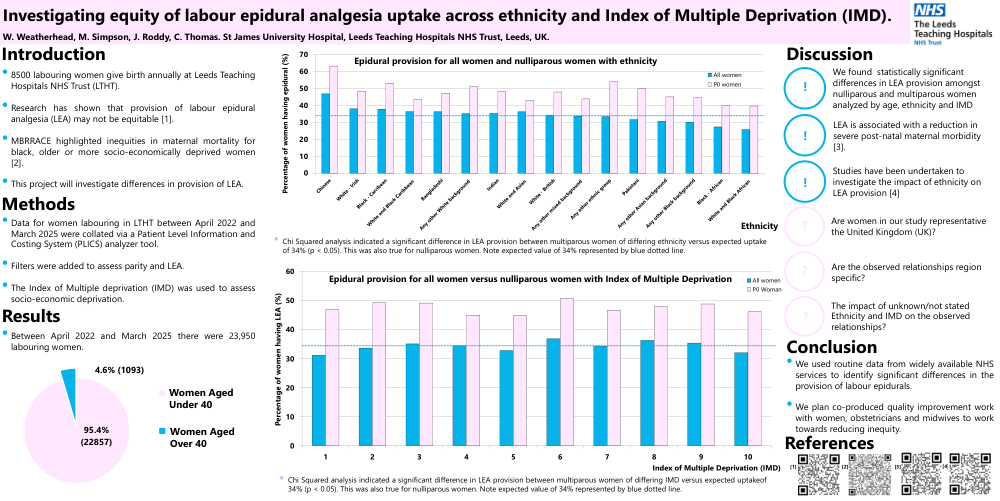
•Between April 2022 and March 2025 there were 23,950 labouring women.
Discussion
•We found statistically significant differences in LEA provision amongst nulliparous and multiparous women analysed by age, ethnicity and IMD
•LEA is associated with a reduction in severe post-natal maternal morbidity (3).
•Studies have been undertaken to investigate the impact of ethnicity on LEA provision [4]
•Are women in our study representative the United Kingdom (UK)?
•Are the observed relationships region specific?
•The impact of unknown/not stated Ethnicity and IMD on the observed relationships?
Conclusion
•We used routine data from widely available NHS services to identify significant differences in the provision of labour epidurals.
•We plan co-produced quality improvement work with women, obstetricians and midwives to work towards reducing inequity.