226 posters, 5 topics, 20 sessions, 599 authors, 292 institutions
ePostersLive by SciGen Technologies S.A. All rights reserved.
Obstetric Anaesthesia Annual Scientific Meeting 2026
14-15 May 2026 | Liverpool Convention Centre

7163795
Postnatal anaesthetic clinic: representation of attenders by age, ethnicity and deprivation
Poster Presenter
Authors
Affiliations
Part of Topic
Service Evaluation
Postnatal anaesthetic clinic: representation of attenders by age, ethnicity and deprivation
Toby Culling, Alison Tucker, Matt Turner
Department of Anaesthesia, Aneurin Bevan University Health Board, Wales, UK
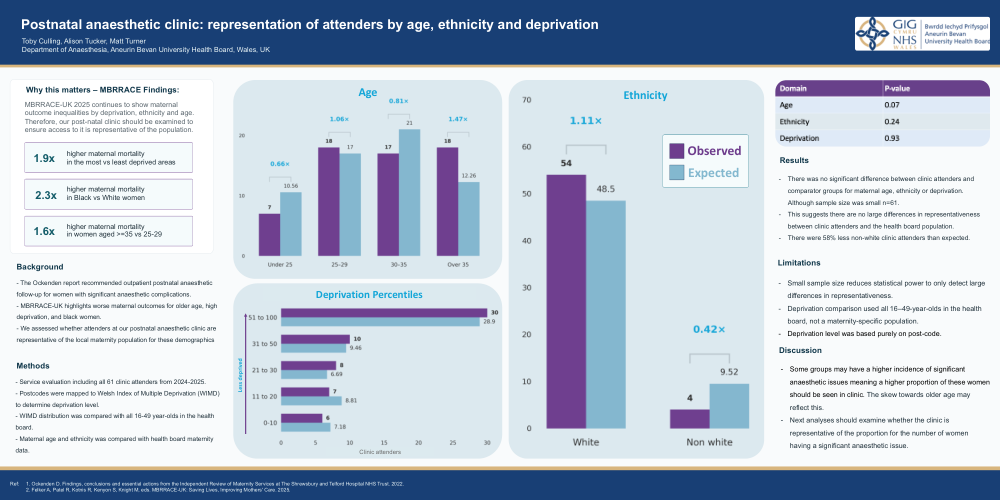
Why this matters – MBRRACE Findings: MBRRACE-UK 2025 continues to show maternal outcome inequalities by deprivation, ethnicity and age. Therefore, our post-natal clinic should be examined to ensure access to it is representative of the population. 1.9× higher maternal mortality in the most vs least deprived areas. 2.3× higher maternal mortality in Black vs White women. 1.6× higher maternal mortality in women aged ≥35 vs 25–29.
Background: The Ockenden report recommended outpatient postnatal anaesthetic follow-up for women with significant anaesthetic complications. MBRRACE-UK highlights worse maternal outcomes for older age, high deprivation, and Black women. We assessed whether attenders at our postnatal anaesthetic clinic are representative of the local maternity population for these demographics.
Methods: Service evaluation including all 61 clinic attenders from 2024–2025. Postcodes were mapped to Welsh Index of Multiple Deprivation (WIMD) to determine deprivation level. WIMD distribution was compared with all 16–49 year-olds in the health board. Maternal age and ethnicity were compared with health board maternity data.
Results: Domain P-value: Age 0.07, Ethnicity 0.24, Deprivation 0.93. There was no significant difference between clinic attenders and comparator groups for maternal age, ethnicity or deprivation, although sample size was small (n=61). This suggests there are no large differences in representativeness between clinic attenders and the health board population. There were 58% less non-white clinic attenders than expected.
Limitations: Small sample size reduces statistical power to only detect large differences in representativeness. Deprivation comparison used all 16–49-year-olds in the health board, not a maternity-specific population. Deprivation level was based purely on postcode.
Discussion: Some groups may have a higher incidence of significant anaesthetic issues meaning a higher proportion of these women should be seen in clinic. The skew towards older age may reflect this. Next analyses should examine whether the clinic is representative of the proportion for the number of women having a significant anaesthetic issue.
References: 1. Ockenden D. Findings, conclusions and essential actions from the Independent Review of Maternity Services at The Shrewsbury and Telford Hospital NHS Trust. 2022. 2. Felker A, Patel R, Kotnis R, Kenyon S, Knight M, eds. MBRRACE-UK: Saving Lives, Improving Mothers’ Care. 2025.
Work undertaken in Aneurin Bevan Health Board (NHS wales)