226 posters, 5 topics, 20 sessions, 599 authors, 292 institutions
ePostersLive by SciGen Technologies S.A. All rights reserved.
Obstetric Anaesthesia Annual Scientific Meeting 2026
14-15 May 2026 | Liverpool Convention Centre

7163792
Epidural needle sizes in the UK and the rest of the world
Poster Presenter
Part of Topic
Service Evaluation
EPIDURAL NEEDLES SIZES IN THE UK AND REST OF THE WORLD
Fooks P, Harrison J, Luther D
Introduction
Aim
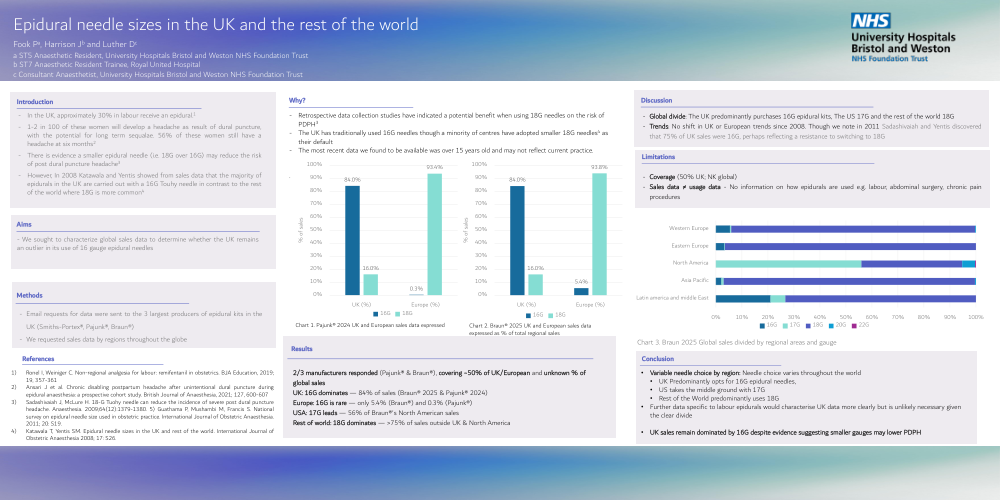
We sought to characterize up to date global sales data to determine whether the UK remains an outlier in its use of 16 gauge epidural needles
Why
Retrospective data collection studies have indicated a potential benefit when using 18G needles on the risk of PDPH3. The UK has traditionally used 16G needles though a minority of centres have adopted smaller 18G needles4 as their default. The most recent data we found to be available was over 15 years old and may not reflect current practice.
Methods
Methods-Email requests for data were sent to the 3 largest producers of epidural kits in the UK (Smiths-Portex®, Pajunk®, Braun®)-We requested sales data by regions throughout the globe
Results
2/3 manufacturers responded (Pajunk® & Braun®), covering ~50% of UK/European and ~25% of global sales UK: 1
6G dominates — 84% of sales (Braun® 2025 & Pajunk® 2024)
Europe: 16G is rare — only 5.4% (Braun®) and 0.3% (Pajunk®)
USA: 17G leads — 56% of Braun®'s North American sales
Rest of world: 18G dominates — >75% of sales outside UK & North America
Discussion
Global divide: The UK predominantly purchases 16G epidural kits, The US 17G and the rest of the world 18G
Trends: No shift in UK or European trends since 2008. Though we note in 2011 Sadashivaiah and Yentis discovered that 75% of UK sales were 16G, perhaps reflecting a resistance to switching to 18G
Limitations included limtied coverage (50% UK/25% global). Also, Sales data ≠ usage data - No information on how epidurals are used e.g. labour, abdominal surgery, chronic pain procedures
Conclusion
• Variable needle choice by region: Needle choice varies throughout the world
• UK Predominantly opts for 16G epidural needles,
• US takes the middle ground with 17G
• Rest of the World predominantly uses 18G
• Further data specific to labour epidurals would characterise UK data more clearly but is unlikely necessary given the clear divide
• UK sales remain dominated by 16G despite evidence suggesting smaller gauges may lower PDPH
References