226 posters, 5 topics, 20 sessions, 599 authors, 292 institutions
ePostersLive by SciGen Technologies S.A. All rights reserved.
Obstetric Anaesthesia Annual Scientific Meeting 2026
14-15 May 2026 | Liverpool Convention Centre

7162605
Maternal Enhanced and Critical Care (MEaCC): Postpartum haemorrhage (PPH) data analysis for 2525 women to inform Maternal Care Bundle implementation
Poster Presenter
Authors
Ben Soni, Laura Garden, Kayley Ciesla, Viv Dolby, Deborah Horner
Affiliations
Bradford Teaching Hospitals NHS Foundation Trust, MEaCC Programme Manager, Bradford Institute for Health Research, Maternal Enhanced and Critical Care (MEaCC) Project Audit Lead, Improvement Academy, Bradford Institute for Health Research, Consultant in Anaesthesia and Critical Care, MEaCC Steering group Chair, Bradford Teaching Hospitals NHS Foundation Trust
Part of Topic
Service Evaluation
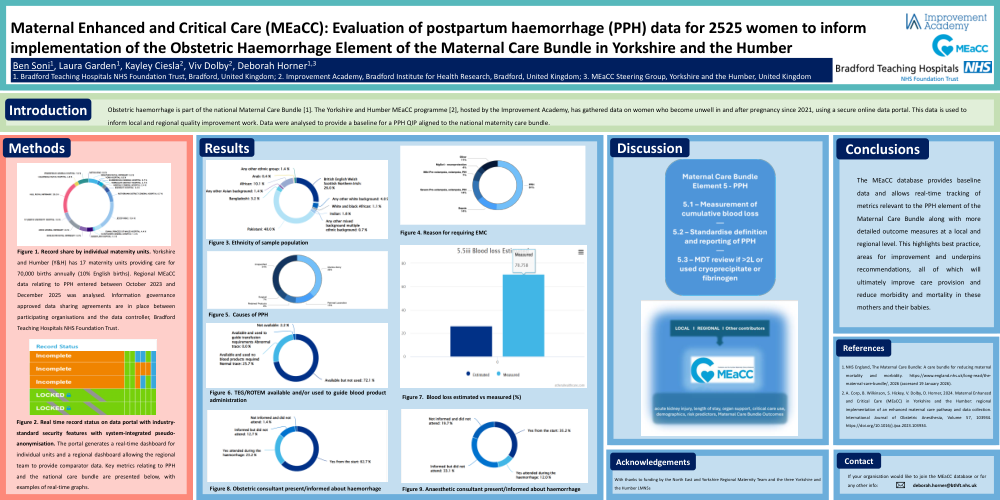
Maternal Enhanced and Critical Care (MEaCC): Evaluation of postpartum haemorrhage (PPH) data for 2525 women to inform implementation of the Obstetric Haemorrhage Element of the Maternal Care Bundle in Yorkshire and the Humber
Introduction
Obstetric haemorrhage is part of the national Maternal Care Bundle [1]. The Yorkshire and Humber MEaCC programme [2], hosted by the Improvement Academy, has gathered data on women who become unwell in and after pregnancy since 2021, using a secure online data portal. This data is used to inform local and regional quality improvement work. Data were analysed to provide a baseline for a PPH QIP aligned to the national maternity care bundle.
Methods
Figure 1. Record share by individual maternity units. Yorkshire and Humber (Y&H) has 17 maternity units providing care for 70,000 births annually (10% English births). Regional MEaCC data relating to PPH entered between October 2023 and December 2025 was analysed. Information governance approved data sharing agreements are in place between participating organisations and the data controller, Bradford Teaching Hospitals NHS Foundation Trust.
Figure 2. Real time record status on data portal with industry-standard security features with system-integrated pseudo-anonymisation. The portal generates a real-time dashboard for individual units and a regional dashboard allowing the regional team to provide comparator data. Key metrics relating to PPH and the national care bundle are presented below, with examples of real-time graphs.
Conclusions
The MEaCC database provides baseline data and allows real-time tracking of metrics relevant to the PPH element of the Maternal Care Bundle along with more detailed outcome measures at a local and regional level. This highlights best practice, areas for improvement and underpins recommendations, all of which will ultimately improve care provision and reduce morbidity and mortality in these mothers and their babies.
References