226 posters, 5 topics, 20 sessions, 599 authors, 292 institutions
ePostersLive by SciGen Technologies S.A. All rights reserved.
Obstetric Anaesthesia Annual Scientific Meeting 2026
14-15 May 2026 | Liverpool Convention Centre

7160865
Association between anaesthetic technique and postoperative pain following lower segment caesarean section for Placenta Accreta Spectrum Disorder
Poster Presenter
Authors
Affiliations
Part of Topic
Service Evaluation
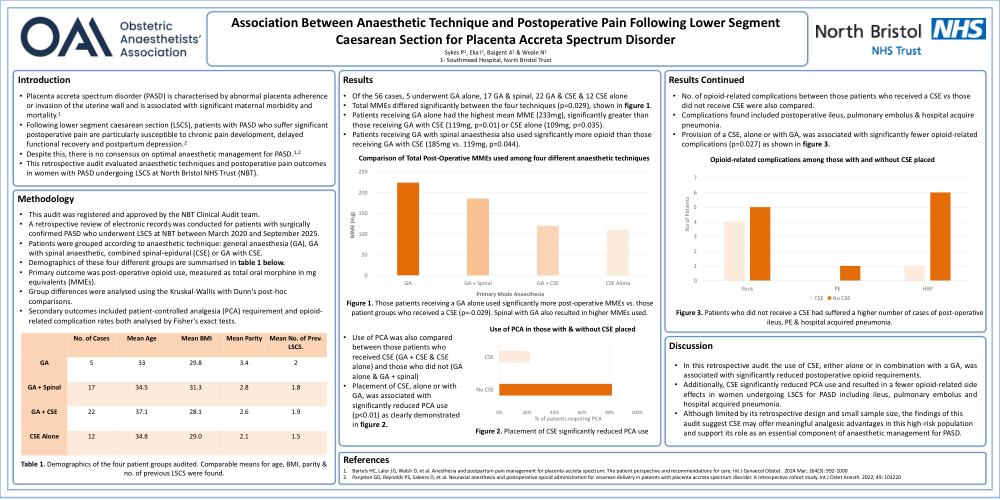
Association Between Anaesthetic Technique and Postoperative Pain Following Lower Segment Caesarean Section for Placenta Accreta Spectrum Disorder
Sykes P, Eka I, Baigent A, Weale N.
Introduction:
•Placenta accreta spectrum disorder (PASD) is characterised by abnormal placenta adherence or invasion of the uterine wall and is associated with significant maternal morbidity and mortality.1
•Following lower segment caesarean section (LSCS), patients with PASD who suffer significant postoperative pain are particularly susceptible to chronic pain development, delayed functional recovery and postpartum depression.2
•Despite this, there is no consensus on optimal anaesthetic management for PASD.1,2
•This retrospective audit evaluated anaesthetic techniques and postoperative pain outcomes in women with PASD undergoing LSCS at North Bristol NHS Trust (NBT).
Methodology:
•This audit was registered and approved by the NBT Clinical Audit team.
•A retrospective review of electronic records was conducted for patients with surgically confirmed PASD who underwent LSCS at NBT between March 2020 and September 2025.
•Patients were grouped according to anaesthetic technique: general anaesthesia (GA), GA with spinal anaesthetic, combined spinal-epidural (CSE) or GA with CSE.
•Demographics of these four different groups are summarised in table 1 below.
•Primary outcome was post-operative opioid use, measured as total oral morphine in mg equivalents (MMEs).
•Group differences were analysed using the Kruskal-Wallis with Dunn's post-hoc comparisons.
•Secondary outcomes included patient-controlled analgesia (PCA) requirement and opioid-related complication rates both analysed by Fisher's exact tests.
Results:
•Of the 56 cases, 5 underwent GA alone, 17 GA & spinal, 22 GA & CSE & 12 CSE alone
•Total MMEs differed significantly between the four techniques (p=0.029), shown in figure 1.
•Patients receiving GA alone had the highest mean MME (233mg), significantly greater than those receiving GA with CSE (119mg, p=0.01) or CSE alone (109mg, p=0.035).
•Patients receiving GA with spinal anaesthesia also used significantly more opioid than those receiving GA with CSE (185mg vs. 119mg, p=0.044).
•Use of PCA was also compared between those patients who received CSE (GA + CSE & CSE alone) and those who did not (GA alone & GA + spinal)
•Placement of CSE, alone or with GA, was associated with significantly reduced PCA use (p<0.01) as clearly demonstrated in figure 2.
•No. of opioid-related complications between those patients who received a CSE vs those did not receive CSE were also compared.
•Complications found included postoperative ileus, pulmonary embolus & hospital acquire pneumonia.
•Provision of a CSE, alone or with GA, was associated with significantly fewer opioid-related complications (p=0.027) as shown in figure 3.
Discussion:
•In this retrospective audit the use of CSE, either alone or in combination with a GA, was associated with significantly reduced postoperative opioid requirements.
•Additionally, CSE significantly reduced PCA use and resulted in a fewer opioid-related side effects in women undergoing LSCS for PASD including ileus, pulmonary embolus and hospital acquired pneumonia.
•Although limited by its retrospective design and small sample size, the findings of this audit suggest CSE may offer meaningful analgesic advantages in this high-risk population and support its role as an essential component of anaesthetic management for PASD.