226 posters, 5 topics, 20 sessions, 599 authors, 292 institutions
ePostersLive by SciGen Technologies S.A. All rights reserved.
Obstetric Anaesthesia Annual Scientific Meeting 2026
14-15 May 2026 | Liverpool Convention Centre

7160723
Ethnic variations in the utilisation of remifentanil patient-controlled analgesia and epidural analgesia during labour
Poster Presenter
Authors
Affiliations
Part of Topic
Service Evaluation
Introduction
Epidural analgesia and Remifentanil patient-controlled analgesia (PCA) are frequently used for labour analgesia. While ethnic variation in epidural use is well reported,1 comparative data for Remifentanil PCA are lacking.
Method
The electronic patient record system was searched to find all delivery records between 1st September 2022 to 1st January 2026 across 3 Manchester hospitals.
Delivery records with labour epidurals and Remifentanil PCA were included.
The patients' ethnicity as recorded was split into 5 ethnic groups as per 2021 census
The rates of labour epidurals and Remifentanil PCA were collected.
The data was analysed using chi-square for independence and logistic regression to estimate the odds ratio and 95% confidence intervals using white ethnicity as reference.
Statistical significance was defined at p<0.05.
Key results
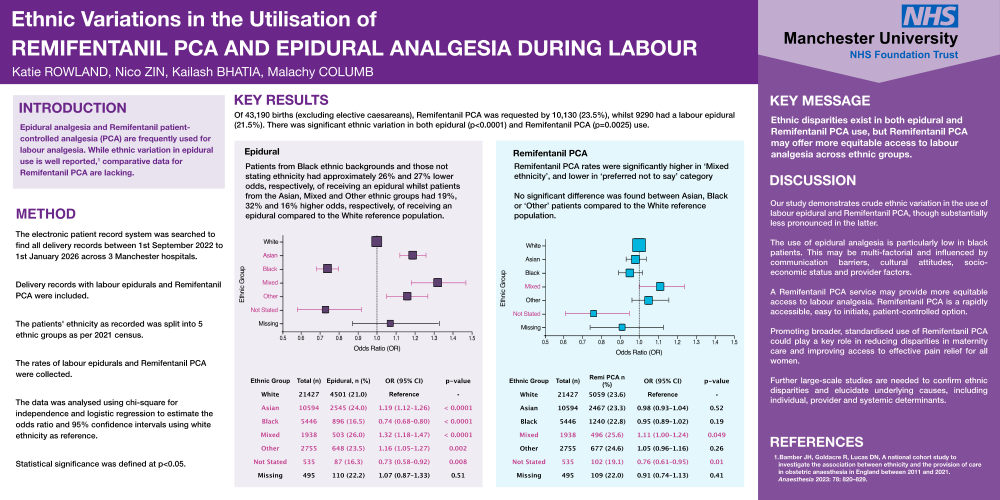
Of 43,190 births (excluding elective caesareans), Remifentanil PCA was requested by 10,130 (23.5%), whilst 9290 had a labour epidural (21.5%). There was significant ethnic variation in both epidural (p<0.0001) and Remifentanil PCA (p=0.0025) use.
Epidural
Patients from Black ethnic backgrounds and those not stating ethnicity had approximately 26% and 27% lower odds, respectively, of receiving an epidural whilst patients from the Asian, Mixed and Other ethnic groups had 19%, 32% and 16% higher odds, respectively, of receiving an epidural compared to the White reference population.
Remifentanil PCA
Remifentanil PCA rates were significantly higher in ‘Mixed ethnicity’, and lower in ‘preferred not to say’ category
No significant difference was found between Asian, Black or ‘Other’ patients compared to the White reference population.
Discussion
Our study demonstrates crude ethnic variation in the use of labour epidural and Remifentanil PCA, though substantially less pronounced in the latter.
The use of epidural analgesia is particularly low in black patients. This may be multi-factorial and influenced by communication barriers, cultural attitudes, socioeconomic status and provider factors.
A Remifentanil PCA service may provide more equitable access to labour analgesia. Remifentanil PCA is a rapidly accessible, easy to initiate, patient-controlled option.
Promoting broader, standardized use of Remifentanil PCA could play a key role in reducing disparities in maternity care and improving access to effective pain relief for all women.
Further large-scale studies are needed to confirm ethnic disparities and elucidate underlying causes, including individual, provider and systemic determinants
Key Message
Ethnic disparities exist in both epidural and Remifentanil PCA use, but Remifentanil PCA may offer more equitable access to labour analgesia across ethnic groups.