226 posters, 5 topics, 20 sessions, 599 authors, 292 institutions
ePostersLive by SciGen Technologies S.A. All rights reserved.
Obstetric Anaesthesia Annual Scientific Meeting 2026
14-15 May 2026 | Liverpool Convention Centre

7159661
Evaluation of current cell salvage use in obstetric theatres at Liverpool Women's Hospital
Poster Presenter
Authors
Affiliations
Part of Topic
Service Evaluation
Background
Obstetric haemorrhage is is responsible for 27% of maternal deaths globally and remains a significant cause of maternal morbidity in the UK (1). Intraoperative cell salvage provides immediate autologous transfusion, reduces exposure to allogenic blood, and is particularly valuable where access to blood products may be delayed. There have been concerns regarding safety of cell salvage in obstetrics due to risk of contamination with amniotic fluid. ASA guidelines do not recommend routine use in obstetrics due to lack of evidence, but Guidelines vary between hospital trusts (2). Cell salvage is routinely used at LWH, this service evaluation aimed to provide a snapshot of current use.
Aims and Objectives
Aim: Evaluate the current use of cell salvage in obstetric theatres, specifically addressing the following objectives:
- To analyse volumes and haematocrit of salvaged blood
- To assess consistency of documentation
- To explore additional factors that influence the quantity and quality of salvaged blood
Methods
A retrospective service evaluation was conducted. Theatre records were reviewed to assess documentation completeness and collect data on: estimated blood loss, reinfused red blood cell volume, haematocrit, swab wash volume used, use of leucocyte depletion filters. Data were anonymised and analysed using descriptive statistics. Approval was obtained from the Trust Audit department.
Results
Overall
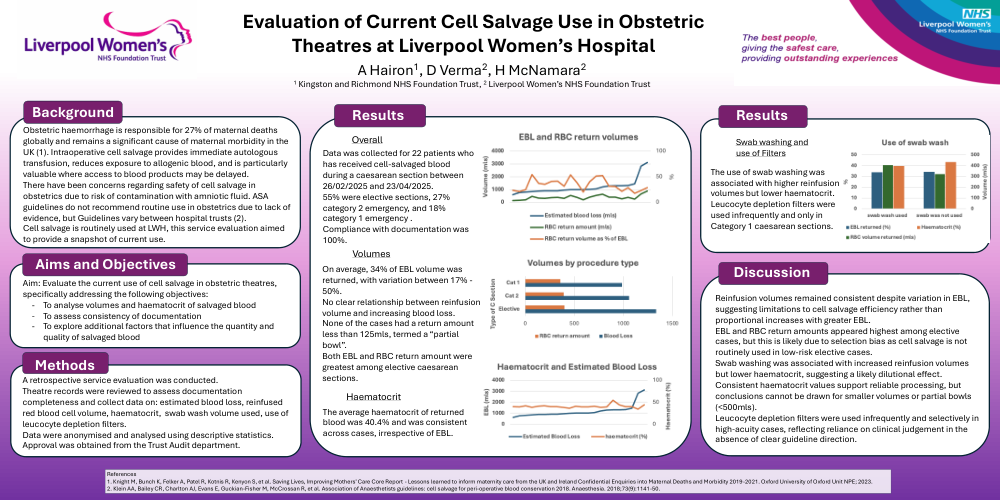
Data was collected for 22 patients who has received cell-salvaged blood during a caesarean section between 26/02/2025 and 23/04/2025. 55% were elective sections, 27% category 2 emergency, and 18% category 1 emergency. Compliance with documentation was 100%.
Volumes
On average, 34% of EBL volume was returned, with variation between 17% - 50%. No clear relationship between reinfusion volume and increasing blood loss. None of the cases had a return amount less than 125mls, termed a “partial bowl”. Both EBL and RBC return amount were greatest among elective caesarean sections.
Haematocrit
The average haematocrit of returned blood was 40.4% and was consistent across cases, irrespective of EBL.
Swab washing and use of filters
The use of swab washing was associated with higher reinfusion volumes but lower haematocrit. Leucocyte depletion filters were used infrequently and only in Category 1 caesarean sections.
Discussion
Reinfusion volumes remained consistent despite variation in EBL, suggesting limitations to cell salvage efficiency rather than proportional increases with greater EBL. EBL and RBC return amounts appeared highest among elective cases, but this is likely due to selection bias as cell salvage is not routinely used in low-risk elective cases. Swab washing was associated with increased reinfusion volumes but lower haematocrit, suggesting a likely dilutional effect. Consistent haematocrit values support reliable processing, but conclusions cannot be drawn for smaller volumes or partial bowls (<500mls). Leucocyte depletion filters were used infrequently and selectively in high-acuity cases, reflecting reliance on clinical judgement in the absence of clear guideline direction.
References
1. Knight M, Bunch K, Felker A, Patel R, Kotnis R, Kenyon S, et al. Saving Lives, Improving Mothers’ Care Core Report - Lessons learned to inform maternity care from the UK and Ireland Confidential Enquiries into Maternal Deaths and Morbidity 2019-2021. Oxford University of Oxford Unit NPE; 2023.
2. Klein AA, Bailey CR, Charlton AJ, Evans E, Guckian-Fisher M, McCrossan R, et al. Association of Anaesthetists guidelines: cell salvage for peri-operative blood conservation 2018. Anaesthesia. 2018;73(9):1141-50.