226 posters, 5 topics, 20 sessions, 599 authors, 292 institutions
ePostersLive by SciGen Technologies S.A. All rights reserved.
Obstetric Anaesthesia Annual Scientific Meeting 2026
14-15 May 2026 | Liverpool Convention Centre

7158306
Major trauma in pregnancy: a three-year case review at a Scottish major trauma centre
Poster Presenter
Part of Topic
Service Evaluation
Introduction
Major trauma in pregnancy demands adherence to standard trauma protocols alongside pregnancy-specific adaptations.1 Mismanagement can occur as a failure to modify care appropriately, or inappropriate deviation from established practice.2 Pregnant people face a 1.6-fold increased mortality risk after major trauma compared to non-pregnant people1, yet the condition is rare enough that trauma teams rarely develop sustained expertise. In the UK, approximately 1% of female major trauma patients are pregnant. We reviewed all relevant cases at our centre to characterise current practice and identify opportunities for improvement.
Methods
We interrogated the Scottish Trauma Audit Group (STAG) database for pregnant patients presenting to our Major Trauma Centre (January 2018-December 2025). STAG captures patients with stays ≥3 days, critical care admissions, or deaths following trauma. Case notes, imaging, and documentation were reviewed against published guidelines.2 Written consent was obtained where possible and Caldicott approval granted for uncontactable patients.
Results
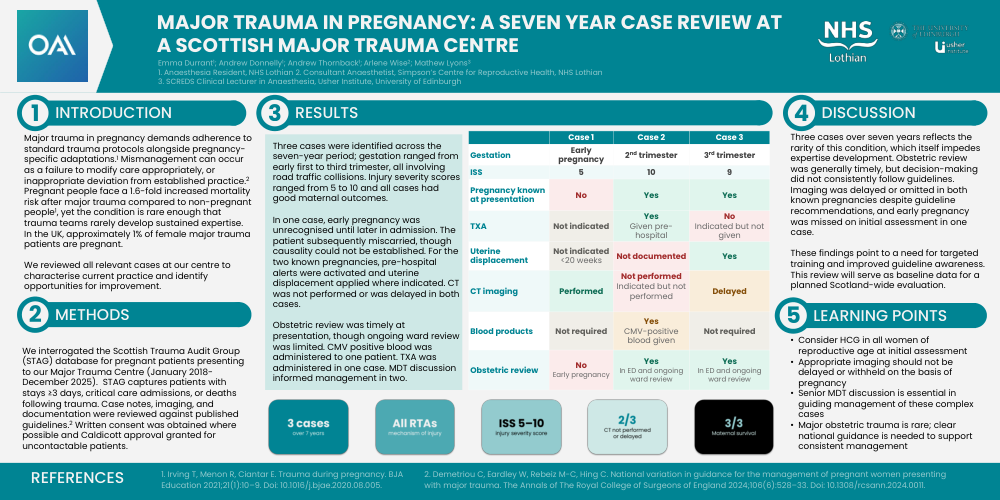
Three cases were identified across the seven-year period; gestation ranged from early first to third trimester, all involving road traffic collisions. Injury severity scores ranged from 5 to 10 and all cases had good maternal outcomes. In one case, early pregnancy was unrecognised until later in admission. The patient subsequently miscarried, though causality could not be established. For the two known pregnancies, pre-hospital alerts were activated and uterine displacement applied where indicated. CT was not performed or was delayed in both cases.
Obstetric review was timely at presentation, though ongoing ward review was limited. CMV positive blood was administered to one patient. TXA was administered in one case. MDT discussion informed management in two. Three cases over seven years reflects the rarity of this condition, which itself impedes expertise development. Obstetric review was generally timely, but decision-making did not consistently follow guidelines. Imaging was delayed or omitted in both known pregnancies despite guideline recommendations, and early pregnancy was missed on initial assessment in one case. These findings point to a need for targeted training and improved guideline awareness. This review will serve as baseline data for a planned Scotland-wide evaluation.
Discussion
Three cases over seven years reflects the rarity of this condition, which itself impedes expertise development. Obstetric review was generally timely, but decision-making did not consistently follow guidelines. Imaging was delayed or omitted in both known pregnancies despite guideline recommendations, and early pregnancy was missed on initial assessment in one case. These findings point to a need for targeted training and improved guideline awareness. This review will serve as baseline data for a planned Scotland-wide evaluation.
Learning points