226 posters, 5 topics, 20 sessions, 599 authors, 292 institutions
ePostersLive by SciGen Technologies S.A. All rights reserved.
Obstetric Anaesthesia Annual Scientific Meeting 2026
14-15 May 2026 | Liverpool Convention Centre

7158222
Factors influencing dose escalation of remifentanil patient-controlled analgesia in labour
Poster Presenter
Part of Topic
Service Evaluation
FACTORS INFLUENCING DOSE ESCALATION OF
REMIFENTANIL PCA IN LABOUR
Lindsay DAWSON, Kailash BHATIA, Nico ZIN, Malachy COLUMB
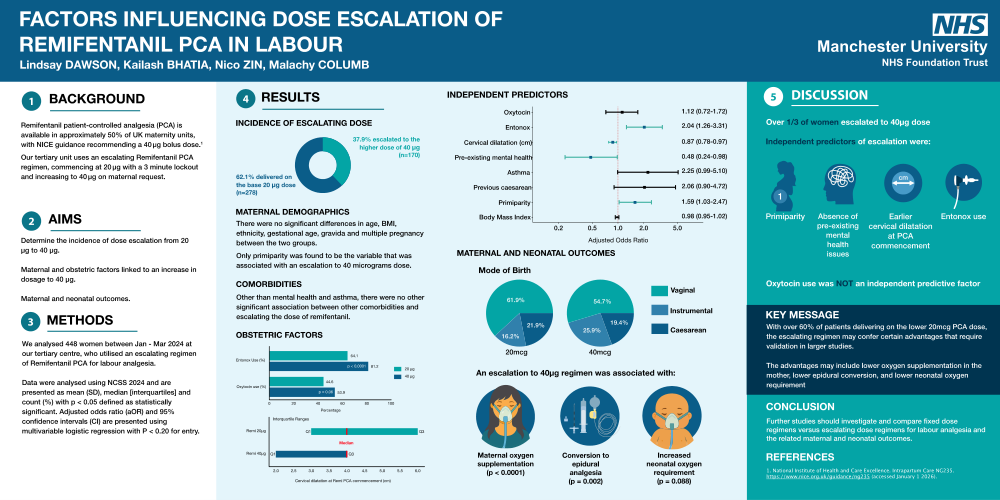
BACKGROUND: Remifentanil patient-controlled analgesia (PCA) is available in approximately 50% of UK maternity units, with NICE guidance recommending a 40 μg bolus dose.1 Our tertiary unit uses an escalating Remifentanil PCA regimen, commencing at 20 μg with a 3 minute lockout and increasing to 40 μg on maternal request.
AIMS: Determine the incidence of dose escalation from 20 μg to 40 μg. Maternal and obstetric factors linked to an increase in dosage to 40 μg. Maternal and neonatal outcomes.
METHODS: We analysed 448 women between Jan - Mar 2024 at our tertiary centre, who utilised an escalating regimen of Remifentanil PCA for labour analgesia. Data were analysed using NCSS 2024 and are presented as mean (SD), median [interquartiles] and count (%) with p < 0.05 defined as statistically significant. Adjusted odds ratio (aOR) and 95% confidence intervals (CI) are presented using multivariable logistic regression with P < 0.20 for entry.
RESULTS: 37.9% escalated to the higher dose of 40 μg (n=170) 62.1% delivered on the base 20 μg dose (n=278)
MATERNAL DEMOGRAPHICS: There were no significant differences in age, BMI, ethnicity, gestational age, gravida and multiple pregnancy between the two groups.
Only primiparity was found to be the variable that was associated with an escalation to 40 micrograms dose.
COMORBIDITIES: Other than mental health and asthma, there were no other significant association between other comorbidities and escalating the dose of remifentanil.
OBSTETRIC FACTORS INCIDENCE OF ESCALATING DOSE: There were no significant differences in age, BMI, ethnicity, gestational age, gravida and multiple pregnancy between the two groups. Only primiparity was found to be the variable that was associated with an escalation to 40 micrograms dose.
MATERNAL AND NEONATAL OUTCOMES: Oxytocin 1.12 (0.72-1.72) 2.04 (1.26-3.31) 0.87 (0.78-0.97) 0.48 (0.24-0.98) 2.25 (0.99-5.10) 2.06 (0.90-4.72) 1.59 (1.03-2.47) 0.98 (0.95-1.02) Entonox Cervical dilatation (cm) Pre-existing mental health Asthma Previous caesarean Primiparity Body Mass Index Adjusted Odds Ratio 0.2 0.5 1.0 2.0 5.0
INDEPENDENT PREDICTORS: 20mcg 61.9% 16.2% 21.9% 40mcg 54.7% 25.9% 19.4% Mode of Birth Vaginal Instrumental Caesarean Increased neonatal oxygen requirement (p = 0.088) Maternal oxygen supplementation (p < 0.0001) Conversion to epidural analgesia (p = 0.002)
An escalation to 40μg regimen was associated with: Maternal oxygen supplementation (p < 0.0001), Conversion to epidural analgesia (p = 0.002), Increased neonatal oxygen requirement (p = 0.088)
DISCUSSION:
Over 1/3 of women escalated to 40μg dose
Independent predictors of escalation were: Absence of pre-existing mental health issues, Primiparity, Earlier cervical dilatation at PCA commencement, Entonox use
Oxytocin use was NOT an independent predictive factor
KEY MESSAGE:
With over 60% of patients delivering on the lower 20mcg PCA dose, the escalating regimen may confer certain advantages that require validation in larger studies.
The advantages may include lower oxygen supplementation in the mother, lower epidural conversion, and lower neonatal oxygen requirement.
CONCLUSION: Further studies should investigate and compare fixed dose regimens versus escalating dose regimens for labour analgesia and the related maternal and neonatal outcomes.
REFERENCES: 1. National Institute of Health and Care Excellence. Intrapartum Care NG235. https://www.nice.org.uk/guidance/ng235 (accessed January 1 2026).