226 posters, 5 topics, 20 sessions, 599 authors, 292 institutions
ePostersLive by SciGen Technologies S.A. All rights reserved.
Obstetric Anaesthesia Annual Scientific Meeting 2026
14-15 May 2026 | Liverpool Convention Centre

7157910
Acute colonic pseudo-obstruction and ileus following caesarean section: a three-year service evaluation
Poster Presenter
Part of Topic
Service Evaluation
Acute colonic pseudo-obstruction and ileus following caesarean section A three-year service evaluation
Julia Critchley, Arlene Wise, Andrew P. Brown, Mathew Lyons
Introduction
Acute colonic pseudo-obstruction (ACPO) and ileus are recognised complications of caesarean birth, with ACPO carrying significant morbidity1,2. Published data suggest ACPO occurs in approximately 1 in 1500 deliveries2. We evaluated the incidence and management of ACPO and ileus in our tertiary obstetric unit.
Methods
We reviewed all cases of ileus and ACPO following caesarean birth over three years (January 2023 to December 2025). Cases were classified by severity and management.
Severe cases were those requiring neostigmine, flatus tube, colonoscopic decompression or surgery.
Results
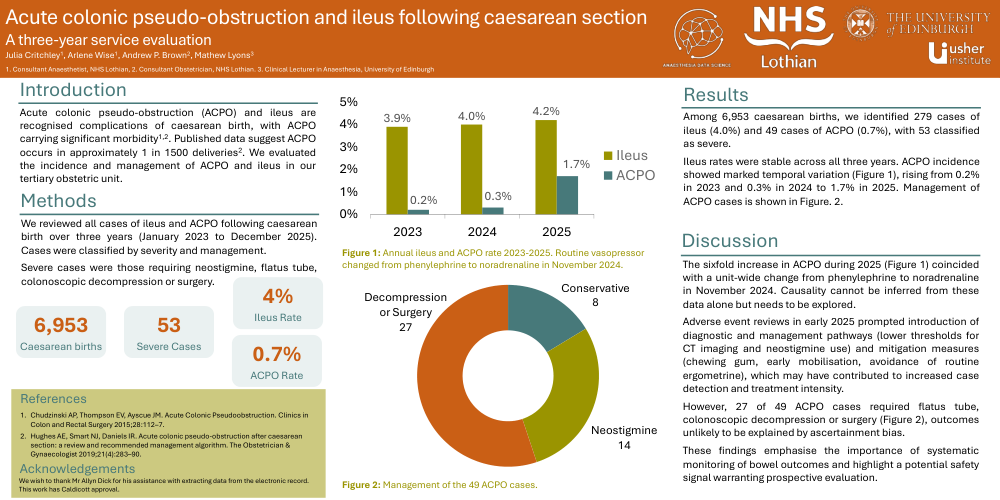
Among 6,953 caesarean births, we identified 279 cases of ileus (4.0%) and 49 cases of ACPO (0.7%), with 53 classified as severe.
Ileus rates were stable across all three years. ACPO incidence showed marked temporal variation (Figure 1), rising from 0.2% in 2023 and 0.3% in 2024 to 1.7% in 2025. Management of ACPO cases is shown in Figure. 2.
Discussion
The sixfold increase in ACPO during 2025 (Figure 1) coincided with a unit-wide change from phenylephrine to noradrenaline in November 2024. Causality cannot be inferred from these data alone but needs to be explored.
Adverse event reviews in early 2025 prompted introduction of diagnostic and management pathways (lower thresholds for CT imaging and neostigmine use) and mitigation measures (chewing gum, early mobilisation, avoidance of routine ergometrine), which may have contributed to increased case detection and treatment intensity.
However, 27 of 49 ACPO cases required flatus tube, colonoscopic decompression or surgery (Figure 2), outcomes unlikely to be explained by ascertainment bias.
These findings emphasise the importance of systematic monitoring of bowel outcomes and highlight a potential safety signal warranting prospective evaluation.