226 posters, 5 topics, 20 sessions, 599 authors, 292 institutions
ePostersLive by SciGen Technologies S.A. All rights reserved.
Obstetric Anaesthesia Annual Scientific Meeting 2026
14-15 May 2026 | Liverpool Convention Centre

7157343
Anaesthetic approach to cervical cerclage: a retrospective service evaluation in a tertiary obstetric centre
Poster Presenter
Authors
Affiliations
Part of Topic
Service Evaluation
Anaesthetic approach to cervical cerclage: a retrospective service evaluation in a tertiary obstetric centre
Introduction
Cervical cerclage is performed to reinforce the cervix and reduce preterm birth risk and second-trimester loss. It is one of the few elective obstetric procedures outside Caesarean section and is undertaken via transvaginal McDonald or Shirodkar techniques. [1] There is limited consensus regarding optimal anaesthetic technique, intrathecal opioid use, and suitability for day-case pathways. National guidance from the Royal College of Obstetricians and Gynaecologists supports both general and regional anaesthesia, with decision-making individualised to the patient. [2]
This service evaluation aimed to assess current anaesthetic practice for cervical cerclage at our tertiary obstetric centre, assess post-operative analgesic requirements, and inform development of a standardised local protocol.
Methods
A retrospective audit was conducted of all cervical cerclage procedures performed at Nottingham City Hospital over a 2-year period. Data were collected from electronic patient records and the theatre management system. All patients undergoing McDonald or Shirodkar cerclage were included.
Variables collected included: anaesthetic technique (i.e. spinal, GA); spinal drug choice; procedure duration; post-operative analgesia requirements; and day-case versus inpatient stay. Data were analysed descriptively to identify patterns in practice and associations with outcomes.
Results
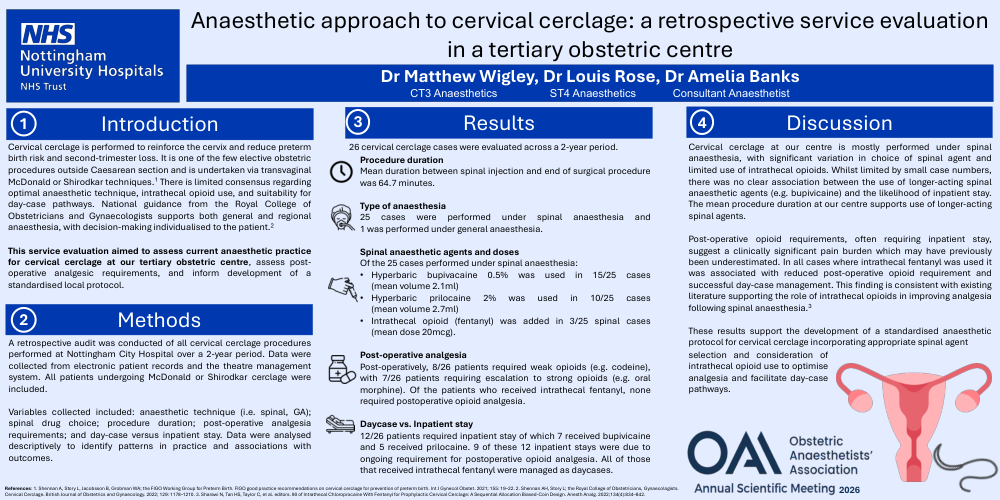
26 cervical cerclage cases were evaluated across a 2-year period.
Procedure duration
Mean duration between spinal injection and end of surgical procedure was 64.7 minutes.
Type of anaesthesia
25 cases were performed under spinal anaesthesia and
1 was performed under general anaesthesia.
Spinal anaesthetic agents and doses
Of the 25 cases performed under spinal anaesthesia:
(mean volume 2.1ml)
(mean volume 2.7ml)
(mean dose 20mcg).
Post-operative analgesia
Post-operatively, 8/26 patients required weak opioids (e.g. codeine), with 7/26 patients requiring escalation to strong opioids (e.g. oral morphine). Of the patients who received intrathecal fentanyl, none required postoperative opioid analgesia.
Daycase vs. Inpatient stay
12/26 patients required inpatient stay of which 7 received bupivicaine and 5 received prilocaine. 9 of these 12 inpatient stays were due to ongoing requirement for postoperative opioid analgesia. All of those that received intrathecal fentanyl were managed as daycases.
Discussion
Cervical cerclage at our centre is mostly performed under spinal anaesthesia, with significant variation in choice of spinal agent and limited use of intrathecal opioids. Whilst limited by small case numbers, there was no clear association between the use of longer-acting spinal anaesthetic agents (e.g. bupivicaine) and the likelihood of inpatient stay. The mean procedure duration at our centre supports use of longer-acting spinal agents.
Post-operative opioid requirements, often requiring inpatient stay, suggest a clinically significant pain burden which may have previously been underestimated. In all cases where intrathecal fentanyl was used it was associated with reduced post-operative opioid requirement and successful day-case management. This finding is consistent with existing literature supporting the role of intrathecal opioids in improving analgesia following spinal anaesthesia. [3]
These results support the development of a standardised anaesthetic protocol for cervical cerclage incorporating appropriate spinal agent selection and consideration of intrathecal opioid use to optimise analgesia and facilitate day-case pathways.
References
1. Shennan A, Story L, Jacobsson B, Grobman WA; the FIGO Working Group for Preterm Birth. FIGO good practice recommendations on cervical cerclage for prevention of preterm birth. Int J Gynecol Obstet. 2021; 155: 19–22. 2. Shennan AH, Story L; the Royal College of Obstetricians, Gynaecologists. Cervical Cerclage. British Journal of Obstetrics and Gynaecology. 2022; 129: 1178–1210. 3. Sharawi N, Tan HS, Taylor C, et al. editors. 90 of Intrathecal Chloroprocaine With Fentanyl for Prophylactic Cervical Cerclage: A Sequential Allocation Biased-Coin Design. Anesth Analg. 2022;134(4):834–842.