586 posters, 8 topics, 23 sessions, 1,077 authors, 622 institutions
ePostersLive by SciGen Technologies S.A. All rights reserved.
ISQua's 40th International Conference 2024
24th - 27th September 2024 | Istanbul, Türkiye

P679
Assessing, measuring and tracking sustainability in healthcare: the potential of the Sustainability Accelerator Tool
Poster Presenter
Part of Topic
Navigating Climate Change and Sustainability in Healthcare System
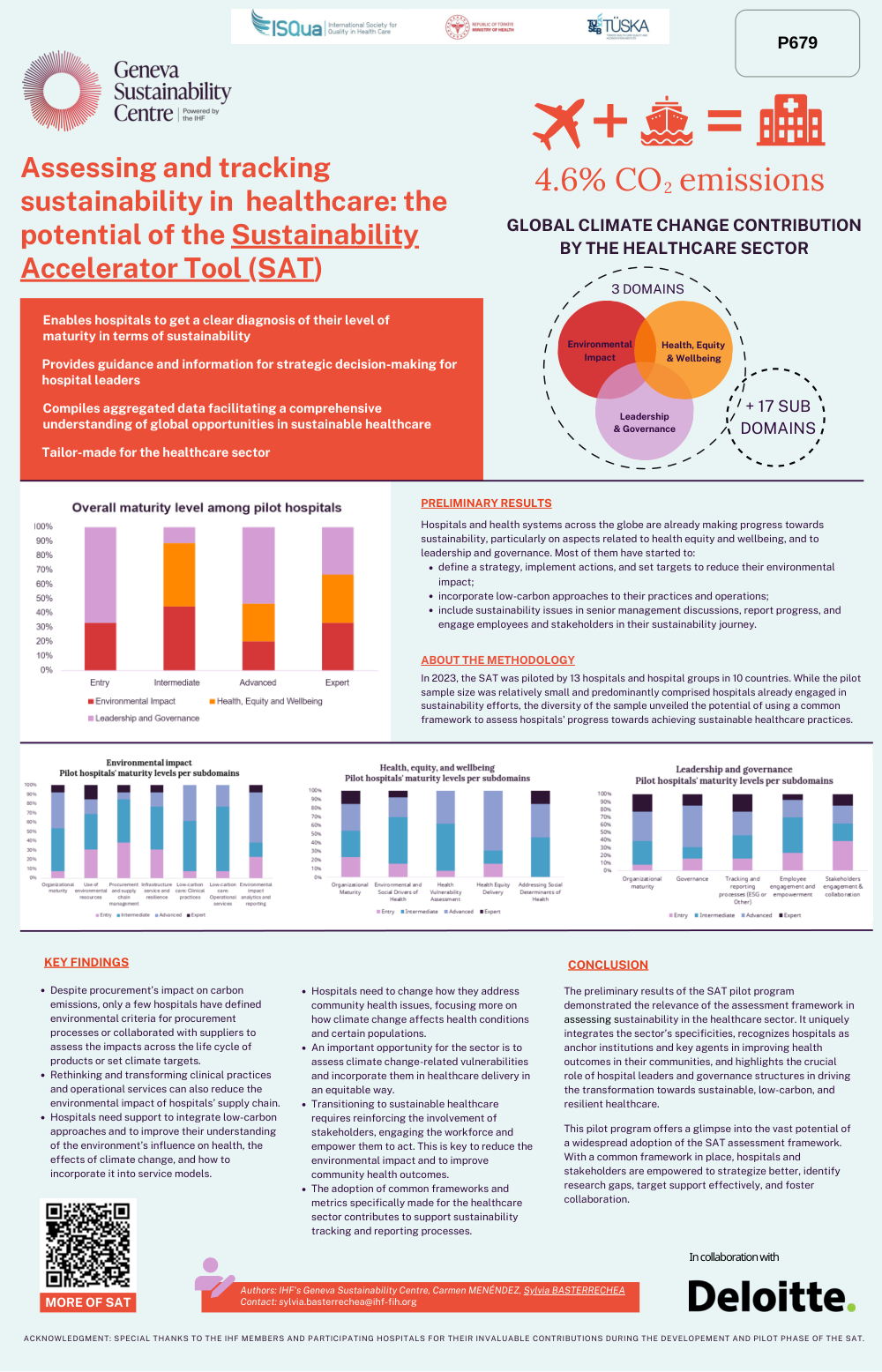
Title: Assessing and tracking sustainability inhealthcare: the potential of the Sustainability Accelerator Tool (SAT)
Preliminary results
Hospitals and health systems across the globe are already making progress towards sustainability, particularly on aspects related to health equity and wellbeing, and to leadership and governance. Most of them have started to:
- define a strategy, implement actions, and set targets to reduce their environmental impact;
- incorporate low-carbon approaches to their practices and operations;
- include sustainability issues in senior management discussions, report progress, and engage employees and stakeholders in their sustainability journey.
ABOUT the METHODOLOGY
In 2023, the SAT was piloted by 13 hospitals and hospital groups in 10 countries. While the pilot sample size was relatively small and predominantly comprised hospitals already engaged in sustainability efforts, the diversity of the sample unveiled the potential of using a common framework to assess hospitals' progress towards achieving sustainable healthcare practices
KEY FINDINGS
- Despite procurement’s impact on carbon emissions, only a few hospitals have defined environmental criteria for procurement processes or collaborated with suppliers to assess the impacts across the life cycle of products or set climate targets.
- Rethinking and transforming clinical practices and operational services can also reduce the environmental impact of hospitals’ supply chain.
- Hospitals need support to integrate low-carbon approaches and to improve their understanding of the environment’s influence on health, the effects of climate change, and how to incorporate it into service models.
- Hospitals need to change how they address community health issues, focusing more on how climate change affects health conditions and certain populations.
- An important opportunity for the sector is to assess climate change-related vulnerabilities and incorporate them in healthcare delivery in an equitable way.
- Transitioning to sustainable healthcare requires reinforcing the involvement of stakeholders, engaging the workforce and empower them to act. This is key to reduce the environmental impact and to improve community health outcomes.
- The adoption of common frameworks and metrics specifically made for the healthcare sector contributes to support sustainability tracking and reporting processes
This pilot program offers a glimpse into the vast potential of a widespread adoption of the SAT assessment framework. With a common framework in place, hospitals and stakeholders are empowered to strategize better, identify research gaps, target support effectively, and foster collaboration.