586 posters, 8 topics, 23 sessions, 1,077 authors, 622 institutions
ePostersLive by SciGen Technologies S.A. All rights reserved.
ISQua's 40th International Conference 2024
24th - 27th September 2024 | Istanbul, Türkiye

P664
Secure and smartly verified e-medical receipts and certificates to encourage patient participation in carbon reduction.
Poster Presenter
Authors
Part of Topic
Navigating Climate Change and Sustainability in Healthcare System
Secure and smartly verified e-medical receipts and certificates to encourage patient participation in carbon reduction.
Introduction
Hospitals can reduce carbon emissions by digitizing medical documents and providing safe and convenient documents that people are willing to use. This study uses secure Hashcode encryption verification technology to produce e-medical receipts, which can be expanded in the future to add value to various types of medical certificates, reduce paper printing, and lower carbon emissions.
Methods
1.Information Technology
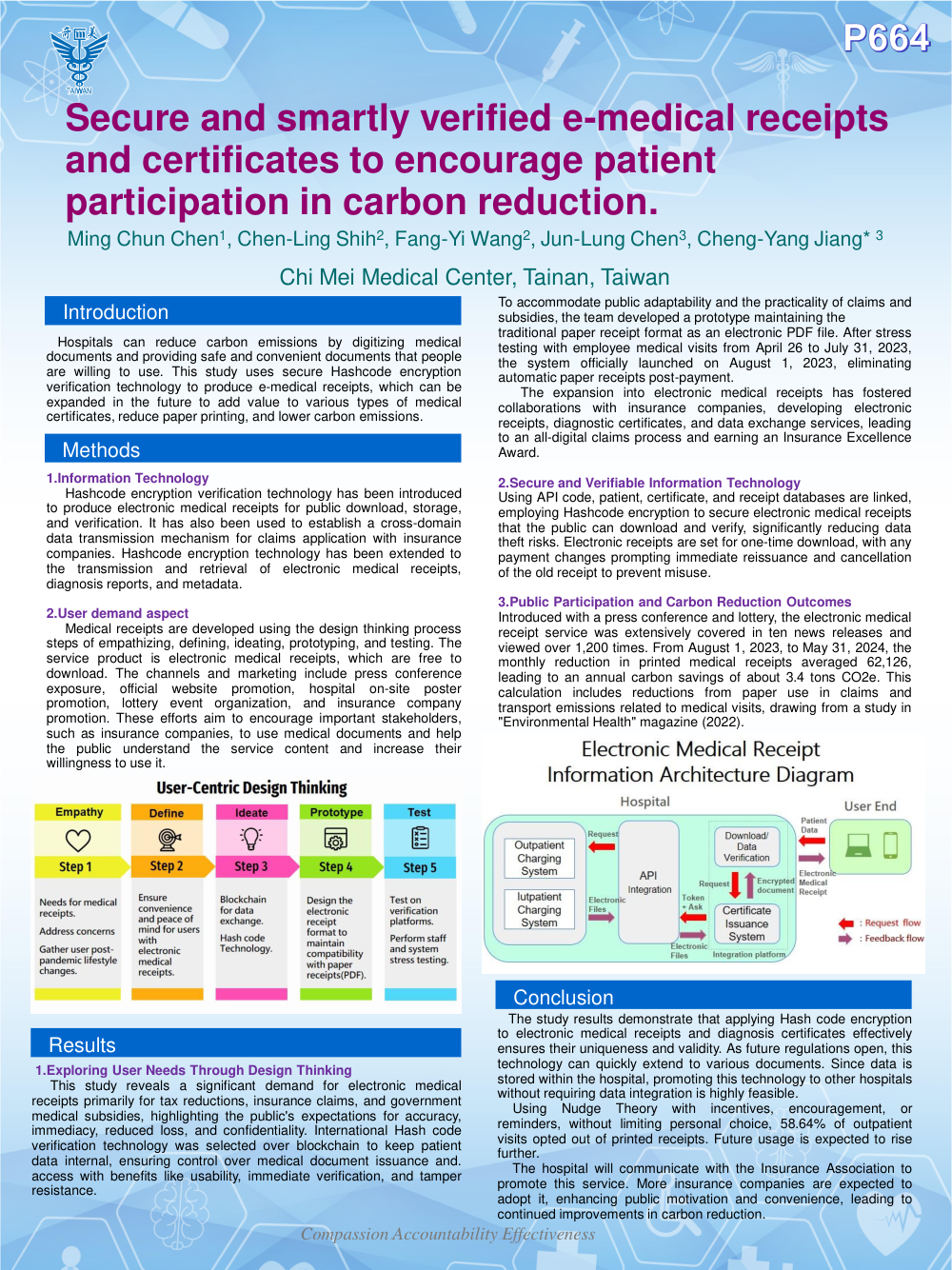
Hashcode encryption verification technology has been introduced to produce electronic medical receipts for public download, storage, and verification. It has also been used to establish a cross-domain data transmission mechanism for claims application with insurance companies. Hashcode encryption technology has been extended to the transmission and retrieval of electronic medical receipts, diagnosis reports, and metadata.
2.User demand aspect
Medical receipts are developed using the design thinking process steps of empathizing, defining, ideating, prototyping, and testing. The service product is electronic medical receipts, which are free to download. The channels and marketing include press conference exposure, official website promotion, hospital on-site poster promotion, lottery event organization, and insurance company promotion. These efforts aim to encourage important stakeholders, such as insurance companies, to use medical documents and help the public understand the service content and increase their willingness to use it.
Results
1.Exploring User Needs Through Design Thinking
This study reveals a significant demand for electronic medical receipts primarily for tax reductions, insurance claims, and government medical subsidies, highlighting the public's expectations for accuracy, immediacy, reduced loss, and confidentiality. International Hash code verification technology was selected over blockchain to keep patient data internal, ensuring control over medical document issuance and. access with benefits like usability, immediate verification, and tamper resistance.To accommodate public adaptability and the practicality of claims and subsidies, the team developed a prototype maintaining thetraditional paper receipt format as an electronic PDF file. After stress testing with employee medical visits from April 26 to July 31, 2023, the system officially launched on August 1, 2023, eliminating automatic paper receipts post-payment.
The expansion into electronic medical receipts has fostered collaborations with insurance companies, developing electronic receipts, diagnostic certificates, and data exchange services, leading to an all-digital claims process and earning an Insurance Excellence Award.
2.Secure and Verifiable Information Technology
Using API code, patient, certificate, and receipt databases are linked, employing Hashcode encryption to secure electronic medical receipts that the public can download and verify, significantly reducing data theft risks. Electronic receipts are set for one-time download, with any payment changes prompting immediate reissuance and cancellation of the old receipt to prevent misuse.
3.Public Participation and Carbon Reduction Outcomes
Introduced with a press conference and lottery, the electronic medical receipt service was extensively covered in ten news releases and viewed over 1,200 times. From August 1, 2023, to May 31, 2024, the monthly reduction in printed medical receipts averaged 62,126, leading to an annual carbon savings of about 3.4 tons CO2e. This calculation includes reductions from paper use in claims and transport emissions related to medical visits, drawing from a study in "Environmental Health" magazine (2022).
Conclusion
The study results demonstrate that applying Hash code encryption to electronic medical receipts and diagnosis certificates effectively ensures their uniqueness and validity. As future regulations open, this technology can quickly extend to various documents. Since data is stored within the hospital, promoting this technology to other hospitals without requiring data integration is highly feasible.
Using Nudge Theory with incentives, encouragement, or reminders, without limiting personal choice, 58.64% of outpatient visits opted out of printed receipts. Future usage is expected to rise further.
The hospital will communicate with the Insurance Association to promote this service. More insurance companies are expected to adopt it, enhancing public motivation and convenience, leading to continued improvements in carbon reduction.