586 posters, 8 topics, 23 sessions, 1,077 authors, 622 institutions
ePostersLive by SciGen Technologies S.A. All rights reserved.
ISQua's 40th International Conference 2024
24th - 27th September 2024 | Istanbul, Türkiye

P663
Ways to reduce healthcare’s impact on climate change: A systematic review
Poster Presenter
Authors
Jeffrey Braithwaite, Elle Leask, Carolynn Smith, Shalini Wijekulasuriya, Kalissa Brooke-Cowden, Georgia Fisher, Romika Patel, Samantha Spanos, Christina Rojas, Andrew Partington, Genevieve Dammery, Ann Carrigan, Lauren Ehrenfeld, Enrico Coiera, Johanna Westbrook, Yvonne Zurynski
Affiliations
Macquarie University, AUSTRALIAN INSTITUTE OF HEALTH INNOVATION, MACQUARIE UNIVERSITY, Flinders University, South Australia
Part of Topic
Navigating Climate Change and Sustainability in Healthcare System
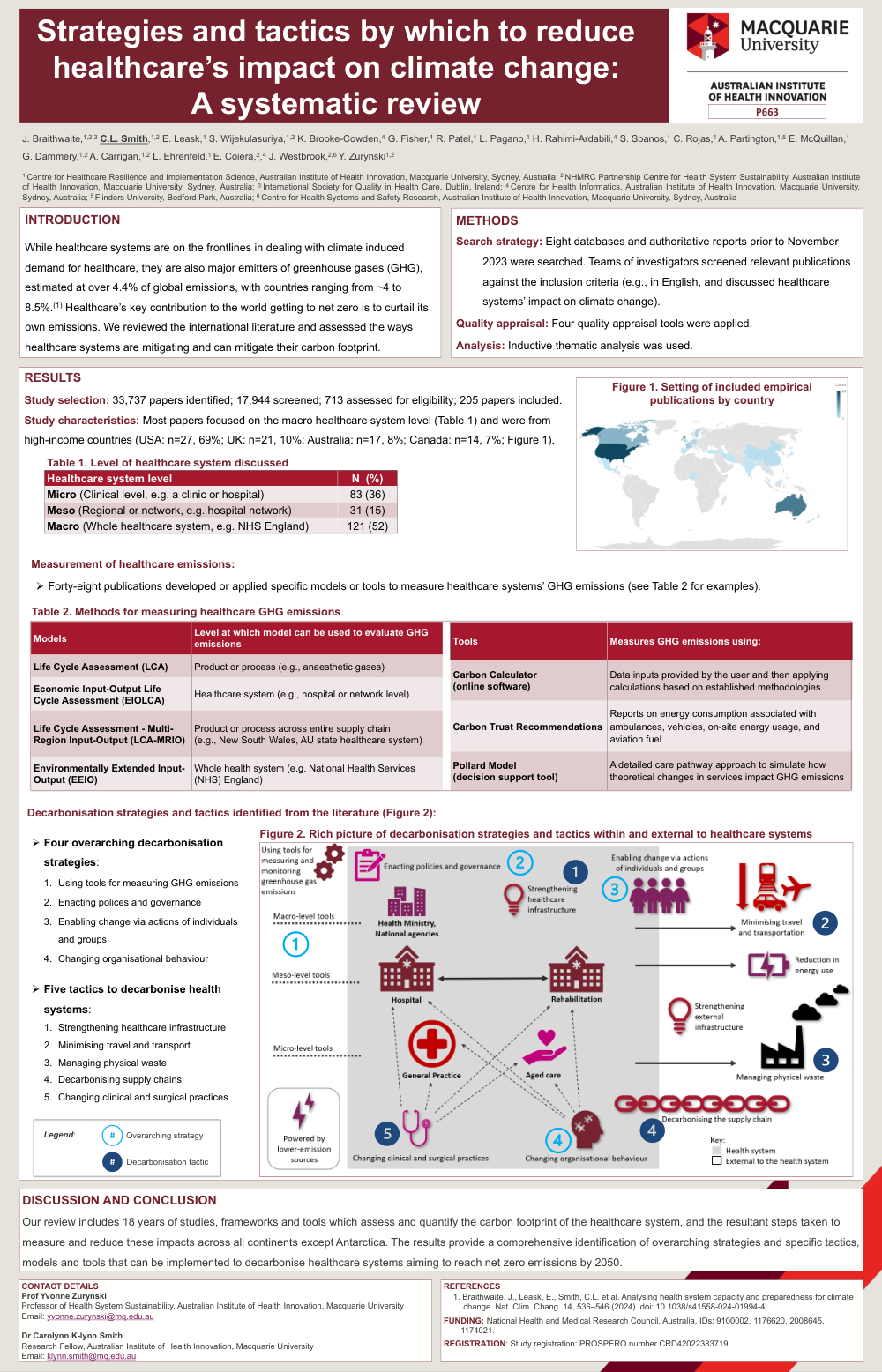
Strategies and tactics by which to reduce healthcare’s impact on climate change: A systematic review
Introduction
While healthcare systems are on the frontlines in dealing with climate induced demand for healthcare, they are also major emitters of greenhouse gases (GHG), estimated at over 4.4% of global emissions, with countries ranging from ~4 to 8.5%.(1) Healthcare’s key contribution to the world getting to net zero is to curtail its own emissions. We reviewed the international literature and assessed the ways healthcare systems are mitigating and can mitigate their carbon footprint.
Methods
Search strategy: Eight databases and authoritative reports prior to November 2023 were searched. Teams of investigators screened relevant publications against the inclusion criteria (e.g., in English, and discussed healthcare systems’ impact on climate change).
Quality appraisal: Four quality appraisal tools were applied.
Analysis: Inductive thematic analysis was used.
Results
- Study selection: 33,737 papers identified; 17,944 screened; 713 assessed for eligibility; 205 papers included.
- Study characteristics: Most papers focused on the macro healthcare system level (Table 1) and were from high-income countries (USA: n=27, 69%; UK: n=21, 10%; Australia: n=17, 8%; Canada: n=14, 7%; Figure 1).
Measurement of healthcare emissions:
- Forty-eight publications developed or applied specific models or tools to measure healthcare systems’ GHG emissions (see Table 2 for examples).
Decarbonisation strategies and tactics identified from the literature (Figure 2):
DISCUSSION AND CONCLUSION
Our review includes 18 years of studies, frameworks and tools which assess and quantify the carbon footprint of the healthcare system, and the resultant steps taken to measure and reduce these impacts across all continents except Antarctica. The results provide a comprehensive identification of overarching strategies and specific tactics, models and tools that can be implemented to decarbonise healthcare systems aiming to reach net zero emissions by 2050.