586 posters, 8 topics, 23 sessions, 1,077 authors, 622 institutions
ePostersLive by SciGen Technologies S.A. All rights reserved.
ISQua's 40th International Conference 2024
24th - 27th September 2024 | Istanbul, Türkiye

ISQUA2024-ABS-2761
Assessment of sustainable healthcare practices in Indonesian hospitals: A focus in water, sanitation, and care waste management interventions
Poster Presenter
Part of Topic
Navigating Climate Change and Sustainability in Healthcare System
Assessment of sustainable healthcare practices in Indonesian hospitals: A focus in water, sanitation, and care waste management interventions
Introduction
The World Health Organization (WHO) has stated that as the climate continues to change, risks to health systems and facilities, including hospitals, clinics, and community care centres, are increasing. This is reducing the ability of health professionals to protect people from a range of climate hazards. Health care facilities are considered the first and last line of defend against climate change impacts due to their potential large emissions of greenhouse gases (GHGs) and their role in providing necessary services and care to people affected by extreme weather and other long term climate hazards. Furthermore, health care facilities can also generate significant amounts of environmental waste and contamination, including GHGs and other pollutants that may be infectious, toxic, or radioactive, posing a threat to the health of individuals and communities. The declaration in Indonesia on management policies for achieving energy efficiency in electricity, water, paper usage, the use of environmentally friendly materials, waste management, and environmental pollution, as well as the adoption of an environmentally friendly culture and operational cost efficiency in line with Hospital Accreditation Standards (STARKES), was launched in September 2022. It is now mandatory for all hospital accreditation surveyors to enhance their knowledge and skills in assessing the sincerity of hospitals in making these improvements.
Aim
The World Health Organization (WHO) has stated that as the climate continues to change, risks to health systems and facilities, including hospitals, clinics, and community care centres, are increasing. This is reducing the ability of health professionals to protect people from a range of climate hazards. Health care facilities are considered the first and last line of defend against climate change impacts due to their potential large emissions of greenhouse gases (GHGs) and their role in providing necessary services and care to people affected by extreme weather and other long term climate hazards. Furthermore, health care facilities can also generate significant amounts of environmental waste and contamination, including GHGs and other pollutants that may be infectious, toxic, or radioactive, posing a threat to the health of individuals and communities. The declaration in Indonesia on management policies for achieving energy efficiency in electricity, water, paper usage, the use of environmentally friendly materials, waste management, and environmental pollution, as well as the adoption of an environmentally friendly culture and operational cost efficiency in line with Hospital Accreditation Standards (STARKES), was launched in September 2022. It is now mandatory for all hospital accreditation surveyors to enhance their knowledge and skills in assessing the sincerity of hospitals in making these improvements.
Method
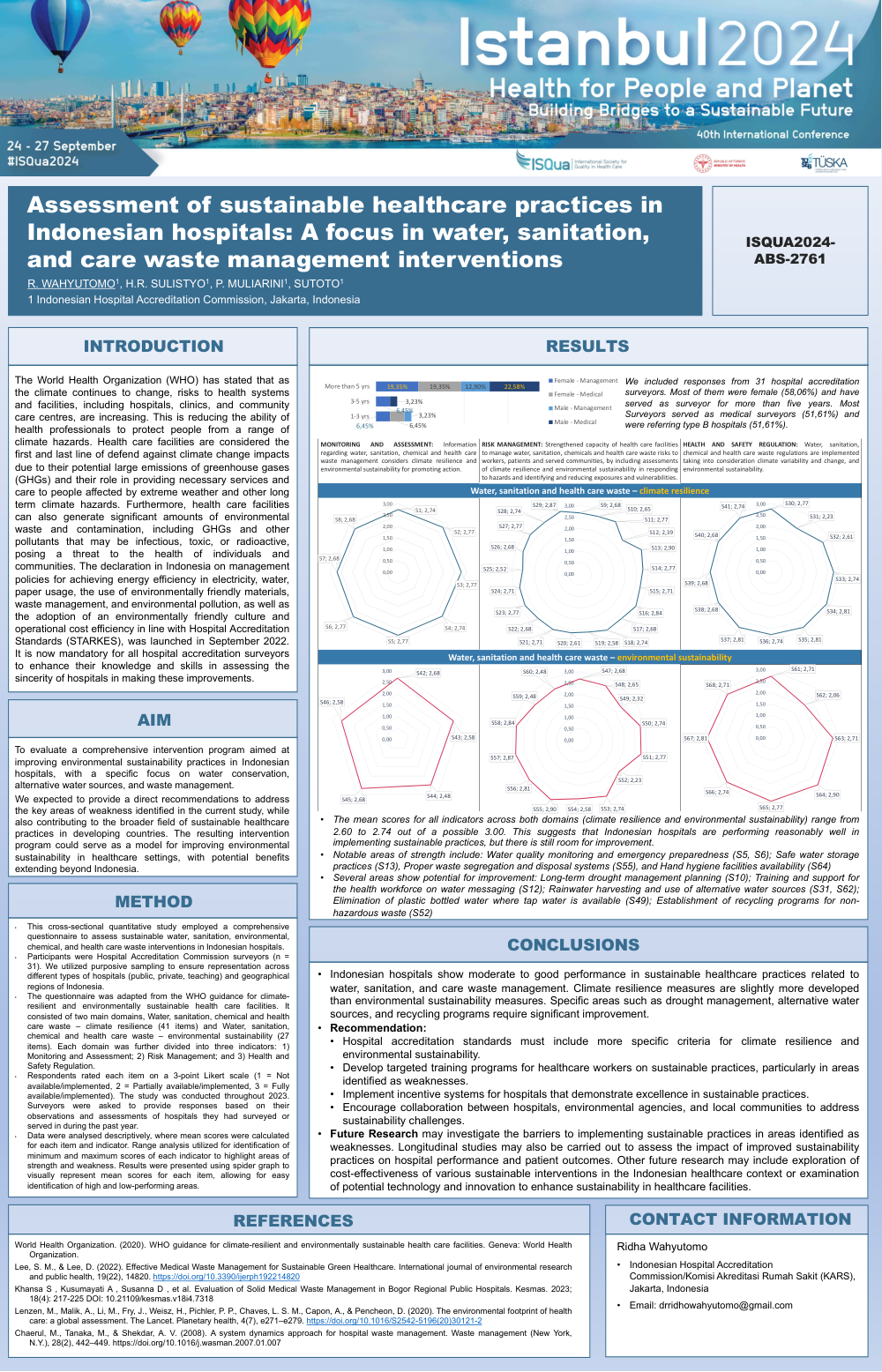
We included responses from 31 hospital accreditation surveyors. Most of them were female (58,06%) and have served as surveyor for more than five years. Most Surveyors served as medical surveyors (51,61%) and were referring type B hospitals (51,61%).