586 posters, 8 topics, 23 sessions, 1,077 authors, 622 institutions
ePostersLive by SciGen Technologies S.A. All rights reserved.
ISQua's 40th International Conference 2024
24th - 27th September 2024 | Istanbul, Türkiye

P676
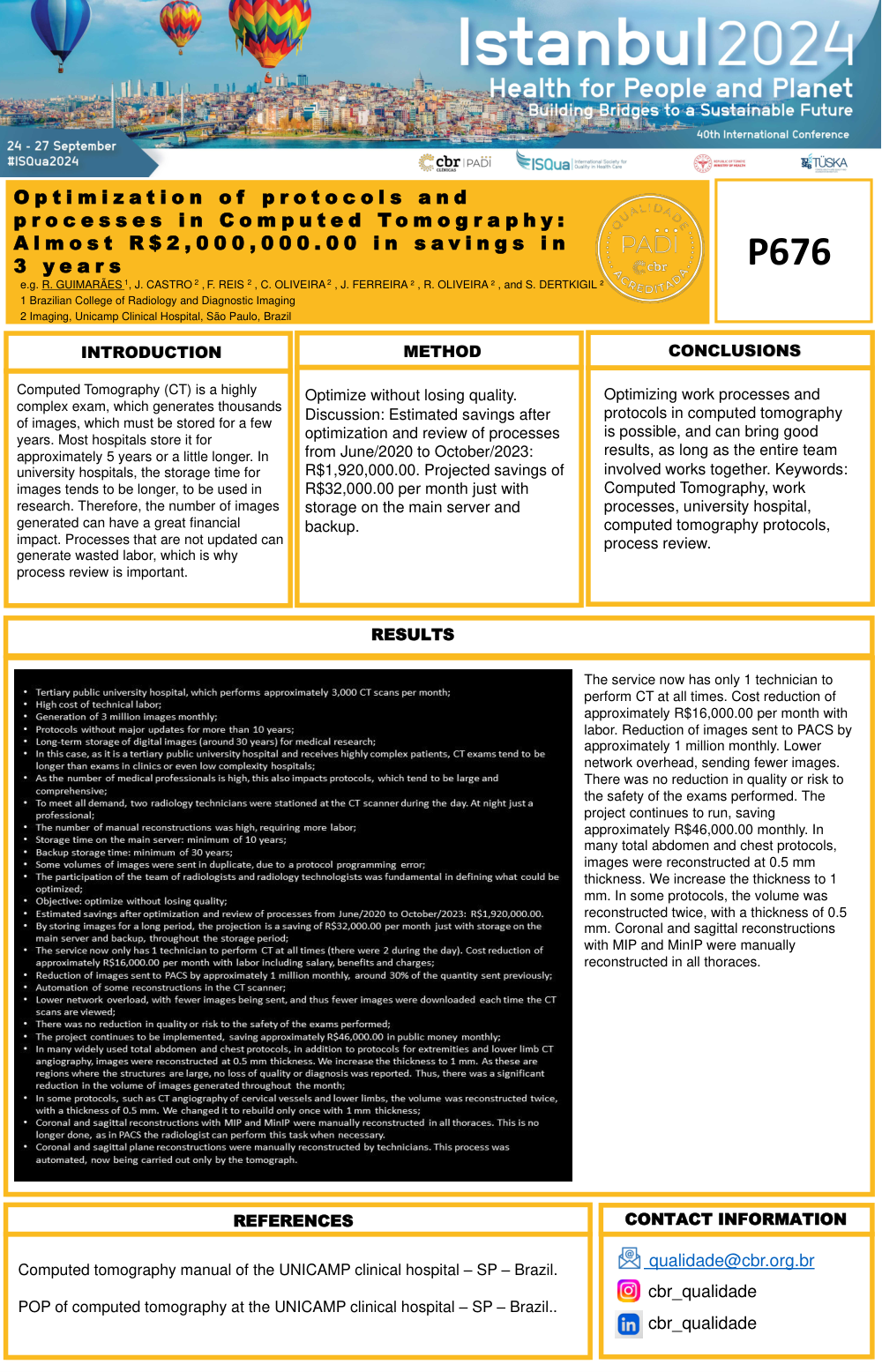
Optimization of protocols and processes in Computed Tomography: Almost R$2,000,000.00 in savings in 3 years
Poster Presenter
Authors
Affiliations
Part of Topic
Navigating Climate Change and Sustainability in Healthcare System
Optimization of protocols and processes in Computed Tomography: Almost R$2,000,000.00 in savings in 3 years
Ruy M. Guimaraes* 1, José Castro2, Fabiano Reis2, Carlos Oliveira2, Josias Ferreira2, Rodrigo Oliveira2, Sérgio Dertkigil2
1Certification, CBR - Brazilian College of Radiology and Diagnostic Imaging, 2Imaging, Unicamp Clinical Hospital, São Paulo, Brazil
Introduction: Computed Tomography (CT) is a highly complex exam, which generates thousands of images, which must be stored for a few years. Most hospitals store it for approximately 5 years or a little longer. In university hospitals, the storage time for images tends to be longer, to be used in research. Therefore, the number of images generated can have a great financial impact. Processes that are not updated can generate wasted labor, which is why process review is important.
Methods: Optimize without losing quality. Discussion: Estimated savings after optimization and review of processes from June/2020 to October/2023: R$1,920,000.00. Projected savings of R$32,000.00 per month just with storage on the main server and backup.
Results: The service now has only 1 technician to perform CT at all times. Cost reduction of approximately R$16,000.00 per month with labor. Reduction of images sent to PACS by approximately 1 million monthly. Lower network overhead, sending fewer images. There was no reduction in quality or risk to the safety of the exams performed. The project continues to run, saving approximately R$46,000.00 monthly. In many total abdomen and chest protocols, images were reconstructed at 0.5 mm thickness. We increase the thickness to 1 mm. In some protocols, the volume was reconstructed twice, with a thickness of 0.5 mm. Coronal and sagittal reconstructions with MIP and MinIP were manually reconstructed in all thoraces.
Conclusion: Optimizing work processes and protocols in computed tomography is possible, and can bring good results, as long as the entire team involved works together. Keywords: Computed Tomography, work processes, university hospital, computed tomography protocols, process review.
References: Computed tomography manual of the UNICAMP clinical hospital – SP – Brazil.
POP of computed tomography at the UNICAMP clinical hospital – SP – Brazil.